
Key Takeaways
- Strategic Partnership Focus:FedEx is prioritizing collaborations with specialized robotics firms over developing complex automation in-house, viewing external expertise as the fastest and most effective path to integrating advanced solutions.
- Human-Centric Automation:The company is targeting physically demanding and repetitive tasks, like bulk package unloading, with automation to improve worker safety and efficiency, freeing human employees for more skilled roles.
- Pragmatic, ROI-Driven Approach:FedEx maintains a calculated strategy, focusing on “fit-for-purpose” technologies with clear business value and demonstrable ROI, rather than chasing hype or unproven, complex solutions like humanoids for immediate deployment.
The gears of global logistics are grinding towards an automated future, and warehouses, the very heart of supply chains, are at the vanguard of this transformation. While some industry titans, notably Amazon, have opted to cultivate their robotic fleets internally, others are forging alliances with outside innovators to accelerate their journey into automation. Among these, the $84 billion logistics behemoth, FedEx, stands out for its deliberate embrace of a partnership-driven strategy.
Automating the Toughest Jobs: The Scoop Initiative
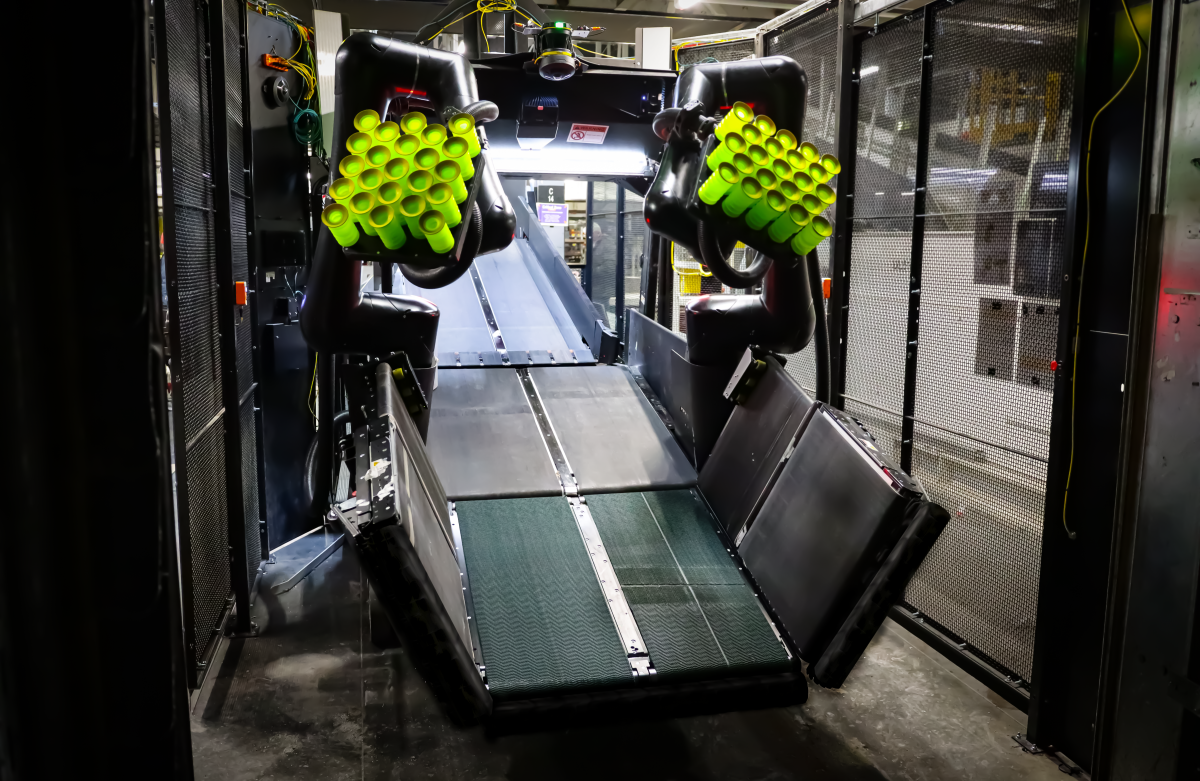
FedEx’s approach to the automation race is perhaps best exemplified by its recent multi-year partnership with Berkshire Grey, a robotics company majority-owned by SoftBank. This collaboration has already yielded “Scoop,” an innovative bot specifically engineered for the arduous task of bulk package unloading—a process that involves efficiently removing large, multi-parcel bundles from delivery vehicles. This fall, FedEx will commence a pilot program, rolling out Scoop to its warehouses, with aspirations of scaling the solution if the initial trials prove successful.
The decision to focus on bulk unloading wasn’t arbitrary. Stephanie Cook, FedEx’s director of advanced technology and innovation, robotics, highlighted the inherent challenges of this particular role. “Bulk unloading is one of the most physically demanding and unpredictable jobs in the FedEx warehouse,” Cook told TechCrunch. She revealed that this isn’t FedEx’s first foray into automating this specific task, underscoring the difficulty in finding a suitable robotic solution previously. “There’s nothing that is off-the-shelf that we recognize will work for our needs,” Cook explained, emphasizing the bespoke nature of the solution required. “We worked with Berkshire Grey in the past and felt this was a good fit for us in terms of a collaboration. We knew it wasn’t something that we could just develop in a matter of months. It was going to take a multi-year journey to get here.”
O.P. Skaaksrud, vice president of advanced technology and innovation at FedEx, further elaborated on why bulk unloading is an ideal candidate for robotic intervention. While the task demands some decision-making capabilities from the bots, these decisions are less granular than those required for picking or searching for individual, specific packages. This distinction makes it a more manageable challenge to automate effectively. “Because we have such variety of package mix, to specialize individual picking, it’s just not gonna be fast enough,” Skaaksrud noted. He contrasted Scoop’s capabilities with other unloaders on the market that perform single picks, finding them insufficient for FedEx’s volume and mix. By automating these strenuous, repetitive tasks, FedEx aims to enhance worker safety and allow human employees to transition to less dangerous, more skilled positions within the company.
The Philosophy Behind Partnerships: Why Not In-House?
While FedEx maintains a robust internal development arm for certain technologies, such as its SenseAware and SenseAware ID sensor systems for package tracking, the company draws a clear distinction when it comes to robotics. Developing complex sensor hardware is one thing; cultivating advanced robotics capabilities is “next level,” according to Skaaksrud. “It’s much better and faster to partner with other companies in the field to move faster,” he asserted, articulating the core rationale behind their partnership-first strategy. “That is the way we look at it. We see these partnerships as really benefiting both FedEx and the companies we work with.”
This philosophy extends beyond mere efficiency; it acknowledges the deep specialization and rapid innovation occurring within the robotics sector. Rather than expending significant capital and time to replicate expertise already honed by dedicated robotics firms, FedEx can strategically integrate proven, cutting-edge solutions. This approach also subtly addresses any concerns about proprietary technology. Skaaksrud insightfully countered that the hardware itself, be it a robot or a truck, is merely a tool. The true proprietary value, he argued, lies in FedEx’s expansive network and the intelligent operational “brain” that orchestrates its vast delivery web—a system that remains uniquely FedEx, irrespective of the specific hardware deployed.
A Portfolio of Collaborations: Broadening the Automation Front
Berkshire Grey is but one cog in FedEx’s expansive automation ecosystem. The company has actively cultivated a diverse portfolio of partnerships and pilot programs aimed at automating various facets of its operations, both within and beyond the warehouse walls:
Warehouse Robotics:Within its facilities, FedEx collaborates with Dexterity, a robotics startup that has achieved unicorn status due to its specialization in robots designed with a “human-like” touch, capable of intricate manipulation. Another key partnership is with Nimble, another unicorn startup pioneering fully autonomous warehouse solutions, promising to revolutionize the internal flow of goods.
Autonomous Delivery:The quest for autonomous delivery, spanning both last-mile and long-haul scenarios, is another critical area of focus. In 2021, FedEx initiated a pilot with autonomous trucking startup Aurora Innovation, tasking self-driving trucks with hauling packages along defined routes in Texas. This collaboration proved highly successful, leading to an expansion of their partnership in 2022, culminating in over 3,200 autonomous loads completed to date—a testament to the viability of long-haul autonomous logistics.
However, the journey has not been without its detours. FedEx also partnered with Nuro, an autonomous last-mile delivery robotics company, in 2021, initially envisioning a long-term commitment. By 2025, Nuro pivoted from direct delivery services to licensing its autonomous technology, leading to the conclusion of their partnership with FedEx. Furthermore, FedEx has learned lessons from its own in-house attempts at last-mile automation. The company developed and launched the SameDay Bot in 2019, but the reception was lukewarm, famously leading to its ban from New York City by then-Mayor Bill de Blasio. The SameDay Bot initiative was discontinued a few years later, though FedEx reiterates that last-mile automation remains a strategic interest, albeit with a refined approach.
A Calculated Path Forward: Beyond the Hype
Despite the pervasive buzz around automation, FedEx’s leadership, including Skaaksrud and Cook, emphasizes a pragmatic and disciplined approach. The company is not merely chasing the “next shiny robot” or the latest technological fad. “Don’t be too focused only on the technology, because then we’re going to fail,” Skaaksrud warned, encapsulating their philosophy. He likens their strategy to “3D chess,” requiring a holistic view that integrates often-unglamorous but essential components to form a productive, problem-solving solution. “We are definitely doing what is required to not only have interesting technology, but interesting productive technology that’s going to solve business problems.”
This commitment to practicality and ROI means a calculated rollout of new technologies. For Cook, the human element remains paramount. Automation strategies must be designed to work synergistically with the human workforce, making jobs easier, safer, and ultimately more fulfilling. It is this human-centric perspective, coupled with a focus on clear returns, that informs their stance on emerging, highly hyped technologies like humanoids.
“The orchestration aspects of multiple humanoids in a limited space that is highly dynamic, you know how hard it is,” Skaaksrud mused, acknowledging the immense complexity. While FedEx is certainly observing the humanoid space with interest, their current assessment leans away from immediate deployment. “I think that humanoids are very interesting, and we’re definitely paying attention, but it’s this fit for purpose. You got to figure that out because the hype is just really high, but there’s a lot of potential there long-term. But you have to understand the limitations and set your expectations accordingly.” For FedEx, a viable solution must align with specific business needs and offer a clear path to integration and value, rather than simply being a technological marvel.
Bottom Line
FedEx’s journey into advanced automation is a masterclass in strategic integration. By deliberately choosing a partnership-first approach for complex robotics, the logistics giant is effectively tapping into specialized expertise and accelerating its capabilities, ensuring it remains competitive in an increasingly automated world. Their focus on practical, “fit-for-purpose” solutions that enhance worker safety and operational efficiency, rather than succumbing to technological hype, underscores a pragmatic vision. As FedEx continues to weave these innovations into its vast network, it is not just automating tasks; it is redefining the future of logistics, building a smarter, safer, and more resilient delivery ecosystem.
{content}
Source:{feed_title}