
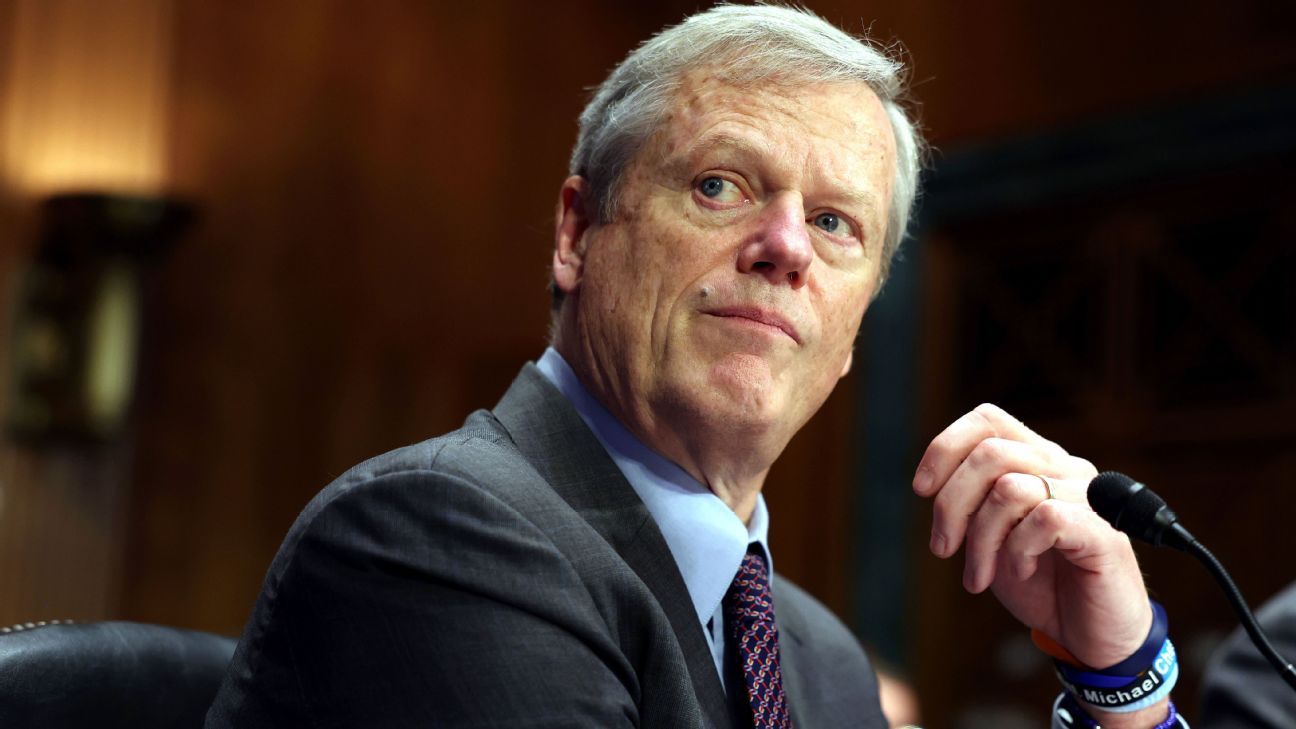
PHOENIX —The air in Phoenix was thick with anticipation for the Women’s Final Four, but the real fireworks weren’t on the court just yet. Instead, a seismic rumble emanated from the pre-tournament media availability, where NCAA president Charlie Baker delivered a firm, data-driven defense of the controversial two-site regional format, directly challenging the fiery criticisms leveled by UConn coaching legend Geno Auriemma.
Auriemma, a man rarely shy about speaking his mind, had ignited a firestorm last week after the Fort Worth Regional. His scathing indictment of the NCAA’s decision-making, particularly concerning the tournament’s logistical setup, resonated across the women’s basketball landscape. “I just don’t understand some of the decisions that are made about our game when we’re trying to grow the goddamn game,” Auriemma had thundered, a sentiment that perfectly encapsulates the frustration felt by many coaches and players navigating the complexities of the current system.
Auriemma’s grievances weren’t mere gripes; they were pointed critiques of operational shortcomings impacting player welfare and competitive integrity. He highlighted the use of “new baskets that have not been broken in,” a seemingly minor detail that can drastically affect shooting percentages and player confidence in high-stakes games. Imagine practicing for months on a familiar rim, only to arrive at a regional site with an unforgiving hoop that alters the very physics of the game. Such details, Auriemma argued, undermine the elite level of competition the NCAA purports to foster.
Even more egregious in Auriemma’s eyes were the scheduling nightmares. He specifically cited a shootaround before a crucial game that was not only held off-site from the main arena but commenced at an ungodly 6:20 a.m. For student-athletes balancing demanding academic schedules with peak athletic performance, such logistical hurdles aren’t just inconvenient; they’re detrimental. They disrupt sleep patterns, limit recovery time, and add unnecessary stress, all while the NCAA claims to be prioritizing the athlete experience. Auriemma’s frustration wasn’t just about his team; it was a broader call for common sense and athlete-centric planning in a rapidly expanding sport.
Baker’s Counter-Attack: The Data Speaks
NCAA President Charlie Baker, however, was prepared with his own arsenal: cold, hard data. During his brief media availability, Baker pushed back with an almost dismissive tone regarding the format’s efficacy. “It’s pretty hard to argue when attendance is up, viewership is up, and ticket sales are up consistently year over year, that this formula isn’t working,” Baker stated, framing the debate in purely quantitative terms. He asserted that the overall upward trend in key metrics for the women’s tournament validates the two-site model, which was implemented in 2023 and is guaranteed for at least five more seasons.
While Baker acknowledged the specific concerns around scheduling, promising that “the committee will take a very hard look at” them, his primary defense rested on the undeniable surge in the sport’s popularity. This argument, while statistically sound on the surface, glosses over a critical distinction: Is the growth *because of* the two-site format, or *despite* it? The explosion in women’s basketball interest, fueled by generational talents and increased media attention, might be propelling these numbers regardless of the tournament structure. Attributing all success solely to the current format risks ignoring deeper systemic issues that Auriemma and others are vocalizing.
Auriemma also broadened his critique to Title IX compliance, declaring that in practice, it’s “pretty much out the window. … I think most of the NCAA laws have gone out the window.” This is a profound accusation, striking at the heart of equity in collegiate sports. Baker responded by pointing to an increase in scholarship numbers for women across the board, alongside the sanctioning of new women’s sports like wrestling, acrobatics and tumbling, and stunt. He specifically highlighted that “the fact that we now have roster maxes in all sports, but scholarships are uncapped, I think the data at the end of the year is going to show an enormous increase in the number of fully scholarship women athletes.” While this points to broader efforts in gender equity, it doesn’t directly address Auriemma’s concerns about the specific resource allocation and logistical support within the premier women’s basketball tournament itself, leaving a gap between policy and practice in the eyes of many.
Game Highlights: The Verbal Sparring Match
The pre-Final Four press conference wasn’t a game of basketball, but it was undoubtedly a high-stakes verbal contest, with two of the sport’s most influential figures going head-to-head. Here are the highlights:
- The Opening Tip-Off (Auriemma’s Agitation):Auriemma didn’t hold back, lambasting the NCAA for decisions that hinder the growth of the game he loves. His colorful language (“goddamn game”) immediately set the aggressive tone, putting the NCAA on the defensive.
- The Rebound (Unbroken Baskets & Early Mornings):The specific, tangible complaints about new, “unbroken-in” baskets and the egregious 6:20 a.m. shootaround were key points. These weren’t abstract complaints; they were direct assaults on player experience and competitive fairness, creating vivid imagery of tired athletes struggling on unfamiliar equipment.
- The Fast Break (Baker’s Data Blitz):Baker quickly countered with a flurry of positive statistics – soaring attendance, viewership, and ticket sales. This was his primary weapon, designed to overwhelm Auriemma’s experiential arguments with irrefutable numerical growth, effectively shifting the narrative to the tournament’s overall success.
- The Defensive Stance (Title IX Exchange):Auriemma’s powerful accusation about Title IX being “out the window” forced Baker to defend the NCAA’s broader commitment to women’s sports. Baker’s response, citing increased scholarships and new sanctioned sports, served as a strong counterpoint, attempting to demonstrate systemic progress beyond the basketball tournament’s immediate issues.
- The Final Buzzer (An Uneasy Standoff):While no immediate resolution was reached, the exchange highlighted the fundamental tension between high-level administrative metrics and the on-the-ground realities faced by players and coaches. It set the stage for continued debate, even as the Final Four itself commenced.
Prediction: The Unyielding Push for Progress
The NCAA’s commitment to the two-site regional format for at least five more seasons suggests immediate, drastic change is unlikely. The allure of consolidated viewership and potentially streamlined operations, as evidenced by Baker’s data, will likely keep the current structure in place for the foreseeable future. However, the powerful voices of coaches like Geno Auriemma are not easily silenced. His criticisms are representative of a larger sentiment within the coaching ranks and among players who prioritize optimal conditions and fair play over mere attendance figures.
Expect continued pressure on the NCAA to refine the logistical aspects within the existing format. The “committee will take a very hard look” at scheduling, and it’s plausible we’ll see adjustments to practice times, court access, and perhaps even equipment protocols to mitigate the issues highlighted. The growth of women’s basketball is too significant to ignore these athlete-centric concerns. The ultimate prediction is not an immediate overhaul of the format, but rather a slow, deliberate evolution driven by a constant push-and-pull between administrative efficiency and the passionate advocacy for the athlete’s best interests. The sport’s incredible momentum demands nothing less than an environment that genuinely supports its stars, both on and off the court.