
Audio of this article is brought to you by the Air & Space Forces Association, honoring and supporting our Airmen, Guardians, and their families. Find out more at afa.org
The United States Air Force recently conducted a significant operational exercise, placing its semi-autonomous Collaborative Combat Aircraft (CCA) directly under the control of combat operators for the first time. This initiative marks a pivotal moment in the Air Force’s strategy to integrate advanced uncrewed systems into its combat fleet rapidly.
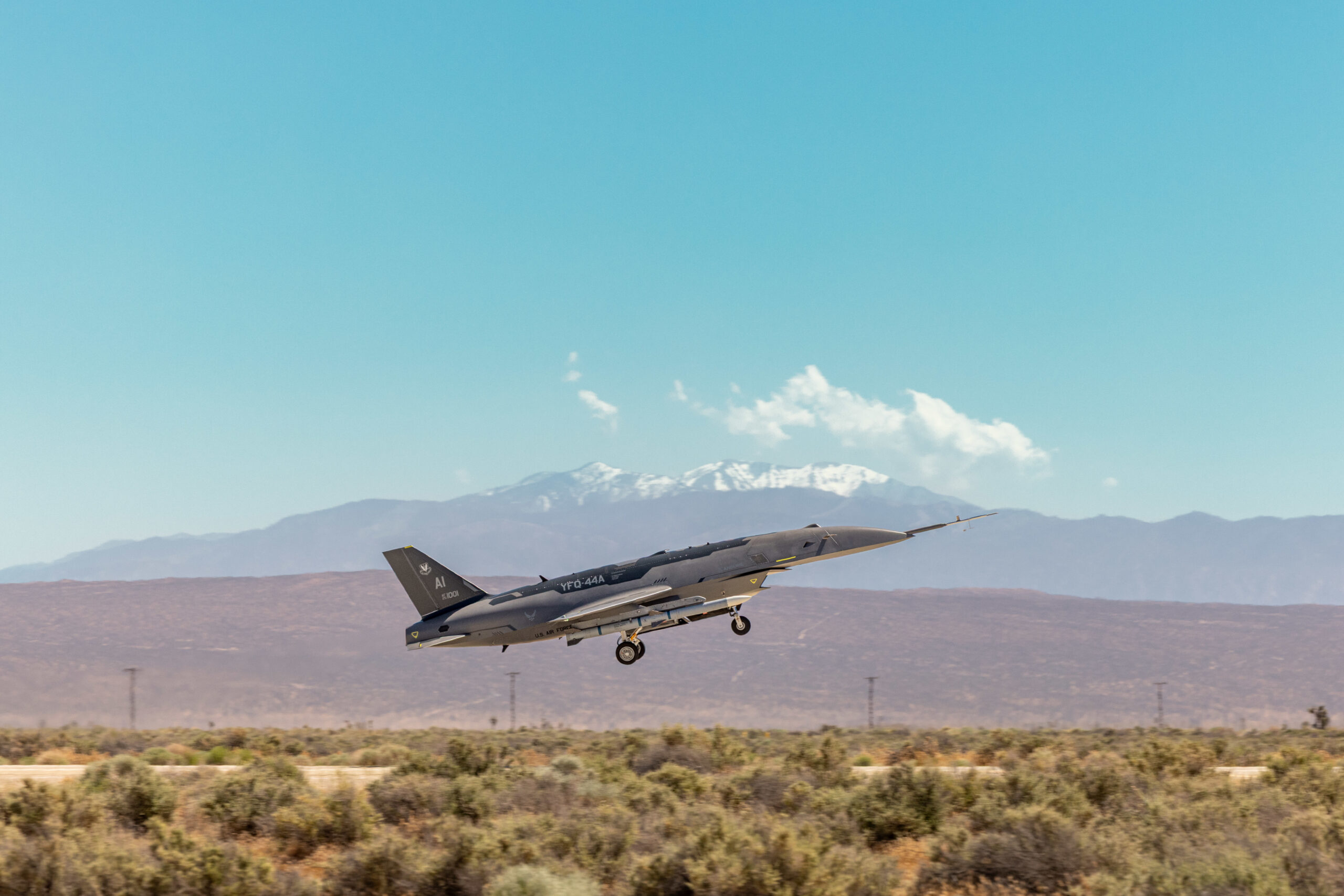
During the exercise, an Anduril Industries YFQ-44A CCA performed flights from Edwards Air Force Base in California. These operations were managed and controlled by Airmen from the newly formed Experimental Operations Unit (EOU), as announced by the Air Force on April 16. The service emphasized that this event represents a crucial step towards delivering fully operational CCAs to the combat fleet with unprecedented speed.
Lt. Col. Matthew Jensen, commander of the EOU, highlighted the unit’s complete involvement in the exercise. “This experimental operations event was executed by EOU members from start to finish,” Jensen stated. “Every sortie generated and flown was done with a warfighter, not an engineer or test pilot, kicking the tires and controlling the prototypes. We are learning by doing, at a speed and risk tolerance accepted by the USAF’s most senior leaders, to ensure CCA is ready to operate and win in the most demanding combat environments.”
Collaborative Combat Aircraft are sophisticated uncrewed aerial vehicles designed for semi-autonomous flight. They are intended to operate in conjunction with crewed fighter jets, such as the F-22 or F-35, undertaking a range of missions including strike operations, reconnaissance, and electronic warfare. The Air Force has identified the development of a fleet of at least 1,000 CCAs as a cornerstone of its future airpower strategy. These platforms are envisioned as a means to extend the operational reach of crewed fighters, while simultaneously reducing both costs and the risks faced by human operators in contested environments.
Currently, Anduril’s YFQ-44A and General Atomics’ YFQ-42A are the initial CCA prototypes under evaluation by the Air Force for potential integration into its fleet. In January, the Air Force also identified Northrop Grumman’s Talon drone, designated the YFQ-48A, as a “strong contender” for a subsequent phase of the CCA program.
Established in 2024 as part of Air Combat Command, the Experimental Operations Unit’s primary mandate is to develop a comprehensive “playbook” of tactics, techniques, and procedures (TTPs) for CCAs. This unit plays a critical role in accelerating and streamlining the transition of these drones into active service, where human aviators will be responsible for their management and supervision.
During the recent exercise, EOU Airmen collaborated closely with personnel from Air Force Materiel Command’s 412th Test Wing. Together, they conducted a series of sorties with the YFQ-44A, enabling Airmen to refine essential operational and logistical procedures necessary for deploying and sustaining CCAs in challenging combat scenarios, according to the Air Force’s April 16 announcement. While the exact dates of the sorties were not detailed in the official Air Force release, Mark Shushnar, Anduril’s vice president of autonomous airpower, indicated in a blog post that the flights occurred between April 5 and April 12.
Anduril reported that the YFQ-44A initially flew autonomously from the company’s test site in Southern California to Edwards Air Force Base. Upon arrival, the EOU assumed full operational control, conducting daily sorties from a simulated forward operating base. These operations included a full spectrum of tasks: pre- and post-flight checks and clearances, the loading and unloading of inert weapons, and in-flight tasking of the CCA during taxi and flight phases.
Maintainers and ground crew from the EOU were also integral to sustaining the YFQ-44A’s flight operations. Anduril highlighted that these tasks required only “a handful” of maintainers with minimal training, a stark contrast to the significantly larger manpower typically required for traditional uncrewed aircraft systems. Following the conclusion of the exercise, the YFQ-44A flew back to Anduril’s Southern California facility.
Photographs released by the Air Force depicted a YFQ-44A flying over Edwards Air Force Base, equipped with two inert munitions under each wing. The design and markings of these munitions are consistent with the AIM-120 AMRAAM, an advanced medium-range air-to-air missile.
Operators controlled the CCA using a ruggedized laptop, which facilitated the uploading of mission plans, initiation of autonomous taxi and takeoff procedures, transmission of new orders during flight, and management of data and checks post-flight. Anduril’s Menace-T command, control, communications, and computing solution served as the primary ground element for these flight operations, notably without requiring extensive fixed infrastructure.
Anduril characterized the high tempo of these flight operations as a “critical, early test of the processes, procedures and logistics footprint required to sustain regular operational testing and, ultimately, deployed combat operations.”
This capability is deemed essential for CCAs to effectively contribute to the Air Force’s Agile Combat Employment (ACE) concept, which emphasizes distributed operations during future conflicts. The simulated base at Edwards purposefully lacked the extensive infrastructure typically found at large, established bases, further testing the EOU Airmen’s ability to operate in austere environments.
The Air Force affirmed that the “hands-on” testing conducted at Edwards is a central component of its rapid acquisition strategy, aimed at quickly fielding combat-ready CCAs in substantial numbers. Speaking at AFA’s Warfare Symposium in February, Gen. Dale R. White explained that this approach not only helps Air Force operators understand how they will utilize CCAs but also provides acquisition officials with valuable insights into the strengths and weaknesses of specific systems. This feedback loop is crucial for refining requirements for future increments of CCAs. Helfrich added that embedding EOU operators with acquisition personnel “create[s] a tight feedback loop that lets us trade operational risk with acquisition risk in real time.”
These recent flights occurred approximately six months after the YFQ-44A’s inaugural semi-autonomous flight in October 2023. Mark Shushnar of Anduril emphasized that the rapid advancement of their CCA since its first flight underscores the importance of developing robust autonomy from the outset. “The start of experimental testing with the EOU just six months after the first semi-autonomous first flight of YFQ-44A is clear proof that our early bets are already paying dividends,” Shushnar stated. “That early focus on autonomy is what enabled the EOU to operate and maintain the aircraft with minimal testing.”
Further EOU flights are anticipated, with Lt. Col. Jensen indicating in February that his team plans to integrate CCAs into major exercises “as soon as we can.” Jensen added, “[That] will probably surprise some people when they show up to Red Flag and they’re like, ‘why are the robots flying with us?’ But you know, we’ll drive it and see what happens.”
Why This Matters
The recent exercise involving the U.S. Air Force’s Experimental Operations Unit and the Anduril YFQ-44A Collaborative Combat Aircraft represents a significant leap forward in military aviation and carries profound implications across strategic, operational, technological, and geopolitical spheres.
Strategic Shift in Airpower:This development signals a fundamental reorientation in how major powers envision and execute air warfare. The integration of CCAs is not merely about adding new platforms; it’s about creating a ‘loyal wingman’ concept where crewed aircraft can extend their reach, survivability, and lethality by commanding semi-autonomous drones. This can dramatically alter the balance of power, allowing for more distributed, resilient, and adaptable air operations, especially in highly contested environments. The goal of fielding over 1,000 CCAs underscores a commitment to a future where human-machine teaming is central to air superiority, potentially changing how air forces are structured and resourced globally.
Operational Efficiency and Risk Reduction:By delegating high-risk or repetitive tasks to CCAs, human pilots can focus on complex decision-making, while the drones absorb threats or conduct missions in dangerous airspace. This reduces the exposure of highly trained and invaluable human aviators to combat risks, thereby improving survivability rates and potentially lowering the human cost of conflict. Furthermore, CCAs offer a more cost-effective solution than advanced crewed fighters, allowing for the deployment of greater numbers of platforms and expanding operational capacity within existing budget constraints. The testing of these systems in a simulated forward operating base, focusing on minimal logistical footprint and quick turnaround times, is crucial for validating the Air Force’s Agile Combat Employment (ACE) doctrine, which emphasizes rapid deployment and sustainment in diverse, austere locations.
Advancements in Autonomy and AI:The rapid progression of the YFQ-44A from its first flight to operational control by warfighters in just six months highlights the accelerating pace of technological development in autonomous systems and artificial intelligence. This exercise validates the efficacy of advanced AI algorithms in mission planning, in-flight decision-making, and human-machine interface design. The ability for operators to control complex aerial vehicles with minimal training using a ruggedized laptop demonstrates a significant simplification of operational complexity, which is vital for widespread adoption across a diverse force. This success will likely spur further investment and innovation in AI-driven defense technologies globally.
Geopolitical Impact and Arms Race:The successful integration of CCAs by the U.S. Air Force could intensify an emerging technological arms race among global powers. Nations like China and Russia are also heavily investing in autonomous combat systems. The U.S. demonstrably moving towards operationalizing CCAs could pressure adversaries to accelerate their own programs, leading to a new dimension of military competition. This shift could destabilize existing military doctrines and create new challenges for international arms control and strategic stability.
Future of Military Training and Acquisition:The establishment of units like the Experimental Operations Unit signifies a proactive approach to developing the tactics, techniques, and procedures (TTPs) necessary for future warfare. It also highlights a critical feedback loop between operators, developers, and acquisition officials, allowing for rapid iteration and refinement of systems based on real-world testing. This agile acquisition model, contrasted with traditional, lengthy defense procurement processes, is crucial for staying ahead in a rapidly evolving technological landscape. It will also necessitate significant changes in how military personnel are trained, focusing on human-machine teaming, data analysis, and advanced digital skills.
Audio of this article is brought to you by the Air & Space Forces Association, honoring and supporting our Airmen, Guardians, and their families. Find out more at afa.org