
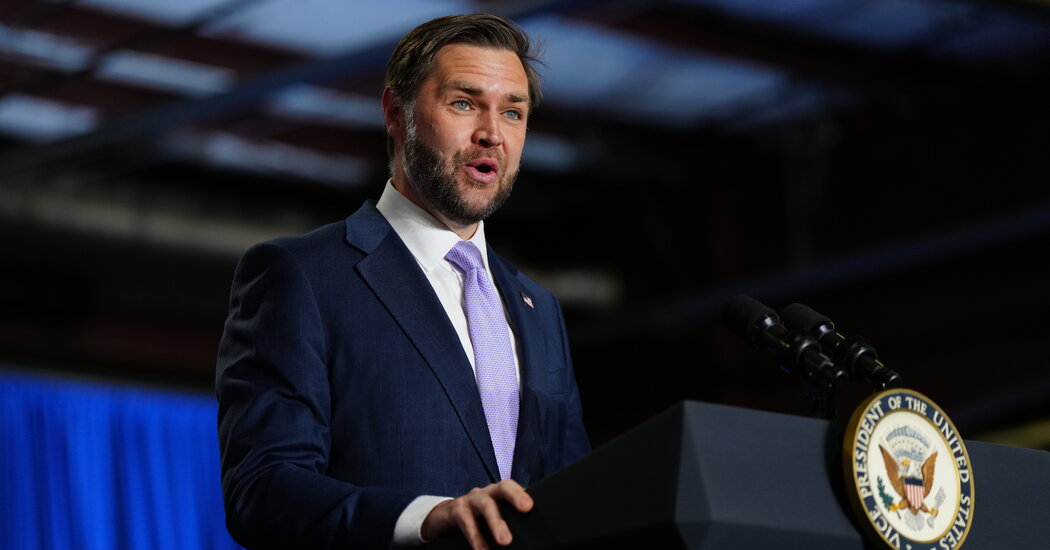
Vice President JD Vance traveled to Maine on Thursday to promote the Trump administration’s anti-fraud initiative, asserting that the state was experiencing a significant “festering” fraud problem. Addressing a crowd in an airport hangar, Mr. Vance suggested that electing Republican officials to offices currently held by Democrats would be an effective remedy for these issues.
With the November midterm elections approaching, Mr. Vance has become a prominent voice for the Trump administration’s concentrated effort to identify and mitigate fraud within federal benefit programs. This initiative positions the Vice President at the forefront of a policy drive focused on fiscal accountability.
Amidst broader public concerns regarding economic stability and the escalating financial burden of the ongoing conflict in Iran, the Vice President has emphasized the need for stringent oversight of public benefits spending. This includes significant actions such as the halting of $1.3 billion in federal Medicaid payments to California and $259 million to Minnesota, with further warnings reportedly planned for other states. Medicaid, a joint federal and state program, is a primary target for these federal oversight efforts.
The administration’s anti-fraud task force has provided Mr. Vance with a platform to campaign against Democratic state governments. During his appearance in Bangor, Mr. Vance stated his willingness to collaborate with Democrats on fraud prevention but asserted that the Maine state government had demonstrated “no cooperation” in these federal efforts.
“Maine Democrats, elected Democrats, seem to really like fraudsters,” Mr. Vance remarked to attendees, a statement that underscored the partisan framing of his message.
Following the event, Governor Janet Mills of Maine, a Democrat, issued a statement refuting the Vice President’s claims. She highlighted various anti-fraud measures implemented by the state in recent years, including established “partnership with federal law enforcement.” Governor Mills characterized the Vice President’s remarks as an attempt to divert public attention from what she described as the Trump administration’s “endless war in Iran and failure to control crushing costs — including sky high gas prices — that Maine families and businesses are struggling with every day.”
The Trump administration is actively utilizing federal mechanisms to identify and address potential areas of government waste and fraud. This week, federal officials dispatched letters to attorneys general across the nation, stipulating that federal Medicaid funding could be rescinded if states failed to comply with the federal government’s intensified efforts to detect and eliminate fraud and waste within the program.
Mr. Vance articulated a shift in federal policy, indicating that the federal government would no longer provide funding for programs and then attempt to rectify improper spending retroactively. Instead, the approach would be proactive.
“We’re actually making the money conditional on state governments fighting fraud to begin with,” Mr. Vance explained, outlining the administration’s revised strategy. He further indicated that advanced “filters” and artificial intelligence (A.I.) programs would be deployed to aid in identifying fraudulent activities and verifying eligibility for benefits.
During his address, Mr. Vance referenced a specific case in Maine involving tax fraud charges related to Medicaid against an immigrant business owner, who has reportedly pleaded guilty. This example was presented as evidence of the type of fraud the administration aims to combat.
Democrats broadly criticized Mr. Vance’s visit, characterizing it as a politically motivated maneuver designed to shift public discourse away from rising costs of living and the ongoing war. Their criticism also referenced recent remarks by President Trump, who had stated earlier in the week that economic issues were not a significant concern for him “even a little bit” amidst the U.S. military engagement in Iran.
When questioned by a reporter about the potential for federal funding reductions to adversely affect rural and low-income families in Bangor who rely on such programs, Mr. Vance offered reassurances. He stated that vulnerable individuals would not be impacted, provided they met the eligibility criteria for assistance.
“We’re setting this up so the people who need these programs and are eligible for them — they’re not going to suffer the consequences,” Mr. Vance affirmed, emphasizing the targeted nature of the anti-fraud measures.
The Vice President also voiced strong support for Paul LePage, Maine’s former Republican governor, who is currently campaigning for a House seat in the state’s Second Congressional District. Mr. Vance endorsed LePage, describing him as “the biggest threat to fraudsters that ever existed in the state of Maine,” aligning him with the administration’s core message.
Furthermore, Mr. Vance alleged that Governor Mills had declined to pursue certain potential fraud cases. Governor Mills, who is currently serving her second term, recently withdrew from a prospective race for the Senate seat long held by Republican Senator Susan Collins of Maine. Senator Collins is engaged in a challenging re-election campaign against Graham Platner, a progressive Democratic challenger. Mr. Vance offered tempered support for Senator Collins, remarking, “Sometimes I get frustrated with Susan Collins.” He added, “But the thing I love about Susan is she is independent, because Maine is an independent state.” Senator Collins has previously sought legislative restrictions on President Trump’s authority to conduct the war in Iran indefinitely, actions that have drawn criticism from President Trump.
Why This Matters
The Vice President’s visit to Maine and the broader federal anti-fraud initiative carry significant implications across several domains. Firstly, it represents a notable shift in the dynamics of federal-state relations, particularly concerning the administration of large, jointly funded programs like Medicaid. By making federal funding explicitly conditional on state-level anti-fraud efforts, the Trump administration is asserting greater federal oversight and demanding increased compliance from states, potentially altering the balance of power and leading to increased tensions or renegotiations over program implementation.
Secondly, the initiative highlights a central policy debate regarding government spending and accountability. While proponents argue that robust anti-fraud measures are essential to protect taxpayer money and ensure resources reach intended recipients, critics raise concerns that overly aggressive or politically motivated enforcement could inadvertently penalize vulnerable populations or disrupt vital services for eligible individuals. The reliance on advanced technologies like A.I. also introduces new considerations regarding data privacy, algorithmic fairness, and the potential for errors in eligibility determinations.
Thirdly, the timing and rhetoric of the Vice President’s visit underscore the highly politicized nature of policy in an election year. Both the administration’s emphasis on fraud and the Democratic counter-arguments about economic concerns and foreign policy serve as key talking points in the run-up to the November midterm elections. This illustrates how policy initiatives can be strategically deployed as campaign tools to shape public perception and mobilize voters, rather than solely focusing on their administrative merits. The specific endorsements and criticisms of local political figures, such as Paul LePage and Senator Susan Collins, further integrate federal policy messages into state-level electoral contests.
Finally, the contrasting priorities articulated by the administration and its critics — a focus on government efficiency versus public concerns over the cost of living and foreign military engagements — reflect a broader national debate on the most pressing issues facing the country. This divergence can influence voter behavior and ultimately shape the legislative agenda and future direction of government policy.