
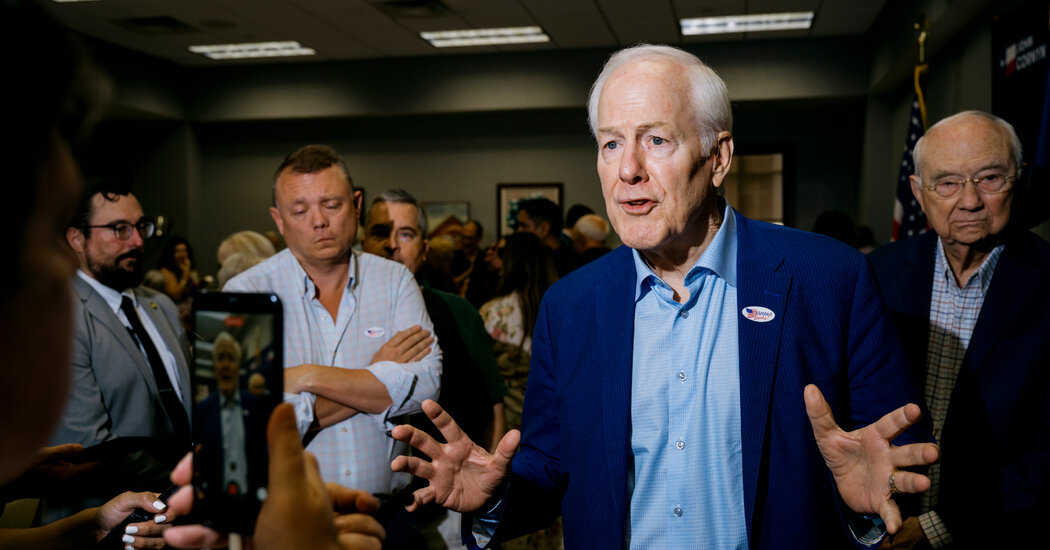
Republican senators expressed significant concerns on Tuesday following former President Donald Trump’s endorsement of Ken Paxton, the Texas Attorney General, in the state’s Senate primary runoff. The decision, which bypasses incumbent Senator John Cornyn, prompted warnings that it could jeopardize the Republican Party’s hold on the Senate seat and complicate efforts to maintain its majority.
The news of Mr. Trump’s endorsement, disseminated via social media, circulated among Senate Republicans as they prepared for their weekly party luncheon. Many senators conveyed surprise and apprehension regarding the former President’s choice, which affects Senator Cornyn, a figure with over two decades of service in the Senate.
Upon learning of the announcement, Senator John Hoeven of North Dakota remarked, “Oh boy,” and subsequently affirmed his support for Senator Cornyn. Senator Roger Wicker of Mississippi declined to comment on the endorsement when questioned by reporters outside the Senate chamber.
Senator Lisa Murkowski, an Alaska Republican known for her independent voting record, voiced “supremes disappointment” with Mr. Trump’s decision. She further articulated that the endorsement of Mr. Paxton, who has faced various legal and ethical controversies, could potentially render a historically secure Republican Senate seat vulnerable in the general election.
“I think that this puts that seat in jeopardy,” Senator Murkowski stated to reporters.
Mr. Trump’s endorsement, issued while early voting is underway in Texas, is anticipated to enhance Mr. Paxton’s prospects in what has already become a high-stakes and intensely contested primary. Many Republican senators, including Majority Leader John Thune of South Dakota, had reportedly encouraged Mr. Trump to support Senator Cornyn, viewing him as a more robust candidate for the general election. Mr. Trump’s decision to endorse Mr. Paxton, contrary to this advice, was perceived by some as a disregard for the counsel of party leadership.
“It’s his decision,” Senator Thune commented to reporters as he arrived for the party luncheon at the Capitol, acknowledging the former President’s autonomy. He later added, “None of us control what the president does. He made his decision. That doesn’t change the way I feel.”
The endorsement is also likely to contribute to an already strained dynamic between Mr. Trump and certain Republican senators. These senators have at times expressed discomfort with the former President’s political tactics and interventions during his second term, particularly as the Republican Party has increasingly aligned with his directives rather than upholding traditional Senate independence.
With a narrow majority in the Senate, Republican leaders already face challenges in advancing key legislative priorities. Concerns are now growing that the recent primary defeat of Senator Bill Cassidy of Louisiana by a Trump-backed challenger, combined with the rejection of Senator Cornyn, could further complicate legislative efforts. This assessment comes from two leadership aides who spoke on condition of anonymity to discuss internal political considerations.
Both Senator Cassidy and Senator Cornyn had engaged in efforts to maintain favorable relations with Mr. Trump and secure his endorsement. However, days after his primary loss, Senator Cassidy, whose 2021 vote to convict Mr. Trump of inciting an insurrection had previously strained their relationship, has demonstrated a more independent stance. On Tuesday, Senator Cassidy, who received a standing ovation from his Republican colleagues at the luncheon, indicated he would oppose a bill to fund immigration enforcement operations if it included security appropriations linked to Mr. Trump’s White House ballroom project.
Should Senator Cornyn lose his primary, Mr. Trump would potentially face an increased number of “lame duck” senators—those nearing the end of their terms or not seeking re-election—who might be more inclined to diverge from his demands. This scenario echoes previous instances, such as Senator Thom Tillis of North Carolina, who chose not to seek re-election last year after Mr. Trump indicated he would support a challenger.
Senator Susan Collins, a Maine Republican who is also running for re-election and has previously differed with Mr. Trump on various policy matters, also expressed disappointment regarding the endorsement of Mr. Paxton.
“John Cornyn is an outstanding senator and deserved, in my judgment, the president’s support,” Senator Collins stated. “Obviously, it’s the president’s call, but I’m disappointed that he did it.”
Even senators considered close allies of Mr. Trump in the Senate acknowledged the potential challenges. Senator Lindsey Graham of South Carolina affirmed Mr. Trump’s right to make an endorsement but observed that “you don’t have to be a rocket scientist to figure out the pathway for Paxton is there, but it’s more uphill.”
On the Democratic side, strategists have expressed optimism about their prospects in Texas, particularly with the nomination of James Talarico, a state legislator who has focused on outreach to independent voters and demonstrated strong fundraising capabilities. Senator Graham further suggested that the Texas Senate race would likely become more expensive and competitive if Mr. Paxton were to secure the Republican nomination. “What we’ve got to do is raise a lot more money now,” Senator Graham concluded, indicating the financial demands of a more challenging contest.
Why This Matters
The former President’s endorsement in the Texas Senate primary holds significant implications for the balance of power in the U.S. Senate, the internal dynamics of the Republican Party, and the future of legislative governance. The Texas seat, traditionally a Republican stronghold, is crucial for the party’s ambition to maintain or expand its narrow Senate majority. A more competitive or jeopardized race, as suggested by several senators, could shift national electoral calculations.
This endorsement further underscores the ongoing tension between the populist, Trump-aligned wing of the Republican Party and its more traditional, establishment figures. By endorsing a challenger over a long-serving incumbent like Senator Cornyn, Mr. Trump continues to assert his influence over party primaries, often prioritizing loyalty and alignment with his political agenda over incumbency or perceived general election electability. This pattern can lead to deeper internal divisions and a questioning of traditional party hierarchies.
The potential for a more divisive primary and a general election that requires substantial financial and political resources could divert funds and attention from other critical races. Furthermore, if the primary results in a nominee perceived as weaker or more controversial by a broader electorate, it could increase the chances for the Democratic candidate, potentially flipping a key Senate seat. This outcome would significantly impact the legislative agenda, as control of the Senate determines which bills are prioritized and have a chance of becoming law, affecting everything from economic policy to judicial appointments.
The reactions from Republican senators, ranging from dismay to strategic concerns, highlight a growing frustration within the party’s congressional ranks regarding Mr. Trump’s interventions. The emergence of more independent voices, as exemplified by Senator Cassidy post-primary, suggests that such challenges to incumbents might inadvertently foster greater autonomy among some senators, potentially altering the dynamics of legislative cooperation and dissent within the Republican caucus. This could complicate future efforts by party leadership to unify votes on key legislation, regardless of who holds the presidency.
Ultimately, this situation in Texas is a microcosm of the broader struggle for the identity and direction of the Republican Party. It reflects the ongoing power struggle between the former President’s enduring influence and the party’s need to appeal to a wider general election audience, particularly in competitive states. The outcome of this primary, and subsequently the general election, will offer crucial insights into the evolving landscape of American political power and the effectiveness of different intra-party strategies.