
Audio of this article is brought to you by the Air & Space Forces Association, honoring and supporting our Airmen, Guardians, and their families. Find out more at afa.org
U.S. Air Force Qualifies First Instructor Pilots for New T-7A Red Hawk Trainer Jet
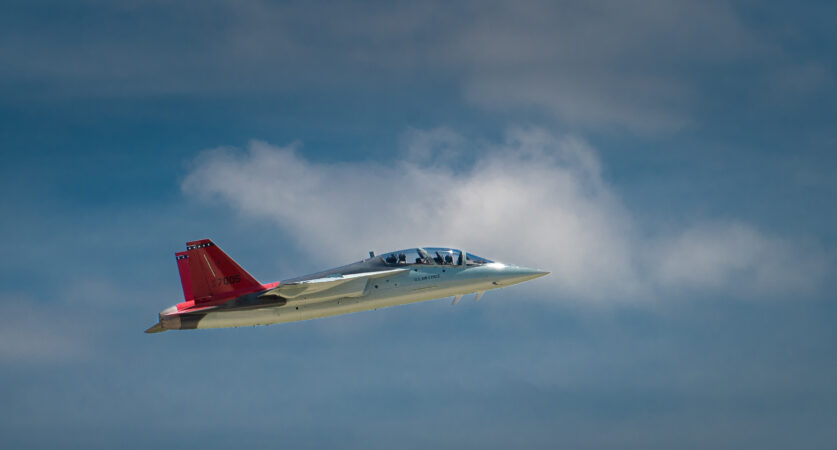
Joint Base San Antonio-Randolph, Texas – The U.S. Air Force’s Air Education and Training Command (AETC) has announced a significant milestone in the introduction of its new T-7A Red Hawk advanced pilot training jet: the qualification of its first instructor pilots. This development, confirmed on June 3, marks a crucial step in preparing the Air Force to transition from its aging T-38 Talon fleet to the modern T-7A.
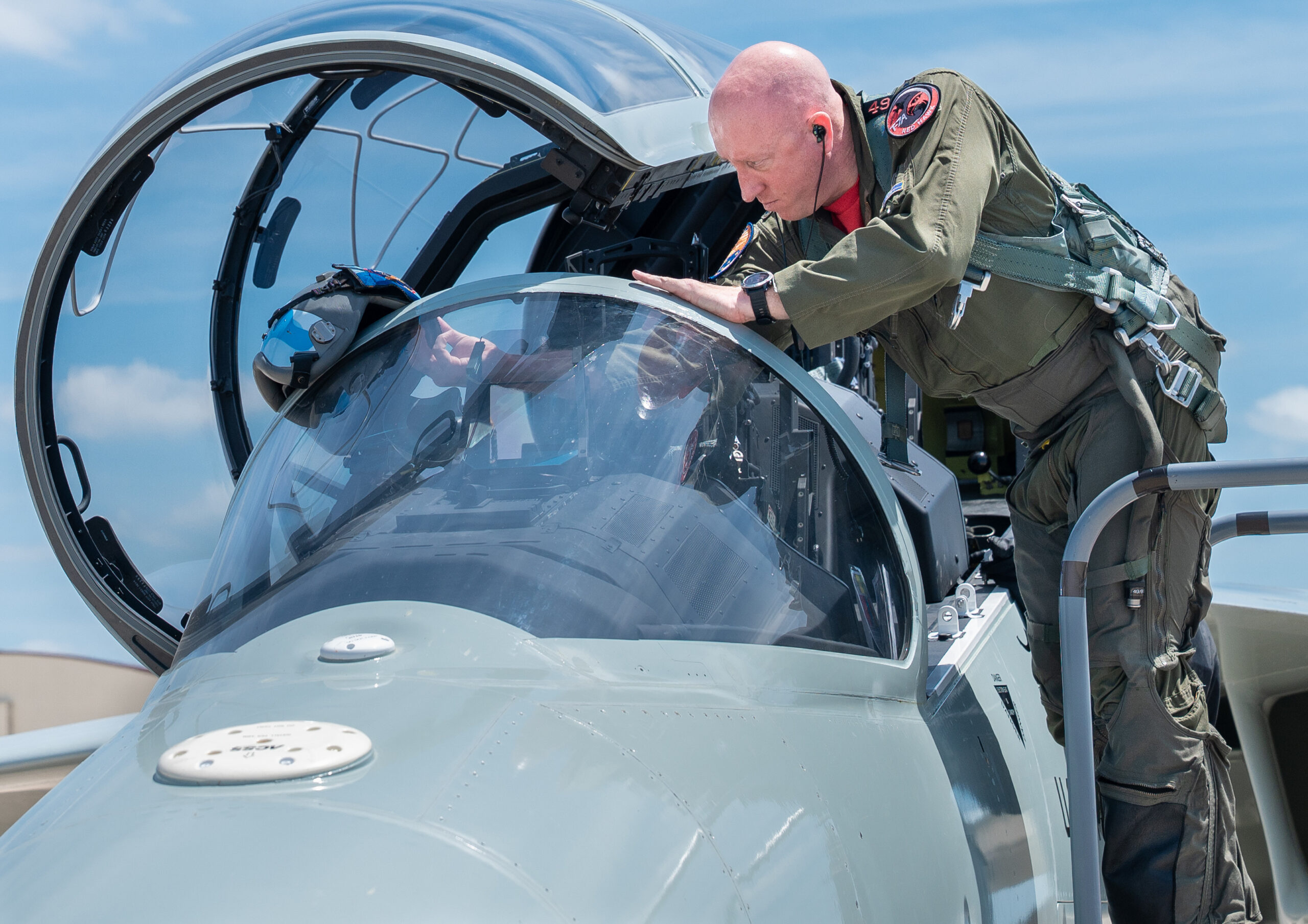
The newly qualified instructor pilots are Lt. Col. Michael Trott, commander of the 99th Flying Training Squadron, and Lt. Col. Phillip Bourquin, the squadron’s director of operations. Both officers have been actively engaged with the T-7A program since the 99th Flying Training Squadron, the Air Force’s inaugural operational unit to receive the new aircraft, accepted its first jet in December.
The 99th Flying Training Squadron is designated as the primary training unit for future T-7A instructor pilots. Its mission is to educate and certify the Airmen who will subsequently train the next generation of U.S. Air Force pilots. To achieve this, members of the squadron must first become proficient in the T-7A themselves, under the guidance of Boeing and Air Force test pilots.
The qualification process for Trott and Bourquin commenced with their participation in the ferry flight of the first two production T-7A jets from Boeing’s St. Louis facilities to Joint Base San Antonio-Randolph, Texas. Beyond their flight training, both officers and the other 14 members of the 99th Squadron are tasked with a multitude of responsibilities. These include collaborating with Boeing contractors to establish and rigorously test the initial T-7A simulators, meticulously reviewing flight guides and technical orders provided by Boeing, offering critical feedback on the aircraft and its systems, and developing a comprehensive training syllabus for future instructors.
A factor influencing the pace of the initial qualification process has been the limited availability of aircraft. The squadron currently operates only two T-7A jets, with one largely reserved for essential maintenance training for ground crews, thereby constraining the number of aircraft available for flight operations.
With Trott and Bourquin now qualified, AETC has stated that the 99th Flying Training Squadron has achieved “operational independence.” This signifies that the newly certified instructor pilots are authorized to train their fellow squadron members, reducing the reliance on external support from Boeing or Air Force test personnel. However, this internal training will not commence immediately. Trott and Bourquin plan to undergo a period of “seasoning” sorties to accumulate additional experience and proficiency before assuming instructional duties within the squadron.
The full qualification of the initial cadre of squadron members is anticipated to gain momentum as more T-7A Red Hawks are delivered. The next aircraft delivery is projected for August. Following the complete qualification of the squadron, efforts will focus on initial operational test and evaluation (IOT&E) for the T-7A and the finalization of the Pilot Instructor Training (PIT) syllabus. These steps are prerequisite to the declaration of initial operational capability (IOC), which is currently targeted for summer 2027. Upon achieving IOC, the 99th Flying Training Squadron will begin training instructor pilots from outside its initial cadre, who will then deploy to various AETC bases to commence student pilot instruction. Columbus Air Force Base, Mississippi, is slated to be the first base after Joint Base San Antonio-Randolph to receive the T-7A, with deliveries planned for fiscal year 2027.
The T-7A Red Hawk is designed as the successor to the T-38 Talon, which has served as the Air Force’s advanced training jet for future fighter and bomber pilots since the 1960s. The T-38 faces increasing challenges regarding maintenance and parts availability due to its age. More critically, Air Force officials emphasize that the T-38 was engineered to train pilots for third-generation aircraft, rendering it ill-equipped to prepare Airmen for the complexities of modern fifth-generation platforms such as the F-22 and F-35, let alone future sixth-generation aircraft like the B-21 bomber.
Officials have characterized the T-7A as a modern, adaptable platform. It is capable of high-performance maneuvers, including pulling up to 8 Gs, yet is designed to be more forgiving to fly than the T-38. Lt. Col. Trott remarked in January that “It flies like a fighter, maneuvers like a fighter.” Boeing integrated existing, proven designs into the T-7A, utilizing landing gear based on the F-16 and the same engine found in the F/A-18. The aircraft’s side-stick control, similar to those in the F-35 and F-22, provides a familiar interface for pilots transitioning to advanced fighters.
A key technological feature of the T-7A is its Large Area Display in the cockpit, which can be customized to present a simplified data layout for novice pilots or a complex array of information for advanced students. This inherent flexibility has prompted AETC leadership to explore the potential for the T-7A to assume some undergraduate pilot training duties currently performed by the T-6 Texan II, in addition to its primary role of higher-end training currently handled by the T-38.
Why This Matters
The qualification of the first instructor pilots for the T-7A Red Hawk represents a critical juncture for the U.S. Air Force and its future readiness. This development is not merely a procedural step but a foundational element in modernizing the entire pilot training pipeline, with significant implications for national defense and air superiority. The T-38 Talon, despite its storied service, is fundamentally a product of a different era, designed for a threat landscape that no longer exists. Its advanced age makes it increasingly expensive and difficult to maintain, posing operational challenges and safety concerns.
The T-7A Red Hawk directly addresses these issues by introducing a state-of-the-art trainer that mirrors the capabilities and cockpit environment of current and future fighter and bomber aircraft. By providing pilots with early exposure to modern controls, displays, and performance characteristics, the T-7A aims to reduce the training gap between basic flight instruction and the highly complex operational environments of fifth and sixth-generation aircraft. This more effective and efficient training is expected to shorten the time it takes to produce combat-ready pilots, enhance their proficiency, and ultimately improve the lethality and survivability of the U.S. Air Force in contested airspace.
Furthermore, the T-7A’s flexibility, including the potential to take on some undergraduate training duties, could streamline the entire training continuum, optimizing resource allocation and potentially leading to cost savings in the long term. This strategic investment in advanced training infrastructure underscores the Air Force’s commitment to maintaining its technological edge and ensuring its personnel are equipped with the skills necessary to confront evolving global threats. The successful integration of the T-7A is therefore crucial for sustaining the U.S. Air Force’s ability to project power and maintain air dominance for decades to come.
Audio of this article is brought to you by the Air & Space Forces Association, honoring and supporting our Airmen, Guardians, and their families. Find out more at afa.org