
The influence of former President Donald Trump’s endorsements within the Republican Party has been a defining feature of recent primary elections, often serving as a significant advantage for candidates in congressional races. However, a recent move in South Carolina’s gubernatorial primary runoff has highlighted evolving dynamics in state-level contests, suggesting a more complex picture for the power of presidential backing.
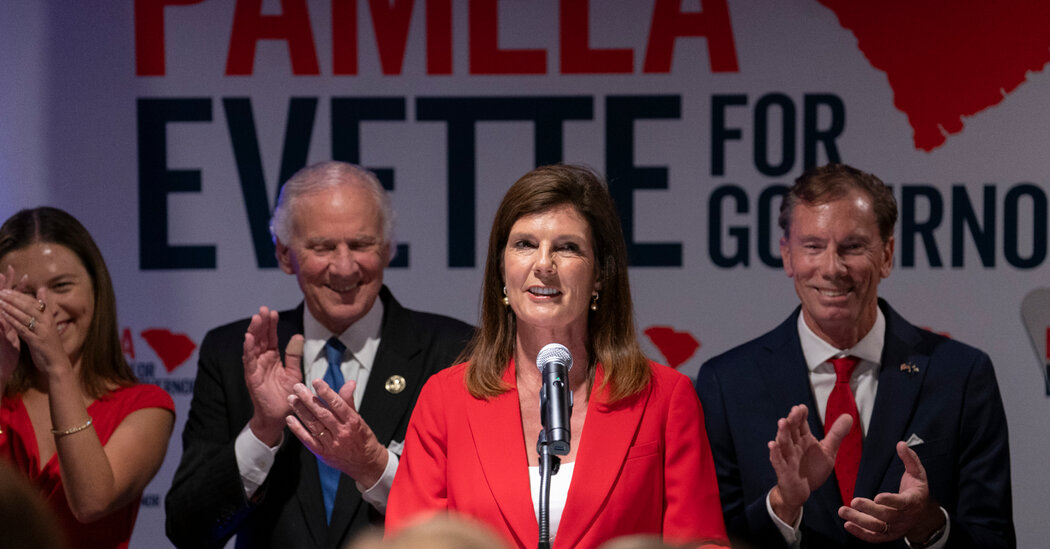
On Friday, former President Trump issued a rare dual endorsement in the South Carolina Republican gubernatorial runoff, backing both Lieutenant Governor Pamela Evette and Attorney General Alan Wilson. This decision came after Ms. Evette, whom Mr. Trump had initially endorsed a month prior, failed to secure an outright victory in the initial primary round, leading to a runoff election.
In a post on his Truth Social platform, Mr. Trump explained his decision, stating, “I can’t hurt one of them by only Endorsing the other, so, therefore, I am going to Endorse, for Governor of South Carolina, both Pam Evette and Alan Wilson!” He added, “With either one you can’t go wrong.” This move is not entirely without precedent; in 2022, Mr. Trump similarly endorsed “ERIC” – a name shared by two candidates – on the eve of a Senate primary in Missouri.
The dual endorsement for South Carolina reflects a broader pattern of mixed results for Mr. Trump’s favored candidates in gubernatorial primaries this election cycle. While his endorsements have often proved decisive in federal races for the Senate and House, their impact on state executive offices appears to be less consistent.
In the South Carolina runoff, Attorney General Alan Wilson has been leading Lieutenant Governor Evette in pre-runoff polls. Adding to Mr. Wilson’s momentum, Senator Tim Scott, a Republican from South Carolina, publicly endorsed Mr. Wilson shortly after Mr. Trump’s dual announcement.
The perceived shift in the weight of Mr. Trump’s endorsements in gubernatorial contests has drawn attention from political observers. Scott Huffmon, a political science professor at Winthrop University in Rock Hill, S.C., and director of the Winthrop Poll, suggested that this trend could indicate a growing divergence within the conservative electorate. He posited that some voters, while potentially comfortable supporting a “Make America Great Again” (MAGA) loyalist for Congress, might prefer a governor “who has their eyes firmly fixed here at home rather than on Washington.” This perspective aligns with voter sentiment observed in South Carolina, where residents expressed a greater interest in electing a leader capable of addressing state-specific concerns such as infrastructure challenges and rising costs, rather than focusing primarily on national political movements.
A notable example of Mr. Trump’s preferred candidate facing challenges in a gubernatorial primary occurred in Georgia. There, Burt Jones, the state’s lieutenant governor who had secured early support from Mr. Trump, was defeated by Rick Jackson, a billionaire health care executive. Mr. Jackson invested millions of his own money into his campaign, utilizing extensive advertising to portray himself as a version of Mr. Trump. Following Mr. Jackson’s victory, Mr. Trump acknowledged this strategy in a social media post, writing, “Congratulations to Rick Jackson, who very successfully campaigned on being ‘TRUMP,’ and won.” This outcome suggests that while the “Trump brand” remains potent, its successful application might not always require the former President’s direct endorsement, particularly when a candidate can effectively emulate his political style and messaging.
Despite the varying efficacy of the former President’s endorsements, Republican candidates in South Carolina, including Mr. Wilson, made considerable efforts to secure and highlight his support. Mr. Wilson’s campaign website features a “Trump Tough” section, and he has frequently lauded the former President in public remarks. Upon receiving Mr. Trump’s co-endorsement, Mr. Wilson issued a statement declaring, “I’ve proudly stood with President Trump from the very beginning, defended him when others would not, and fought alongside him against the Radical Left. I look forward to working with him as Governor to continue delivering conservative victories for the people of this state.”
Lieutenant Governor Evette had been even more assiduous in tying her campaign to Mr. Trump prior to the runoff. She regularly shared photographs of herself with Mr. Trump in her campaign communications, leading some voters to believe she had his official backing before it was publicly confirmed. Mr. Trump had actively promoted Ms. Evette’s candidacy, participating in a telephone rally for her and Senator Lindsey Graham on the eve of the state’s initial primary. During that call on June 8, Mr. Trump praised Ms. Evette as “outstanding” and “MAGA all the way,” adding, “Her competition is not serious, and cannot compete with her.” This earlier, unequivocal support highlights the shift represented by his later dual endorsement.
The South Carolina runoff presents voters with two Republican candidates with distinct backgrounds. Pamela Evette, an Ohio-born businesswoman, has served as Lieutenant Governor alongside Governor Henry McMaster since 2019. With Governor McMaster term-limited, Ms. Evette has positioned herself as his natural successor, focusing her messaging on managing the state’s growth and frequently aligning with Mr. Trump’s political platform. Governor McMaster also endorsed Ms. Evette, and Mr. Trump initially suggested she consider the governor’s son, Henry McMaster Jr., as her running mate. This proposal generated controversy among Ms. Evette’s opponents, who alleged a “backroom deal.” Ms. Evette denied these accusations, stating she would not select a running mate until after the primary, and Mr. McMaster Jr. subsequently withdrew from consideration.
Alan Wilson, a National Guard veteran, has served as South Carolina’s Attorney General for 15 years. His campaign has prioritized affordability, a key concern for many voters. Mr. Wilson has also garnered significant support from other candidates who did not advance to the runoff, including sitting members of Congress Representatives Nancy Mace and Ralph Norman.
The winner of the Republican runoff will advance to face State Representative Jermaine Johnson, who secured the Democratic nomination earlier this month. The outcome of this election will not only determine the next leader of South Carolina but may also provide further insights into the evolving landscape of Republican primary politics and the enduring, yet adaptable, influence of former President Donald Trump.
Why This Matters
The evolving dynamics of former President Trump’s endorsements, particularly his unusual dual backing in South Carolina, carry significant implications for the Republican Party and the broader American political landscape. Firstly, it provides a barometer for the enduring, yet potentially shifting, nature of Mr. Trump’s influence. While his endorsements remain powerful, especially in federal races, their mixed results in state-level gubernatorial contests suggest that local issues and candidate appeal can sometimes outweigh presidential backing. This nuance is critical for understanding the future of the “Make America Great Again” movement and its integration into different tiers of governance.
Secondly, this situation highlights a potential divergence within the Republican electorate. The idea that voters might prefer state leaders focused on “here at home” issues over those aligned primarily with national political figures or movements points to a practical consideration for state leadership. Governors are responsible for tangible local issues like infrastructure, education, and economic development, and voters may increasingly prioritize candidates with demonstrated experience or a clear focus on these areas, even if they align with conservative principles.
Thirdly, Mr. Trump’s strategy of issuing dual endorsements, as seen in South Carolina and previously in Missouri, could set a precedent for future primary elections. This tactic allows him to avoid alienating a segment of his base or being associated with a losing candidate, thereby preserving his perceived political capital. However, it also dilutes the power of a singular, decisive endorsement, which has historically been a hallmark of his political interventions.
For South Carolina specifically, the runoff will determine the state’s next chief executive at a critical juncture. The chosen candidate will be tasked with navigating challenges related to rapid population growth, infrastructure strain, and economic pressures. The general election against the Democratic nominee will further test the appeal of the Republican platform and leadership in a state that has consistently supported Mr. Trump in presidential elections but may now be prioritizing state-specific governance more acutely.
Ultimately, these developments offer valuable insights into the adaptability of political influence, the internal complexities of a major political party, and the evolving considerations of voters as they weigh national political trends against the immediate needs of their local communities.