
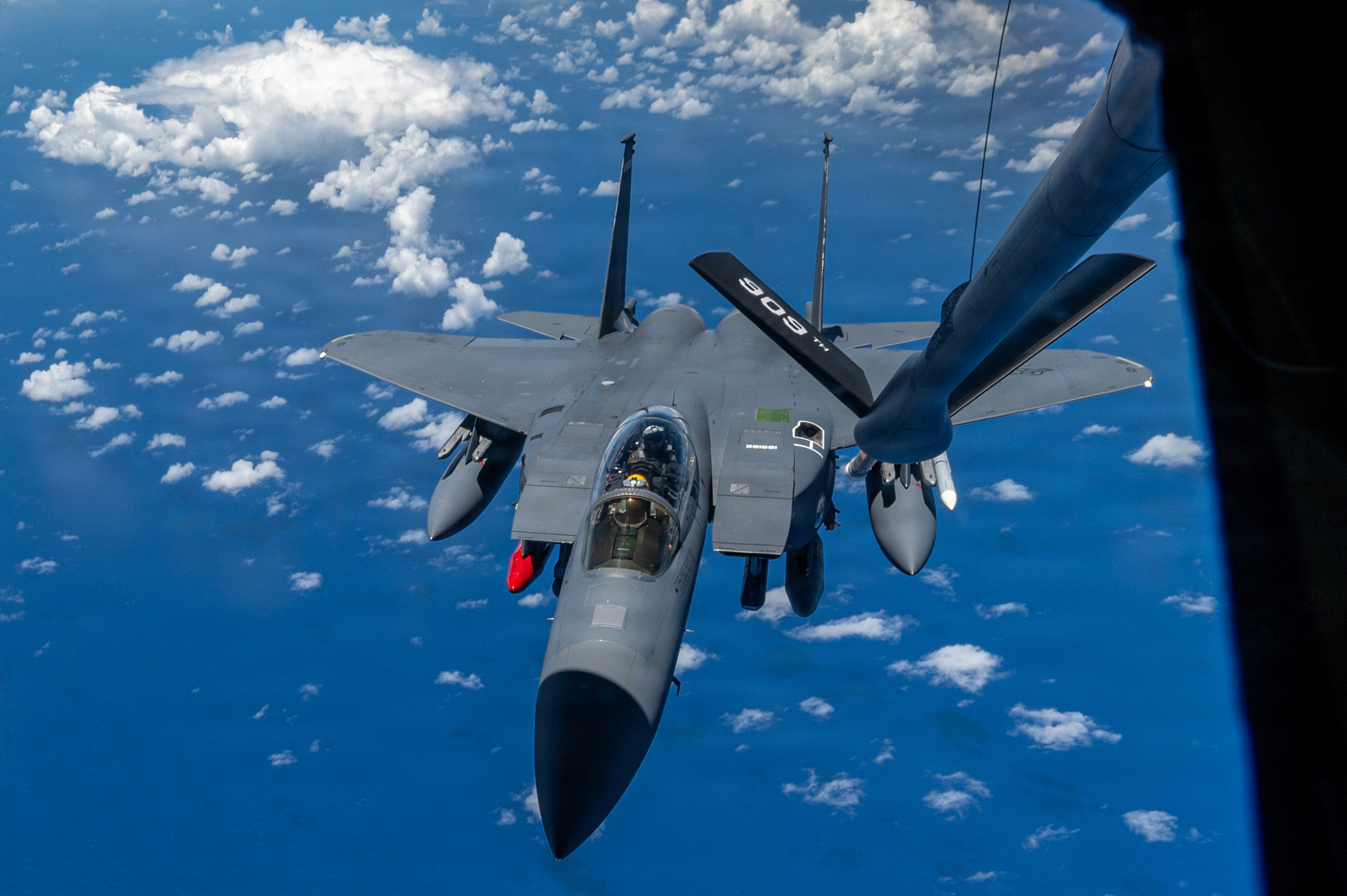
An F-15EX Eagle II fighter aircraft has landed at Kadena Air Base, Japan, this week, marking a significant, albeit temporary, step in the U.S. Air Force’s efforts to modernize its airpower in the Indo-Pacific region. The advanced fighter jet is on a “visit” to the strategically vital base on Okinawa, according to a July 1 release from the 18th Wing, as personnel undertake preparations for the eventual permanent stationing of F-15EXs. This permanent deployment, however, has faced delays, with the process now projected to commence in 2027, pushed back from an initial spring 2026 timeline.
The F-15EX, accompanied by two F-15E Strike Eagles, arrived on June 29. The duration of this particular visit was not immediately specified by the 18th Wing. This arrival is part of what the Pentagon describes as the “next phase” of its initiative to replace the aging F-15C/D Eagle fleet currently stationed on the island. The U.S. Air Force announced in 2024 its intention to replace 48 F-15C/D aircraft at Kadena with a force of 36 F-15EX Eagle IIs.
This marks the second occasion an F-15EX has visited Kadena Air Base. Previously, in July 2025, two Eagle IIs conducted a similar visit for integration and familiarization training exercises. In both instances, the visiting F-15EX aircraft have been assigned to the 85th Test and Evaluation Squadron, based at Eglin Air Force Base, Florida, underscoring their role in validating capabilities and preparing for operational deployment.
The initial operational unit slated to receive the F-15EX at Kadena is the 67th Fighter Squadron. This unit was originally prepared to receive its first jets in the spring and summer of 2026. However, industrial action, specifically strikes at contractor Boeing’s factory between August and November 2025, led to a “significant disruption” in the fighter jet’s delivery schedule, as previously reported by Air & Space Forces Magazine. These manufacturing delays have had a ripple effect, impacting the Air Force’s broader modernization efforts.
Following the resolution of the strikes, Boeing resumed deliveries of the F-15EX to the Air Force. Aircraft numbers 14 and 15 were delivered to Portland Air National Guard Base, Oregon, on August 19 and November 16, respectively, in 2026. The company subsequently delivered the 16th F-15EX in December of the same year. Despite these resumed deliveries, the impact on the Kadena timeline has been substantial. In May 2027, Air Force Secretary Troy Meink officially announced that the arrival of the first F-15EX at Kadena is now scheduled for 2027, with the final aircraft expected to arrive in 2028.
The current temporary presence of the F-15EX at Kadena serves a crucial purpose: to enable pilots, maintainers, and mission support personnel to familiarize themselves with the advanced aircraft. This includes advancing “tactics, maintenance procedures, and sustainment” to support the fighter jet’s future missions within the region. Brigadier General John Gallemore, Commander of the 18th Wing, emphasized the significance of this preparatory phase. “The F-15EX represents the next chapter of airpower at Kadena,” he stated. “Our Airmen have the opportunity to train with the aircraft, build confidence in its capabilities and ensure we’re ready to project lethality and integrate into operations as we continue providing combat power in support of a free and open Indo-Pacific.”
Lieutenant Colonel Casey Watts, Commander of the 85th Test and Evaluation Squadron, echoed this sentiment, highlighting the importance of early integration. “Building familiarity with the aircraft now will help ensure a smooth transition as the Eagle II becomes part of Kadena’s long-term mission and strengthens combat readiness across the Indo-Pacific,” Watts remarked. Queries directed to Boeing regarding the ongoing status of deliveries and projected quantities of aircraft for fiscal years 2026 and 2027, as well as to an Air Force spokesperson, did not receive an immediate response.
The retirement of the permanently stationed F-15C/D aircraft from Kadena Air Base concluded in January 2025, marking the final deployment of these models by the Active-Duty Air Force. The F-15C/D models originally joined the Air Force fleet in 1979 and were first stationed at Kadena in the 1980s. To bridge the capability gap created by their departure and the delayed arrival of the F-15EXs, the Air Force has implemented a rotational deployment strategy since 2022, cycling various fighter units through Kadena on a six-month basis. These rotational deployments have included a diverse mix of aircraft such as F-15Es, F-16s, F-35s, and F-22s.
The F-15EX Eagle II represents a substantial upgrade from its predecessors. It is the newest and most heavily modernized variant of the venerable Eagle family. Key technological enhancements include digital fly-by-wire flight controls, a large area display glass-cockpit, and a modern touchscreen interface. The aircraft is equipped with the advanced APG-82 Active Electronically Scanned Array (AESA) radar, the robust Eagle Passive/Active Warning Survivability System (EPAWSS) for self-defense, and the Joint Helmet-Mounted Cueing System. Beyond these avionics improvements, the F-15EX boasts superior performance characteristics, including increased speed and range, a substantial 29,000-pound payload capacity, and two additional weapons stations compared to earlier F-15 variants, allowing it to carry more munitions or a more diverse loadout.
In early June, the Senate Armed Services Committee voted 18-9 to advance its fiscal year 2027 National Defense Authorization Act (NDAA). This bill included crucial approval for the Pentagon to pursue multiyear contracts for both the F-15EX and the F-35A Joint Strike Fighter. Such multiyear contracts are vital for providing stability in funding and streamlining the aircraft delivery process for defense contractors. The advanced bill is now awaiting a full vote by the Senate. However, the Senate committee’s language explicitly stipulated that these multiyear contracts would only be approved on the condition that the Secretary of the Air Force can provide assurances that Boeing will consistently meet its established delivery schedules, underscoring congressional concerns regarding past production delays.
Why This Matters
The deployment of the F-15EX Eagle II to Kadena Air Base, even on a temporary basis, carries significant strategic implications for U.S. defense posture and regional stability in the Indo-Pacific. Kadena Air Base, located on Okinawa, Japan, is a cornerstone of American military presence in the region, providing a critical forward operating base with unparalleled access to key areas such as the East China Sea, the Taiwan Strait, and the Korean Peninsula. Modernizing the fighter fleet at this pivotal location is essential for maintaining a credible deterrent and ensuring the U.S. and its allies can effectively respond to emerging security challenges.
The replacement of the aging F-15C/D fleet, which has served for decades, with the F-15EX is not merely an upgrade but a necessity to maintain a qualitative edge. The F-15EX’s advanced avionics, including its AESA radar and comprehensive electronic warfare suite, coupled with its increased payload capacity and digital controls, significantly enhance its lethality, survivability, and interoperability. These capabilities are crucial in an increasingly contested environment, allowing the U.S. Air Force to project power, conduct air superiority missions, and integrate seamlessly with allied forces, particularly Japan’s Air Self-Defense Force.
The delays in the F-15EX’s permanent deployment, however, highlight vulnerabilities in the defense industrial base and supply chain. The impact of the Boeing factory strikes underscores how industrial disruptions can have far-reaching effects on national security timelines and strategic planning. While the rotational deployment of other advanced fighters has provided an interim solution, a consistent, permanently stationed, modernized fleet is preferred for long-term readiness and operational continuity. These delays could also be perceived by potential adversaries as a sign of weakness or inconsistency in U.S. commitment, potentially altering regional power dynamics.
Furthermore, the Senate’s condition for multiyear contracts—requiring assurances of delivery schedule adherence from Boeing—reflects growing congressional scrutiny over defense acquisition programs. This oversight is vital for ensuring taxpayer money is spent efficiently and that critical defense assets are delivered on time, directly impacting the U.S. military’s ability to meet its strategic objectives. Ultimately, the successful and timely deployment of the F-15EX to Kadena is more than just an aircraft delivery; it is a critical component of strengthening the U.S.-Japan alliance, enhancing regional deterrence, and projecting a resolute commitment to a free and open Indo-Pacific.