
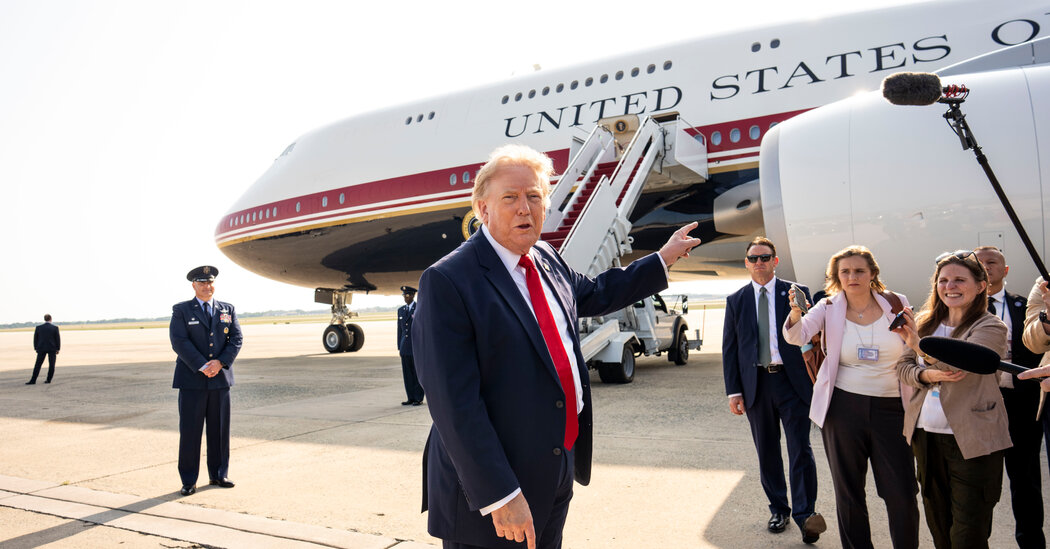
The administration of former President Donald Trump issued federal subpoenas on a Friday to several journalists employed by The New York Times. These legal directives followed reports published by the news organization earlier that week concerning potential security vulnerabilities related to the presidential aircraft, specifically a new Boeing 747-8, which had been reportedly donated by the government of Qatar and designated as a future Air Force One. This action marked a significant development in the administration’s interactions with the press, prompting widespread discussion about press freedom and government transparency.
The subpoenas mandated that the reporters appear to testify before a federal grand jury convened in Manhattan on a specified Wednesday. Legal analysts and press freedom advocates widely viewed this move as an intensified measure within the Trump administration’s broader approach to managing news coverage and obtaining information from journalists, particularly regarding national security matters. Federal grand juries are typically convened to investigate potential criminal conduct and determine whether there is sufficient evidence to issue an indictment, operating under strict secrecy to protect ongoing investigations and the reputations of those not yet charged.
The delivery methods of these subpoenas also drew particular attention, as federal agents reportedly served the documents directly at the private residences of some of the targeted journalists. This method of service, while legally permissible, can be perceived as an aggressive tactic, raising concerns among press organizations about potential intimidation and the implications for journalistic independence and the safety of reporters.
In response to the subpoenas, The New York Times promptly issued a strong denouncement of the administration’s actions, characterizing them as a direct challenge to the principles of a free press and an attempt to stifle vital public information, particularly concerning government operations and the use of taxpayer funds.
David McCraw, The Times’s top newsroom lawyer, released a statement on Friday evening condemning the subpoenas. He asserted, “The appearance of federal law enforcement agents on the doorstep of news reporters should shock the conscience of any American who believes in the Constitution and the press freedom it protects.” Mr. McCraw further emphasized the role of journalism in a democratic society, stating, “Our journalists report the facts and advance the American public’s right to know how their government is operating and their taxpayer dollars are being used.” He concluded by characterizing the administration’s actions as “nothing more than an attempt to prevent the public from knowing what is happening in their country by intimidating journalists from doing their jobs.” This statement highlighted the newspaper’s view that the subpoenas represented an effort to suppress information and hinder the essential function of independent reporting, particularly when it involves sensitive government operations.
The content of the subpoenas provided limited specific details regarding the nature of the alleged offenses, requesting only that the journalists provide testimony “in regard to an alleged violation of federal criminal law.” The subpoenas were issued under the authority of Jay Clayton, who at the time served as the U.S. Attorney for the Southern District of New York in Manhattan. This office is recognized as one of the most influential federal law enforcement bodies in the United States, responsible for prosecuting federal crimes and representing the U.S. government in civil matters within its jurisdiction. Notably, Mr. Clayton had recently received a nomination from then-President Trump to assume the role of Director of National Intelligence, a position overseeing the U.S. intelligence community and coordinating intelligence agencies, which added another layer of public scrutiny to the subpoena issuance.
At the time of the initial reporting, representatives for both the White House and the U.S. Attorney’s Office in Manhattan did not immediately respond to requests for comment regarding the subpoenas, leaving the administration’s official stance on the matter unaddressed publicly that evening.
The journalists named in the subpoenas included Julian E. Barnes, Eric Lipton, Tyler Pager, and Eric Schmitt. Their reporting had focused on a series of articles concerning presidential travel and aircraft security. One article, published on a Wednesday, detailed how President Trump had reportedly used the older presidential aircraft for his departure from Turkey, a decision said to be made at the recommendation of the Secret Service due to unspecified security precautions. A subsequent report, published on Thursday, stated that the new Air Force One, identified as a Boeing 747-8 that had been a gift from Qatar, allegedly lacked certain advanced security features present on the older model, including sophisticated antimissile defense systems. Both articles relied on information provided by anonymous sources, who cited the sensitive nature of the security details as the reason for their anonymity and the public interest in presidential security and safety protocols.
Prior to the publication of the initial Wednesday article, a significant interaction occurred between a senior official from the Federal Bureau of Investigation (FBI) and a reporter, alongside a senior editor, at The New York Times. According to an individual familiar with the exchange, the FBI official requested that the newspaper delay or withhold the publication of the article, citing concerns related to national security. However, the official reportedly declined to provide specific details or explanations regarding the precise national security threat. During this conversation, the FBI official also pressed The Times to reveal the identities of its anonymous sources for the forthcoming article, a request that the newspaper firmly declined to fulfill, adhering to journalistic ethical standards regarding source protection. Charlie Stadtlander, a spokesperson for The Times, later confirmed this account of the pre-publication interaction, emphasizing the newspaper’s commitment to both national security and journalistic principles.
Throughout his political career and particularly during his presidency, Donald Trump was consistently vocal in his criticism of numerous news organizations, often referring to some outlets as “fake news” or “enemies of the people.” During his tenure, especially in his second term, his administration demonstrated an assertive posture in its engagement with the press, frequently utilizing federal governmental powers in attempts to influence reporting and to investigate disclosures of information. This period saw increased scrutiny on the relationship between government and independent journalism, sparking widespread debate over the role of the media in a democracy and the balance between government transparency and official secrecy.
The issuance of subpoenas to New York Times journalists was not an isolated incident during this administration’s term. Earlier in the same year, the Justice Department had also initiated efforts to compel testimony from journalists affiliated with The Wall Street Journal and The Washington Post regarding their reporting. In those instances, the Justice Department eventually withdrew its subpoenas after both news organizations mounted robust legal challenges through sealed filings, which typically involve arguments presented confidentially to a court to protect sensitive legal strategies or information, illustrating the legal complexities involved in such cases.
Investigations into the unauthorized disclosure of classified government information, commonly known as “leak investigations,” have been pursued by both Democratic and Republican administrations throughout U.S. history, reflecting a bipartisan concern for national security. However, the practice of issuing subpoenas directly to journalists to compel their testimony or to reveal sources is widely considered to be an uncommon and sensitive measure. Organizations dedicated to the protection of press freedom and First Amendment rights frequently argue that such subpoenas can have a “chilling effect” on news gathering, potentially deterring sources from coming forward with important information and making journalists hesitant to pursue sensitive stories, thereby impeding the public’s right to information and government accountability.
Further underscoring the administration’s assertive approach, FBI agents undertook the highly unusual step in January of conducting a search of the residence of Hannah Natanson, a reporter for The Washington Post. This action was reportedly part of an investigation into a government contractor’s handling of classified material. During the search, agents executed a warrant and seized multiple electronic devices belonging to Ms. Natanson, including her phones, laptops, and a smartwatch. At the time, Ms. Natanson had been engaged in extensive reporting for several months, involving conversations with numerous government employees, focusing on the Trump administration’s initiatives to reduce the size of the federal workforce, which touched on potentially sensitive government operations and policy decisions.
Beyond the subpoena incident, The New York Times had been involved in a number of distinct legal disputes and lawsuits with former President Trump and various entities within his administration, highlighting a strained and often litigious relationship that extended beyond specific reporting on national security or government leaks.
For instance, in the preceding year, President Trump himself had filed a lawsuit against The Times, alleging defamation. His legal complaint accused the newspaper of publishing false statements, damaging his reputation, and purportedly attempting to undermine his potential candidacy for the 2024 presidential election, a claim vigorously contested by the newspaper as an assault on legitimate reporting.
The newspaper had also initiated legal action against the Defense Department. In December, The Times filed a lawsuit following the department’s implementation of new restrictions on journalists covering military affairs, arguing these restricted access to crucial information necessary for public understanding of defense matters. The newspaper subsequently filed a second lawsuit after the Defense Department further reduced physical access for reporters to the Pentagon, the headquarters of the U.S. Department of Defense. These lawsuits contended that the restrictions hampered the ability of journalists to inform the public about military operations and policy, asserting a violation of press freedom.
In another separate legal development, the Equal Employment Opportunity Commission (EEOC) had filed a lawsuit against The Times in May, alleging employment discrimination within the news organization. In response, on the same Friday that the journalist subpoenas were issued, The Times filed a counterclaim against the EEOC. In its counterclaim, the newspaper asserted that the EEOC’s lawsuit was not legitimate but rather an act of retaliation specifically targeting its extensive and often critical coverage of the Trump presidency, and furthermore, constituted a violation of its First Amendment rights guaranteeing freedom of the press. This counterclaim added another layer to the complex legal interplay between the administration and the prominent news outlet, underscoring the heightened tensions.
Reporting contributions for related matters were provided by Benjamin Weiser.
Why This Matters
The issuance of federal subpoenas to journalists, particularly when coupled with other governmental actions targeting news organizations, carries significant implications for the principles of press freedom and the functioning of democratic societies worldwide. A free and independent press is widely regarded as a cornerstone of democracy, serving a vital role in holding power to account, ensuring transparency, and informing the public on critical issues ranging from national security to government spending.
Firstly, such aggressive legal tactics can have a profound “chilling effect” on news gathering. When journalists face the threat of legal compulsion to reveal their confidential sources or testify about their reporting, it can deter potential whistleblowers, government insiders, and other anonymous sources from coming forward with information that is in the public interest. This can be particularly true for sensitive matters related to national security, potential government misconduct, or the expenditure of taxpayer dollars. The erosion of source protection, a long-standing ethical principle in journalism, undermines the ability of the press to uncover and report on critical issues, thereby limiting the public’s access to information necessary for informed civic engagement and effective oversight of those in power.
Secondly, these incidents highlight the ongoing tension between legitimate national security concerns and the public’s right to know. While governments have a justifiable interest in protecting classified information and preventing disclosures that could genuinely harm national security, the precise definition of such harm and the measures taken to prevent it are often subjects of intense public and legal debate. Critics argue that aggressive actions against journalists can sometimes be perceived as an attempt to control narratives, suppress inconvenient truths, or punish outlets for unflattering coverage, rather than solely safeguarding national interests. This dynamic raises concerns about potential abuses of power and the weaponization of legal processes against the media, potentially blurring the lines between protecting classified information and shielding government actions from scrutiny.
Finally, the actions taken by a prominent democratic government, particularly one that historically champions democratic values and press freedoms, can set dangerous precedents globally. When a democratic government employs assertive measures against its own independent media, it can embolden authoritarian regimes and less democratic states to adopt similar tactics against their journalists, further eroding press freedoms internationally. The ongoing legal battles and contentious relationship between the U.S. government and the press underscore the constant need for vigilance in upholding First Amendment protections and ensuring that a robust, independent media can continue to serve its essential function in a healthy democracy, both domestically and as an example to the world.