
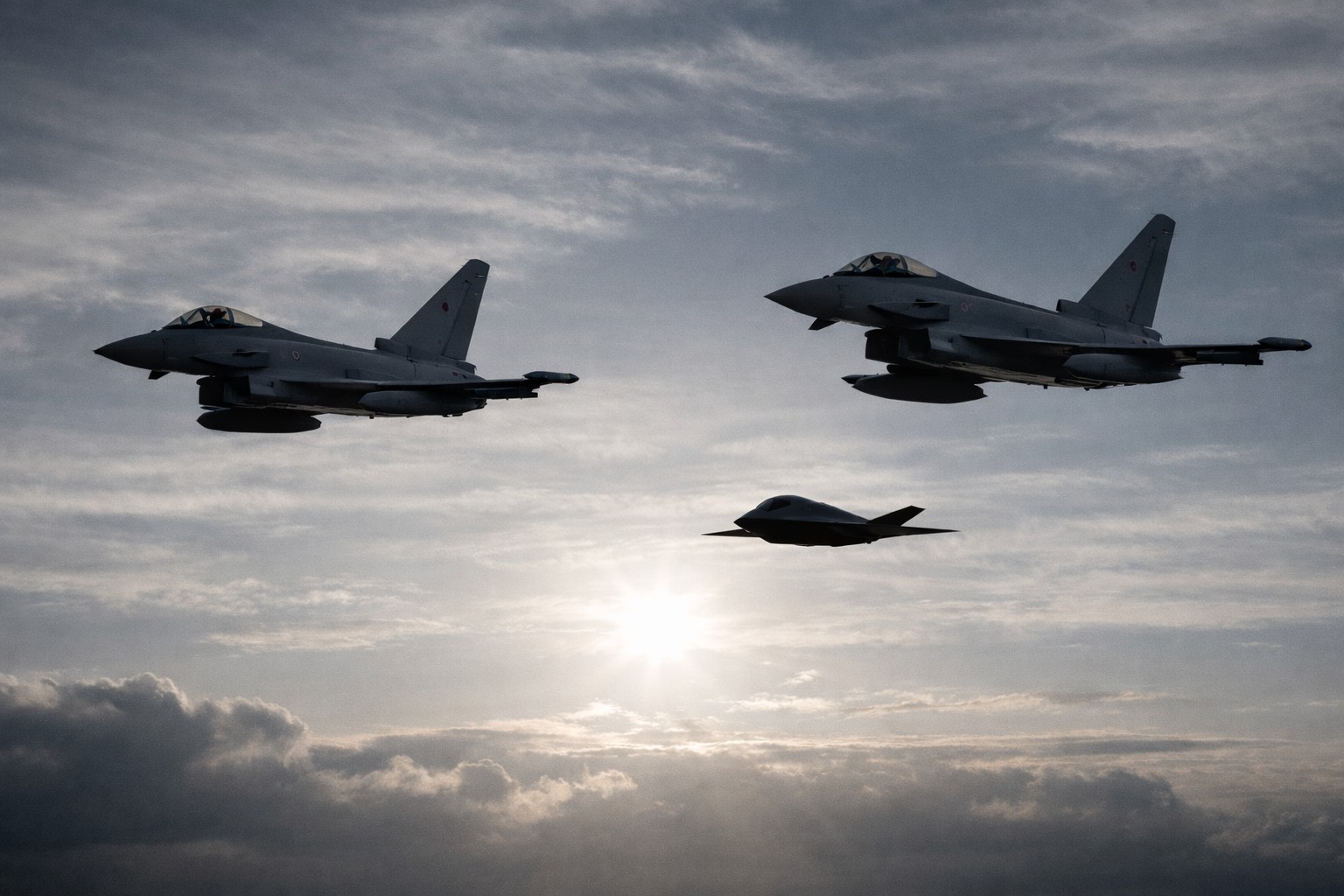
United Kingdom to Integrate Uncrewed Collaborative Combat Aircraft into Air and Missile Defence by 2030s
The United Kingdom’s Ministry of Defence (MoD) has announced that Uncrewed Collaborative Combat Aircraft (CCAs) are projected to become a cornerstone of the nation’s air and missile defence strategy through the 2030s. These advanced autonomous systems are intended to augment and enhance the capabilities of the Royal Air Force’s (RAF) existing crewed fighter fleet, which currently forms the bedrock of the UK’s defensive posture.
This significant detail emerged from a written parliamentary answer provided by Luke Pollard, the Minister for Defence Readiness and Industry, on July 10. The response was directed to Ben Obese-Jecty, the Conservative Member of Parliament for Huntingdon, who had sought an assessment of the potential impact of CCAs on integrated air and missile defence (IAMD) into the next decade, specifically referencing the Defence Investment Plan.
Minister Pollard outlined the current operational framework, stating,“The RAF combat air force provides the core of UK IAMD capability, with Typhoon and F-35 defending UK and NATO skies against air and cruise missile attack, supported by Voyager tankers and Wedgetail early warning aircraft.”He then underscored the future role of uncrewed systems, affirming,“Through the 2030s, Collaborative Combat Aircrafts are expected to also play a key role in IAMD as they augment combat air platforms.”This statement signals a strategic shift towards a more integrated and diversified air defence architecture.
The parliamentary answer further elaborated on the broader investment landscape, noting that the Defence Investment Plan includes a substantial £790 million in additional funding specifically allocated for homeland IAMD. This investment is earmarked to“prioritise the sustainment of critical foundational capabilities while enhancing Command and Control and sensing functions to maximise the effectiveness of existing air defence systems and effectors.”The collective aim of these investments is to foster a more resilient and integrated defence architecture, introduce greater redundancy within critical systems, and strengthen decision-making processes through improved situational awareness. Ultimately, these measures are designed to ensure the UK is better equipped to detect, assess, and respond to evolving aerial threats, while simultaneously laying the groundwork for future capability enhancements.
The MoD’s statement effectively links two distinct, yet interconnected, defence programmes funded under the current plan. The CCA development effort, backed by a £300 million investment, is poised to leverage technologies and manufacturing techniques derived from the Global Combat Air Programme (GCAP). The ambitious goal for this programme is to achieve a concept demonstrator flying by at least 2030, with the department actively pursuing an acceleration towards operational capability as swiftly as possible thereafter. Crucially, the confirmation that these uncrewed aircraft are expected to contribute directly to homeland air defence expands their envisioned mission profile beyond the commonly discussed “loyal wingman” roles. These traditional roles typically involve drones extending the sensor reach and weapons magazines of crewed fighters, acting as force multipliers in offensive or reconnaissance operations. The explicit inclusion of homeland defence highlights a broader, more defensive application of CCA technology.
The strategic rationale behind integrating uncrewed aircraft into the air defence force is rooted in adapting to contemporary and emerging threats. Recent conflicts in Ukraine and the Middle East have vividly demonstrated the efficacy of mass drone and cruise missile raids as a cost-effective means for adversaries to overwhelm conventional air defence systems. Against such saturating threats, the number of available crewed fighters, and critically, the finite number of interceptor missiles they carry, often dictates the ceiling on what can be successfully intercepted. By deploying uncrewed systems, the UK aims to significantly increase the sheer volume of platforms available to counter these complex threats, offering greater persistence, a more favourable cost-exchange ratio for intercepting cheaper drones, and the ability to operate in higher-risk environments without endangering human pilots.
This initiative represents a pivotal step in the evolution of the RAF’s combat air capabilities, moving towards a future where human-machine teaming is central to national security. The development of CCAs in conjunction with next-generation crewed platforms like those envisioned by GCAP, will allow for a flexible and adaptable force that can meet diverse challenges, from high-intensity conflict to persistent surveillance and defence of sovereign airspace.
Why This Matters
The United Kingdom’s commitment to integrating Uncrewed Collaborative Combat Aircraft (CCAs) into its core air and missile defence strategy marks a significant inflection point in national security and defence policy. This decision carries several profound implications:
1. Adaptation to Modern Threats:The explicit mention of countering “mass drone and cruise missile raids” underscores a critical adaptation to the evolving nature of warfare. As demonstrated in recent global conflicts, adversaries are increasingly employing swarms of inexpensive uncrewed aerial vehicles and cruise missiles to overwhelm traditional, expensive air defence systems. CCAs offer a potentially more cost-effective and scalable solution, enhancing the UK’s ability to protect its airspace and critical infrastructure against these prevalent and challenging threats.
2. Enhanced Defence Capability and Resilience:By augmenting crewed fighters, CCAs will provide a significant boost to the RAF’s Integrated Air and Missile Defence (IAMD) capabilities. They can extend sensor ranges, carry additional weaponry, conduct persistent surveillance, and undertake risky missions without endangering human pilots. This increases the total number of interceptors available, offers greater operational flexibility, and builds redundancy into the defence architecture, making it more resilient against sophisticated attacks.
3. Strategic Shift in Air Warfare:This move signals a definitive shift towards a future where human-machine teaming and autonomous systems are central to air power. It positions the UK at the forefront of developing next-generation combat air capabilities, moving beyond solely relying on crewed platforms. This paradigm shift will necessitate new doctrines, training methodologies, and ethical frameworks for the employment of autonomous systems in combat.
4. Industrial and Technological Leadership:The substantial investments—£790 million for IAMD and £300 million specifically for CCAs, leveraging technologies from the Global Combat Air Programme (GCAP)—highlight a commitment to fostering innovation within the UK defence industry. This can stimulate technological advancements, create high-skilled jobs, and potentially establish the UK as a leader in the development and export of advanced uncrewed combat aircraft and associated systems, driving economic growth and national prestige.
5. Interoperability and Alliances:As other major defence powers, notably the United States and various European nations, are also heavily investing in similar collaborative combat aircraft concepts, the UK’s strategy aligns with a broader international trend. This will facilitate greater interoperability with key allies, strengthening collective security efforts within NATO and other defence partnerships, ensuring a more cohesive response to shared threats.
In essence, the integration of CCAs is not merely an incremental upgrade but a transformative step, ensuring the UK’s air defence remains robust, adaptable, and technologically advanced in a rapidly changing global security landscape.