
Key Takeaways:
- Escalating Energy Market Volatility:Iran’s declaration of the Strait of Hormuz closure and subsequent US-Iran military exchanges have injected significant uncertainty into global oil and gas markets. Crude futures are experiencing sharp upward pressure, reflecting the heightened risk of supply disruptions from a chokepoint critical for approximately a fifth of the world’s petroleum and a substantial portion of global LNG trade.
- Heightened Geopolitical Risk Premium:The breakdown of a fragile ceasefire and the direct military confrontations are driving a flight-to-safety in global financial markets. This bolsters demand for traditional safe havens like gold, US Treasuries, and certain defensive currencies, while equity markets, particularly those sensitive to global trade and stability, face headwinds from increased regional instability.
- Broadened Inflationary and Supply Chain Concerns:Sustained disruption in the Strait of Hormuz would not only elevate energy prices, fueling inflationary pressures globally but also severely impact international shipping routes and logistics. This could lead to increased freight costs, extended delivery times, and broader supply chain shocks, potentially stifling global trade and economic growth outlooks.
Global markets are bracing for heightened volatility as the United States launched its third wave of missile strikes this week against Iran, following a provocative move by the Islamic Revolutionary Guard Corps (IRGC) to attack a commercial vessel within the strategic Strait of Hormuz and, critically, declare the vital shipping lane closed. This dangerous escalation immediately sent ripples through energy trading, underscoring the strait’s unparalleled importance to global petroleum and liquefied natural gas (LNG) flows, and raising the specter of severe supply disruptions.
US Central Command (Centcom) confirmed on Saturday that American forces retaliated after the IRGC’s “blatant attack” on the M/V GFS Galaxy, a Cyprus-flagged container ship. While ostensibly targeting a commercial vessel, the incident’s location in the Strait of Hormuz immediately triggered alarms across maritime insurance markets and commodity exchanges. Analysts are flagging potential spikes in freight costs and war risk premiums for all vessels transiting the region, which could significantly impact the profitability of global shipping lines and ultimately filter down to consumer prices.
The US military, employing fighter jets, drones, and warships, conducted roughly 140 strikes against Iranian targets in what has been described as the most intense set of attacks this week. Targets included crucial “Iranian missile and drone sites, naval capabilities, ammunition storage facilities, communication networks, and coastal surveillance locations,” according to Centcom. Such extensive targeting indicates a US strategy aimed at degrading Iran’s capacity to disrupt maritime commerce, a move that, while assertive, also amplifies the risk of direct conflict and further market instability.
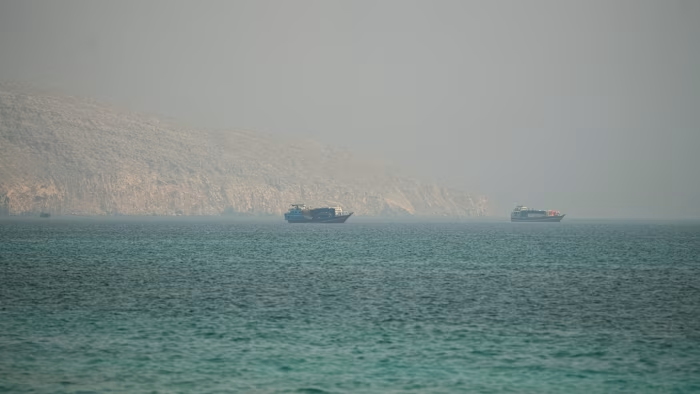
The critical development from an economic perspective came when the IRGC’s naval forces announced on Saturday that the Strait of Hormuz was “closed until further notice and until the end of US interference in the region, and no vessel would be permitted to transit.” This declaration, irrespective of its enforceability, immediately ignited fears among oil traders and refiners. The Strait of Hormuz is a narrow waterway through which approximately 20% of the world’s total petroleum liquids and a significant portion of LNG transit daily. Any sustained closure or even significant impediment would lead to a dramatic surge in global energy prices, impacting everything from airline fuel costs to industrial production expenses.
The Revolutionary Guards justified their decision by claiming several vessels, “encouraged by foreign actors,” attempted to transit via an “unauthorised route” and ignored warnings. They stated that one vessel, which had switched off its onboard systems, was struck by a warning shot and halted. The UK’s Maritime Trade Operations corroborated receiving a report of an incident nine nautical miles east of Oman, adding to the credibility of the maritime threat. Such actions, even if isolated, create an environment of extreme caution, prompting shipping companies to reroute, delay, or demand exorbitant insurance coverage, all of which add substantial costs to global trade.
Iran appeared to retaliate swiftly against the US strikes. The United Arab Emirates’ ministry of defence reported its air defences were “engaging with missile attacks and incoming drones from Iran,” while Bahrain’s interior ministry activated its missile alert siren. These attacks on key US allies in the Gulf introduce a broader regional risk, potentially impacting foreign investment and economic stability in countries that are vital to global energy supply chains and logistics hubs.
Iran’s army confirmed targeting a Patriot missile system, an ammunition depot, and a radar site belonging to the US in Kuwait, as well as a US communications system and a radar site in Bahrain using drones. The IRGC also claimed striking a second “offending” vessel in the Strait of Hormuz and targeting the US Al Udeid Air Base in Qatar with ballistic missiles. These attacks on military installations and perceived sovereign spaces further underscore the escalating tit-for-tat dynamic, which is inherently bearish for investor confidence across the Middle East and beyond.
Further IRGC statements indicated US air strikes against several coastal bases and communications towers along Iran’s southern coastline. In response, Iran claimed to have struck Jordan’s Prince Hassan Air Base, “destroying the base’s command-and-control centre and MQ-9 drone hangars with several ballistic missiles,” adding a stark warning of “even more severe responses” to continued US aggression. Such pronouncements keep geopolitical risk at the forefront, prompting a continuous reassessment of risk premiums in financial markets.
Local officials in southern Iran reported attacks in Bushehr, Asaluyeh, and Dayyer, with state media noting explosions in Bandar Abbas and Sirik. The IRGC further escalated by claiming a “heavy and surprise attack” on Oman’s Port of Duqm, striking and destroying logistical support centres for warships and refuelling platforms serving US aircraft carriers. Centcom has not immediately responded to these specific claims. The targeting of port infrastructure, even if disputed, heightens the perception of a wider conflict, impacting maritime commerce and regional economic activity, particularly in a region already grappling with energy transition challenges and diversification efforts.
The IRGC’s attack on the M/V GFS Galaxy came just a day after top US officials issued a fresh demand for Tehran to declare publicly its commitment to halting attacks in the Strait of Hormuz. Centcom reported a civilian crew member from the Galaxy missing, significant fire damage, and severe damage to the ship’s engine room, emphasizing the human and material cost of these actions.
Washington’s military action this week was a direct response to Tehran’s repeated attacks on commercial ships attempting to transit the strait. Centcom stated, “Iran was provided yet another opportunity to demonstrate adherence to the Memorandum of Understanding after being held accountable for earlier attacks on commercial vessels but has again failed,” referring to an agreement signed almost a month ago to extend a ceasefire. Tehran had initially agreed to reopen the waterway post-MOU, a commitment it has clearly abandoned.
“In response, the United States is imposing a heavy cost by continuing to degrade Iran’s ability to attack civilian mariners and commercial ships freely transiting the strait,” Centcom added, confirming President Donald Trump ordered the strikes. Iran’s chief negotiator, Mohammad Bagher Ghalibaf, posted on X: “The era of one-sided deals is OVER. We told you: keep your word or pay the price. Reality is knocking,” highlighting a clause from the agreement regarding Iran’s responsibility for safe passage.
The US had hit more than 160 targets on Tuesday and Wednesday, before pivoting back towards attempting negotiations. However, Saturday’s actions brought the total to over 300 Iranian targets across three days of strikes. Trump reiterated on Friday that while the US had agreed to continue talks, “in no uncertain terms” for Washington “the Cease Fire is OVER!” This mixed messaging of negotiation alongside military strikes creates a climate of unpredictability, a factor that financial markets inherently dislike.
Senior US officials on Friday indicated talks could advance if Tehran publicly pledged to stop attacks in the strategic waterway, with one official stating, “We are hoping to get to a place where they publicly say that they will stop shooting at ships.” However, recent events suggest a significant step backward from this diplomatic goal. Since the agreement, Iranian forces have attacked several vessels, including tankers belonging to Saudi Arabia and Qatar, leading to retaliatory air strikes from the US, as both sides accuse the other of ceasefire violations. The ongoing tension over shipping lanes—Iran insisting on routes near its shoreline for control, and the US advocating for transit near Oman—underscores the deep-seated strategic and economic dispute over this critical maritime chokepoint.
Market Impact:
The immediate market reaction to the escalating US-Iran conflict and the declared closure of the Strait of Hormuz has been a sharp surge in Brent and WTI crude futures, reflecting a significant risk premium on global oil supplies. Energy stocks, particularly those with upstream exposure, may see short-term gains, while airlines and other energy-intensive industries face increasing cost pressures. Beyond energy, the heightened geopolitical risk will likely drive capital towards safe-haven assets such as gold, the Japanese Yen, and US Treasury bonds, putting pressure on riskier assets and emerging market currencies, especially those in the Middle East. Maritime shipping and insurance stocks will experience volatility due to increased freight rates and war risk premiums. A prolonged disruption in the Strait would not only fuel global inflation but also severely compromise supply chain resilience, potentially leading to a broader deceleration in global economic growth and a shift in investor sentiment towards more defensive postures for the foreseeable future.