
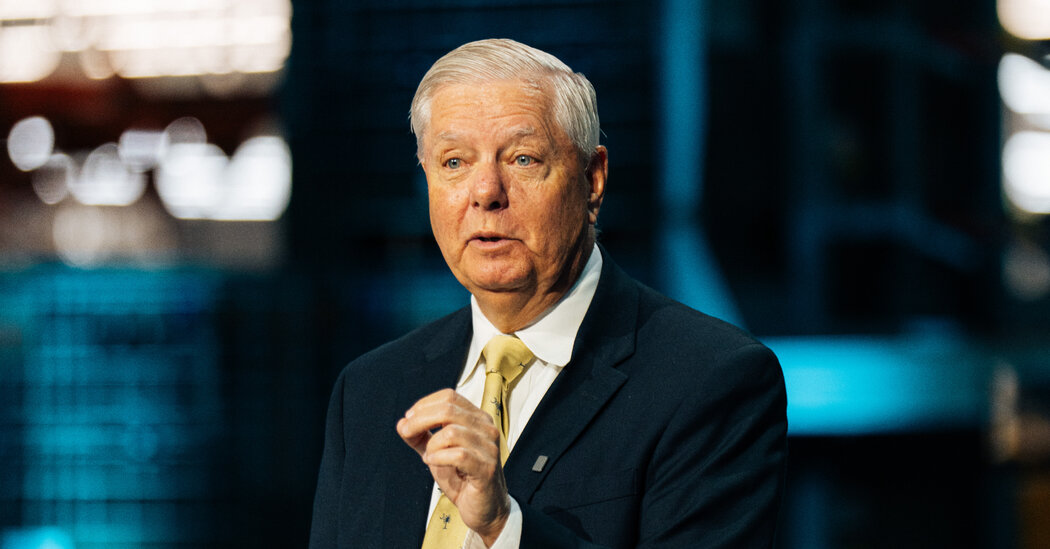
Senator Lindsey Graham, a prominent Republican from South Carolina and a steadfast ally of former President Donald Trump, passed away on Saturday evening at the age of 71. Known for his forceful advocacy of an interventionist U.S. foreign policy, his death marks a significant shift in the landscape of American politics.
His office announced early Sunday that Senator Graham died following “a brief and sudden illness,” without providing further details regarding the cause or location of his death. The senator had recently returned from a diplomatic trip to Ukraine and was scheduled to appear on NBC’s “Meet the Press” on Sunday morning, underscoring his active engagement in policy matters until his final days.
First elected to the U.S. House of Representatives in 1994, Mr. Graham served four terms before successfully campaigning for a Senate seat in 2002. He was a long-serving member of the Senate, having just last month secured the Republican primary nomination for his fifth term, fending off five challengers. He was set to face Democrat Annie Andrews, a pediatrician, in the general election this November.
Tributes poured in from political figures across the spectrum. Former President Donald Trump offered his condolences via social media early Sunday, describing Mr. Graham as “one of the greatest people and Senators I have ever known.” Mr. Trump added, “He was always working, and was a true American Patriot. Lindsey will be greatly missed!!!”
South Carolina Governor Henry McMaster, a Republican, is empowered to immediately appoint a temporary replacement to fill Senator Graham’s vacant seat. This appointment will serve until a special election can be held, which will determine who completes the remainder of Mr. Graham’s term, originally set to conclude in January 2029.
Senator Graham’s death occurs at a sensitive time for Senate Republicans, as another influential senior lawmaker, Senator Mitch McConnell of Kentucky, has been hospitalized for several weeks for undisclosed reasons. This leaves the Republican caucus without two highly experienced and senior members, potentially affecting their legislative strategy and ability to advance priorities, particularly those aligned with Mr. Trump’s agenda.
A consistent advocate for the robust use of American military power overseas, Mr. Graham was a vocal supporter of Israel and Ukraine. His commitment to these causes was evidenced by multiple visits to both nations, often engaging directly with their leaders and military personnel. He recently voiced strong support for aggressive military action against Iran, reflecting his broader foreign policy philosophy. His active role made him a familiar figure among international diplomats and leaders, many of whom publicly acknowledged his passing.
Prime Minister Benjamin Netanyahu of Israel referred to Mr. Graham as a “beloved friend” in a social media post, stating, “Lindsey understood that the security of Israel and America are inseparable. Israel has lost one of its greatest friends.”
In Ukraine, Mr. Graham played a crucial role in navigating the nation’s relationship with the Trump administration following Russia’s full-scale invasion in 2022. He frequently traveled to Kyiv, the capital, despite ongoing Russian bombardments, demonstrating his solidarity and commitment. His final overseas visit included a trip to a drone factory and a meeting with President Volodymyr Zelensky. President Zelensky, expressing his deep sadness, wrote on social media, “Lindsey was a true defender of freedom and the values that make our world safer.”
Senator Graham’s political journey included a notable evolution in his relationship with Donald Trump. During his own long-shot bid for the 2016 Republican presidential nomination, Mr. Graham was a sharp critic of Mr. Trump, famously lambasting him as a “demagogue,” a “race-baiting, xenophobic, religious bigot.” In a 2015 CNN interview, he provocatively suggested, “Tell Donald Trump to go to hell” as a way to “make America great again.” He disclosed that he voted for independent candidate Evan McMullin in the 2016 election, not Mr. Trump or Hillary Clinton.
However, over time, Mr. Graham transformed into one of Mr. Trump’s most ardent and effusive allies. By the time of his South Carolina primary victory speech last month, he humorously remarked, “Mr. President, you’re not far behind God,” illustrating the profound shift in their dynamic. The two men developed a close association, often bonding over golf outings, and while Mr. Graham occasionally voiced minor disagreements, they largely remained aligned on most policy matters. During his recent campaign, he positioned himself as the most effective choice to go to Washington to assist Mr. Trump.
Throughout his Senate career, Mr. Graham rose to chair two influential committees: the Judiciary Committee (from 2019 to 2021) and the Budget Committee (a position he was set to assume in January 2025). As chairman of the Judiciary Committee, he played a central role in shaping the federal judiciary under the Trump administration. He oversaw the confirmation of Justice Amy Coney Barrett to the Supreme Court in 2020 following the death of Justice Ruth Bader Ginsburg. Prior to his chairmanship, he was instrumental in the Republican-led effort to block President Barack Obama’s nomination of Merrick Garland to the Supreme Court in 2016. He also vehemently defended Brett Kavanaugh, one of Mr. Trump’s Supreme Court nominees, when sexual assault allegations threatened to derail Judge Kavanaugh’s confirmation, a pivotal moment in the committee’s history.
More broadly, Mr. Graham was a key figure in advancing Mr. Trump’s strategic efforts to reshape the federal judiciary with conservative appointments. During his tenure leading the committee, the Senate, under then-Majority Leader Mitch McConnell, confirmed over 200 federal judges, a defining achievement of the Trump era with long-lasting implications for American jurisprudence.
As chairman of the Budget Committee, Mr. Graham was instrumental in translating Mr. Trump’s domestic agenda into legislation. He guided the budget resolution that utilized the procedure known as reconciliation, which allowed Republicans to advance significant portions of the president’s sweeping tax, immigration, and spending packages without requiring Democratic support in the Senate. This complex effort demanded months of negotiations among various factions within his own party before the comprehensive tax package became law. This legislative success became a defining accomplishment of Mr. Trump’s return to Washington with a Republican-controlled Congress, further cementing Mr. Graham’s growing influence and his transformation from a vocal critic to a steadfast and outspoken ally.
Born Lindsey Olin Graham in Central, South Carolina, on July 9, 1955, he was the elder of two children to Florence James Graham (known as F.J.) and Millie (Walters) Graham. His parents owned and operated a bar, then called the Sanitary Cafe, where Lindsey and his sister, Darline, worked during their youth. The family initially resided in rooms behind the bar, later moving to a trailer, and eventually a house nearby. In his 2015 memoir, “My Story,” Mr. Graham reflected on his upbringing, stating, “My home was a bar,” and adding that he “was loved inside those walls.”
Why This Matters
The death of Senator Lindsey Graham carries significant implications for both domestic U.S. politics and international relations. As a long-serving and influential Republican, his absence creates an immediate void in the U.S. Senate, particularly within the party’s leadership and its foreign policy establishment.
Domestically, the immediate impact is the vacancy of a Senate seat. Governor McMaster’s appointment of a temporary replacement will influence the balance of power in the Senate, especially as another senior Republican, Senator Mitch McConnell, is currently incapacitated. This situation could affect the progress of legislative initiatives, nominations, and the overall dynamic within the Republican caucus as they navigate pressure from former President Trump’s political agenda. The subsequent special election to fill the remainder of Graham’s term will be a closely watched contest, potentially offering an early indicator of the national political mood ahead of the broader general election.
On the international stage, Senator Graham’s death removes a highly vocal and consistent advocate for an interventionist American foreign policy. His staunch support for Israel, strong backing of Ukraine against Russian aggression, and calls for aggressive action against Iran were defining features of his career. He was a familiar face to world leaders, and his direct engagement in diplomatic efforts, such as his frequent visits to Kyiv, underscored his commitment. His absence will be felt in debates on U.S. military aid, strategic alliances, and the overall direction of American engagement in global conflicts. Within the Republican Party, he was a key voice pushing for robust international engagement, and his successor may or may not share this specific foreign policy outlook.
Furthermore, Graham’s political evolution—from a sharp critic of Donald Trump to one of his most loyal allies—symbolized a broader realignment within the Republican Party. His ability to bridge the gap between traditional Republican foreign policy hawks and the more populist, “America First” wing of the party, particularly through his personal relationship with Trump, was unique. His death leaves a gap in this crucial internal party dynamic, potentially affecting future legislative strategies and the party’s cohesion as it faces upcoming elections. His legacy, particularly in shaping the federal judiciary through his role on the Judiciary Committee, will also have long-term effects on American law and society.
Senator Lindsey Graham: A Profile of a Veteran Legislator Navigating Shifting Political Tides
Lindsey Graham, a long-serving Republican Senator from South Carolina, has forged a distinctive and often evolving path in American politics. Known for his background as a military lawyer and his prominent role in national security debates, Graham’s career spans over three decades in Washington, marked by periods of bipartisan collaboration and, more recently, a close alliance with former President Donald Trump. His journey reflects broader shifts within the Republican Party and the complexities of modern political influence.
Born in Central, South Carolina, on July 9, 1955, Graham grew up in humble circumstances, residing with his parents, Florence and F.J. Graham, in the back of the family’s pool hall, bar, and restaurant. He often described his upbringing as characterized by immense love and strong family bonds. Despite these modest beginnings, he was determined to pursue higher education, becoming the first in his family to attend college.
A profound personal tragedy shaped Graham’s early adulthood. In 1976, at the age of 20, his mother passed away from Hodgkin lymphoma. Just 15 months later, his father succumbed to a heart attack. These losses left Graham, then a college student, responsible for his younger sister, Darline, who was 11 at the time. He became her legal guardian and later formally adopted her to ensure she could receive his military benefits. Darline Graham Nordone has consistently affirmed her brother’s pivotal role, telling The New York Times in 2015, “Lindsey was always my parent. There was no doubt in my mind or anyone else’s mind that Lindsey was my guardian.” She remains his only immediate survivor.
Graham’s academic pursuits continued despite his new family responsibilities. He earned a bachelor’s degree in psychology in 1977 and a Juris Doctor degree in 1981, both from the University of South Carolina. Following law school, he embarked on a career in the U.S. Air Force, serving as a lawyer in the Judge Advocate General’s (JAG) Corps from 1982 to 1988. His military service would continue in the Air Force Reserve and Air National Guard, from which he retired as a colonel in 2015, having served for 33 years. Throughout his time in Congress, he was briefly deployed to both Iraq and Afghanistan as a senator, underscoring his commitment to military affairs.
His political career began at the state level, serving one term in the South Carolina House of Representatives. In 1994, he successfully ran for a seat in the U.S. House of Representatives, replacing a retiring Democratic congressman. He served four terms in the House, during which he gained national prominence as one of the Republican representatives who presented the impeachment case against President Bill Clinton during his trial in the Senate in 1999.
In 2002, Graham sought and won the Senate seat vacated by Strom Thurmond, who had served as a senator from South Carolina for nearly half a century. Graham defeated his Democratic opponent by a 10-point margin in the general election. Early in his Senate career, Graham cultivated a reputation for an independent streak, often engaging in bipartisan efforts to address significant national issues. He was a member of the “Gang of 14,” a bipartisan group of senators who reached a compromise on judicial nominations during President George W. Bush’s second term, averting a showdown over filibusters. He also voted to confirm both of President Barack Obama’s Supreme Court nominees, Sonia Sotomayor and Elena Kagan, reflecting a willingness to support judicial appointments from across the aisle.
Graham also participated in prominent legislative initiatives that sought bipartisan solutions to major challenges. In 2010, he collaborated with Senators John Kerry (Democrat of Massachusetts) and Joseph I. Lieberman (Independent Democrat of Connecticut) to develop a framework for climate change legislation, though it ultimately did not pass. His close association with Senator John McCain (Republican of Arizona) and Senator Lieberman earned them the moniker “three amigos” due to their frequent shared international trips and their consistent advocacy for American military intervention abroad, particularly during the Iraq War. In 2013, Graham was part of the “Gang of Eight,” another bipartisan group that attempted, unsuccessfully, to craft a comprehensive overhaul of the immigration system. More recently, in 2022, he was among 10 Republican senators who supported a bipartisan agreement on gun control.
These instances of bipartisanship and compromise often drew the ire of conservative elements within his home state. In 2009, local Republican officials in South Carolina formally censured him, citing his positions on issues such as a “cap and trade” energy bill, bank bailouts, and “amnesty for illegal aliens,” which they claimed did not represent the wishes of the people of South Carolina.
Despite these challenges from his right flank, Graham proved to be a skilled politician and an adept fundraiser. While a primary challenge from the right was widely anticipated during his 2014 re-election bid, no serious contender emerged. He was again perceived as vulnerable heading into the 2020 general election but ultimately defeated his Democratic opponent, Jaime Harrison, by more than 10 points, demonstrating his enduring electoral strength in South Carolina.
A notable evolution in Graham’s political posture occurred after his initial vociferous criticism of Donald Trump during the 2016 presidential campaign. In the subsequent years, Graham softened his tone and became an increasingly influential voice within the Trump White House, particularly on matters of foreign policy. By April 2018, he publicly declared his support for Trump’s re-election in 2020. Explaining this shift to Mark Leibovich of The New York Times Magazine in 2019, Graham stated his motivation was “to try to be relevant,” adding, “I’ve got an opportunity up here working with the president to get some really good outcomes for the country.” This alignment cemented his role as a key Senate ally for the former president, especially in the realm of international affairs.
Senator John Thune, Republican of South Dakota and the current Senate Minority Whip, reflected on Graham’s public service, stating on social media, “He was a strong advocate for the United States and a strong ally to freedom-loving countries across the globe. He believed in the might of America to achieve good in the world.”
***
Why This Matters
Senator Lindsey Graham’s extensive career in the U.S. Congress offers a compelling lens through which to understand the dynamics of contemporary American politics, particularly within the Republican Party. His trajectory from a self-described independent-minded senator, known for bipartisan efforts on issues like climate change, immigration, and judicial nominations, to a staunch ally of former President Donald Trump, highlights the profound ideological shifts and pressures that have reshaped the Republican landscape.
Graham’s ability to maintain his Senate seat in a reliably Republican state, even after facing censure from local party officials for his moderate stances and surviving perceived vulnerabilities, underscores his political acumen and connection with his South Carolina constituency. His resilience demonstrates that, even amidst intense internal party divisions, veteran politicians can adapt their strategies to retain influence and electoral viability.
Furthermore, his outspoken advocacy for military intervention and his deep involvement in foreign policy debates, stemming from his background as a military lawyer and his continued service in the Air Force Reserve, position him as a significant voice on global security issues. His relationships with figures like John McCain, and later Donald Trump, illustrate how personal alliances and strategic alignment can shape foreign policy discourse and executive decisions. Graham’s stated desire for “relevance” encapsulates a pragmatic approach to power in Washington, suggesting that for many legislators, adapting to the prevailing political winds is a necessary strategy for achieving policy goals and maintaining a seat at the decision-making table. His career, therefore, is not merely a personal biography but a microcosm of the challenges and transformations facing American political leadership in a polarized era.