
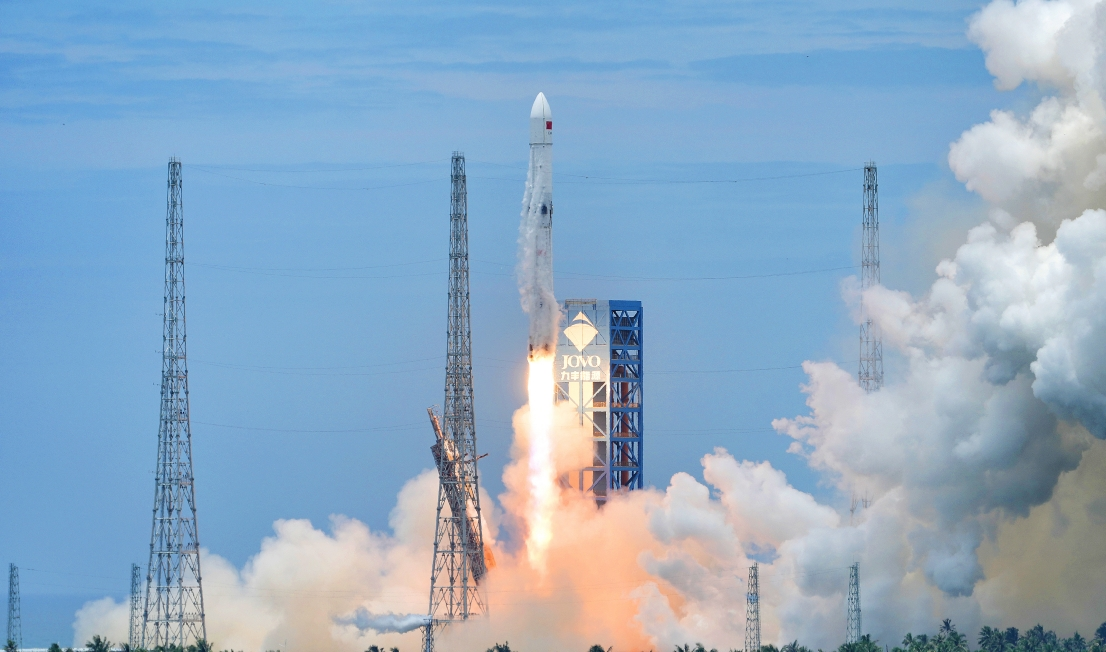
China’s state-owned space company successfully launched a Long March orbital rocket and landed the booster on a seagoing recovery vessel, making it the second country to achieve the feat.
Key Takeaways:
- China Joins Elite Reusable Rocket Club:China’s successful Long March booster recovery at sea marks a significant technological leap, positioning it alongside SpaceX as a leader in reusable rocketry and drastically lowering future launch costs.
- Shifting Global Space Dynamics:While direct competition with Western launch providers is limited by national security rules, China’s new capability will intensify competition in global satellite communications markets and potentially diminish the U.S. military’s space advantage.
- Intensifying Space Race:This achievement fuels an already heated global space race, prompting accelerated development from SpaceX’s Starship to Blue Origin, Rocket Lab, and Stoke Space, as nations and private entities vie for dominance in orbital access and space infrastructure.
China’s Reusable Rocket Breakthrough: A New Era in Space Competition Ignites
A new chapter in the global space race has officially begun. China’s state-owned Aerospace Science and Technology Corporation (CASC) recently achieved a monumental feat, successfully launching a Long March orbital rocket and, critically, landing its booster on a seagoing recovery vessel. This pioneering demonstration positions China as only the second nation in the world to master this complex maneuver, a technological leap that promises to fundamentally reshape the economics and geopolitics of space.
The Breakthrough: China’s “Net Gain” in Reusability
The demonstration on Friday was more than just a successful launch; it was a powerful statement of intent. CASC has now shown it is poised to match an advance that has single-handedly catapulted SpaceX to the pinnacle of the space industry: the ability to reuse rocket boosters repeatedly. This capability is paramount for driving down the astronomical costs associated with launching spacecraft, making space access more affordable and frequent. CASC has ambitious plans, stating its intention to attempt to reuse the recovered booster – which boasts a payload capacity comparable to SpaceX’s venerable Falcon 9 – before the close of the year.
China’s approach to booster recovery, however, offers a distinctive engineering solution. Unlike the Falcon 9, which elegantly unfurls landing legs to settle precisely onto a floating drone ship, the Long March booster utilizes a sophisticated netting system. This involves a large, robust frame strung with netting onboard a recovery ship, designed to capture the descending rocket. Achieving such a controlled flight back to a moving target at sea demands an extraordinary level of technological prowess. It relies heavily on advanced guidance software and precision sensors, robust and reliable engines capable of multiple restarts, and structural integrity rugged enough to endure the immense stresses of atmospheric re-entry and controlled descent.
The Reusability Revolution: SpaceX’s Blueprint and the New Benchmark
For years, SpaceX has been the undisputed pioneer and leader in reusable rocketry. Its fleet of Falcon 9 rocket boosters consistently breaks launch records annually, a testament to the efficiency and cost-effectiveness of reusability. This innovative approach forms the very backbone of the company’s ambitious Starlink satellite network, which demands cheap, regular, and high-cadence access to orbit for its ever-expanding constellation. Beyond Starlink, the Falcon 9 underpins SpaceX’s critical work for NASA, facilitating crew and cargo missions to the International Space Station, and serving the U.S. Space Force with vital national security launches.
The economic advantages of reusability are profound. By amortizing the cost of an expensive first-stage booster across multiple missions, launch providers can drastically reduce the price per launch. This cost reduction doesn’t just benefit the provider; it opens up space to more players, fosters innovation, and accelerates the development of orbital infrastructure. China’s embrace of this technology signals its clear intent to leverage these benefits, not only for its own burgeoning space ambitions but potentially for broader geopolitical influence.
Geopolitical Orbit: Shifting Power Dynamics and Market Implications
The implications of China’s reusable rocket breakthrough extend far beyond engineering marvel. Victoria Samson, the chief director for Space Security and Stability at the Secure World Foundation, unequivocally labeled the demonstration a “huge game changer.” Samson elaborated, “When China figures out how to reuse them, that is going to drop the launch of cost for them tremendously and then they could use it as part of their soft power outreach to launch things for potential allies very cheaply.” This assessment underscores the strategic value of affordable space access as a tool for international diplomacy and influence.
While China’s CASC wouldn’t directly compete with companies like SpaceX for launch customers from the U.S. and Europe – largely due to national security regulations that effectively segment the global market – the impact will still be substantial. A reusable Long March booster would empower China to develop and deploy its own satellite communications networks and even hypothetical orbital data centers at a significantly lower cost. This would place them in direct competition with SpaceX’s Starlink and other Western offerings in critical global markets, particularly across Africa, the Middle East, and Southeast Asia, where affordable satellite internet access is in high demand.
From a military perspective, this development represents a potential diminution of the U.S. advantage in space. The ability to launch satellites more frequently and affordably enhances a nation’s capacity for surveillance, communication, and navigation capabilities, all vital for modern defense strategies. This concern is amplified by recent reports from a consortium of investigative journalists, which surfaced documents detailing active cooperation between China and Russia on methods to potentially damage or counter Starlink – a system that has proven remarkably effective in supporting Ukraine – highlighting the increasingly militarized and contested nature of space.
The Global Race for Space Dominance: A Field of Contenders
Against this backdrop of heightened competition, the race for next-generation space technology continues unabated. SpaceX itself is not resting on its Falcon 9 laurels, pushing forward with its much larger and fully reusable Starship rocket. While the last attempt to launch Starship yielded mixed results, Elon Musk’s newly public conglomerate is widely anticipated to make another attempt this month, fueled by the success of a recent static fire test of the gargantuan booster, which reportedly went off without a hitch. Starship represents an even more ambitious leap in reusability, designed to transport vast payloads and potentially hundreds of humans to lunar and Martian destinations.
The U.S. space sector is also vibrant with other private companies striving to develop their own reusable rocket systems. Jeff Bezos’ Blue Origin, for instance, successfully recovered a booster in 2025 and demonstrated its reuse earlier this year, though its progress has been punctuated by setbacks, including a rocket explosion on the launch pad in May that has temporarily delayed further attempts. Rocket Lab is actively developing its Neutron rocket, which is designed to incorporate a reusable booster for medium-lift missions. Meanwhile, Stoke Space is a newer entrant with ambitious plans for a fully reusable rocket, aiming to conduct initial tests this year. These diverse efforts underscore the widespread recognition that reusability is the future of economical and sustainable space access.
The Bottom Line:China’s successful reusable rocket landing isn’t just a technical marvel; it’s a strategic inflection point. It signifies a profound shift in the global space landscape, promising lower launch costs that will fuel both commercial expansion and geopolitical influence. As nations and private enterprises accelerate their development of advanced reusable systems, the competition for orbital supremacy and the control of crucial space-based infrastructure will only intensify, making the next decade a defining era for humanity’s presence beyond Earth.
When you purchase through links in our articles, we may earn a small commission. This doesn’t affect our editorial independence.
{content}
Source:{feed_title}