
Unlock the White House Watch newsletter for free
Your guide to what Trump’s second term means for Washington, business and the world
**Key Takeaways:**
1. **Erosion of Rule of Law Concerns:** The confirmation hearing for acting Attorney General Todd Blanche highlighted deep-seated concerns over the Department of Justice’s independence, with implications for the predictability of the regulatory environment and the stability of the rule of law – critical pillars for investor confidence and market stability.
2. **Increased Political Risk Premium:** Debates surrounding the “anti-weaponisation” fund, politically motivated prosecutions, and pardons for January 6 rioters introduce a heightened political risk premium into the U.S. economic landscape, potentially impacting foreign direct investment, corporate legal costs, and the overall cost of capital.
3. **Market Uncertainty Ahead:** With a razor-thin Senate majority and a deeply divided political landscape, the protracted and contentious confirmation process for a key cabinet position like the Attorney General signals ongoing governmental gridlock and policy unpredictability, which typically leads to market caution and sector-specific volatility.
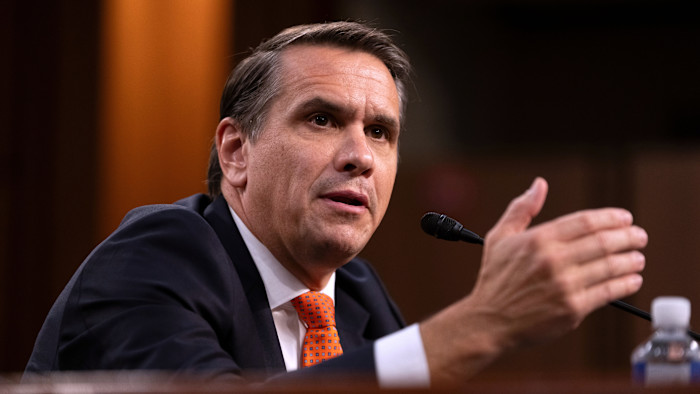
US senators from both parties recently subjected Todd Blanche to intense scrutiny regarding his independence from former President Donald Trump, as they deliberated his permanent elevation to the nation’s chief law enforcement officer. From a financial markets perspective, this confirmation process is far more than mere political theatre; it strikes at the heart of institutional integrity, regulatory predictability, and the robust application of the rule of law – all foundational elements for a stable and attractive investment climate.
The acting Attorney General, notably the president’s former criminal defence attorney, mounted a defence of his stewardship over the Department of Justice (DoJ). The sharp questioning, which spanned from the controversial $1.8bn “anti-weaponisation” fund he greenlit to the department’s handling of the sensitive Jeffrey Epstein files, resonated with investors and compliance officers alike, who watch closely for any signs of politicisation within agencies responsible for enforcing corporate governance, antitrust, and white-collar crime statutes.
The extent of Blanche’s perceived loyalty to Trump, particularly within an institution that has historically prided itself on maintaining an arm’s length from the White House, has become a significant flashpoint in his confirmation process. This is exacerbated by the Republicans’ razor-thin majority on the Senate judiciary committee, meaning the margin for error in securing votes is minimal, leading to a protracted and uncertain outcome that markets generally dislike. Unpredictability in key government appointments can translate into regulatory uncertainty, making long-term business planning more challenging.
Blanche attempted to delineate certain boundaries, notably vowing to resign if instructed to act illegally. However, his repeated assertion that he “served at the pleasure of the president,” and a telling slip where he referred to the president as “I’m his lawyer — was his lawyer,” raised immediate red flags for those monitoring the independence of the DoJ. Senator Adam Schiff, a top Democrat on the committee, swiftly characterised the remark as a “Freudian slip,” a moment that further fuels concerns about political influence potentially overriding judicial impartiality. For corporate boards and compliance departments, the perception of a politically beholden DoJ raises the specter of uneven enforcement, politically motivated investigations, and a less predictable legal landscape, directly impacting operational risk and legal expenditure forecasts.
Ahead of the hearing, the president’s social media endorsements, hailing Blanche as someone who “stood by my side and fought off the Lawfare” and is doing a “PHENOMENAL” job, only amplified these concerns. Such public affirmations, while intended to bolster Blanche, inadvertently reinforce the narrative that the DoJ under his leadership might be perceived as an extension of the executive’s political agenda rather than an independent arbiter of justice.
Blanche ascended to the top role after his predecessor, Pam Bondi, was ousted in April amid frustration over what the president perceived as the slow pace of prosecuting his opponents. This rapid turnover and the stated reasons for it are critical indicators for financial analysts. A DoJ head removed for insufficient political aggression signals a potential shift from merit-based legal proceedings to a system influenced by political expediency. This could deter foreign direct investment and make domestic businesses wary of regulatory challenges, fearing they could be weaponized.
Despite these apprehensions, Blanche told the committee he sought to earn their trust, emphasising his background as a career prosecutor and insisting the DoJ is “keeping America safe.” While his professional background may offer some reassurance, the recent history of the department under his interim leadership complicates this narrative for investors seeking clear, unbiased governance.
The “anti-weaponisation” fund, approved by Blanche to compensate Trump’s political allies as part of a settlement agreement in the president’s $10bn lawsuit against the Internal Revenue Service, emerged as a particularly contentious sticking point. This specific item directly impacts the perception of how public funds and legal settlements might be managed. Republican John Cornyn, an outgoing senator who lost his primary to a Trump-backed opponent, grilled Blanche on whether the fund could be resurrected. Blanche’s assurance that the fund is “dead” and “not moving forward” offered some relief, but Cornyn’s subsequent public statement to CNN that he still had “some concerns” and was not “going to make any decisions at this point” underscores the lingering apprehension. The very existence and approval, even temporary, of such a fund, signals a potential for politicized allocation of government resources, an unpredictable variable for businesses and taxpayers alike.
The unexpected death of Senator Lindsey Graham, a staunch Trump loyalist and key member of the judiciary committee, has further complicated the political calculus, leaving Republicans with only one vote to lose. This political tightrope intensifies the confirmation battle, ensuring market observers will remain fixed on the outcome, understanding that even minor shifts in political power can have outsized impacts on policy.
Democrats, for their part, forcefully highlighted the DoJ’s prosecutions of Trump’s perceived enemies and admonished Blanche’s role in overseeing the release of millions of documents linked to Jeffrey Epstein. Senator Cory Booker eloquently captured the sentiment, stating: “You’re asking this body for a promotion, and you’ve spent today making a lot of promises… But we don’t need your promises. We have your record.” This focus on Blanche’s track record, rather than future assurances, is precisely what financial analysts apply to corporate executives – past performance is a strong indicator of future behaviour, particularly when institutional independence is at stake. A DoJ perceived as selectively prosecuting or protecting certain individuals erodes fundamental trust in the fairness of the legal system, which is paramount for commercial contracts, property rights, and overall economic stability.
Blanche was also pressed on Trump’s pardons of January 6 rioters. While he stated that rioters who injured law enforcement “should have been prosecuted” and “were,” his position on the pardons was more nuanced: “I don’t question President Trump’s authority or his decision to do so.” This stance is a critical point of contention for Senator Thom Tillis, a Republican from North Carolina, who has signalled that Blanche’s position on the Capitol attack is essential to clinching his vote. “Back to the pardons — I get pretty emotional about that,” Tillis remarked. “We need to do a better job of looking through the pardons process.” For markets, the pardoning power, when applied to individuals involved in attacks on democratic institutions, can signal a weakening of accountability and the rule of law, potentially increasing political instability perceived as a risk to asset values.
Although Blanche acknowledged Trump’s authority as president, he importantly stated he did not believe Trump was eligible to run for another term and reiterated his promise to step down if directed to act illegally. “That will never happen,” he asserted. “But yes — if it were to happen, I’m not going to violate my oath to the constitution.” These are crucial statements attempting to project an image of independence, yet the preceding actions and affiliations continue to cast a long shadow.
Since Blanche took over as acting Attorney General, the justice department has pursued prosecutions of Trump’s perceived political adversaries and emboldened his allies. This includes securing a new indictment against James Comey, the former FBI director who investigated Russian ties; charging the liberal-leaning Southern Poverty Law Center with fraud and money laundering; and moving to erase seditious conspiracy convictions of rightwing extremists. These actions, viewed through a financial lens, suggest a DoJ that may be tilting its enforcement priorities based on political alignment rather than purely legal merit. This introduces an unpredictable and potentially hostile regulatory environment for certain organisations, increasing their legal and operational risks.
The profound concern for institutional integrity was underscored by a letter signed by more than 1,200 former justice department employees, urging the committee to reject Blanche’s nomination, stating he had “utterly failed to abide by” his constitutional oath. Following the hearing, Democrats signalled uniform opposition to Blanche’s confirmation, setting the stage for a highly contentious vote.
Blanche, in his defence, urged the committee not to judge him solely by his recent work experience. “The fact that I represented President Trump for a period of time, under two years, does not define my career, nor does it define me,” he argued. “I should be defined by the work that I did as a prosecutor and by the work that I’ve done leading this department.” While an understandable plea, the financial community often operates on perceptions and demonstrated track records, especially when the integrity of critical public institutions is at stake.
**Market Impact:**
The protracted and highly politicized confirmation hearing for Todd Blanche for the role of Attorney General injects significant uncertainty into U.S. financial markets, particularly regarding regulatory predictability and the robust enforcement of the rule of law. A DoJ perceived as politically compromised or weaponized could lead to an increase in the political risk premium for U.S. assets, potentially deterring foreign direct investment and increasing the cost of capital for businesses. Sectors heavily reliant on regulatory stability, such as finance, technology, and energy, could experience increased volatility as investors weigh the risks of politically motivated investigations or uneven enforcement. Furthermore, any perceived erosion of institutional independence could undermine investor confidence in the fairness of the U.S. legal system, impacting everything from contract enforcement to intellectual property protection. The ongoing political gridlock and the deep partisan divisions underscored by this hearing suggest a period of sustained governmental uncertainty, which typically prompts market caution and a flight to quality assets, as investors seek stability amidst the political maelstrom. The ultimate confirmation or rejection of Blanche will send a strong signal about the future trajectory of the nation’s justice system and its implications for the broader economic landscape.