
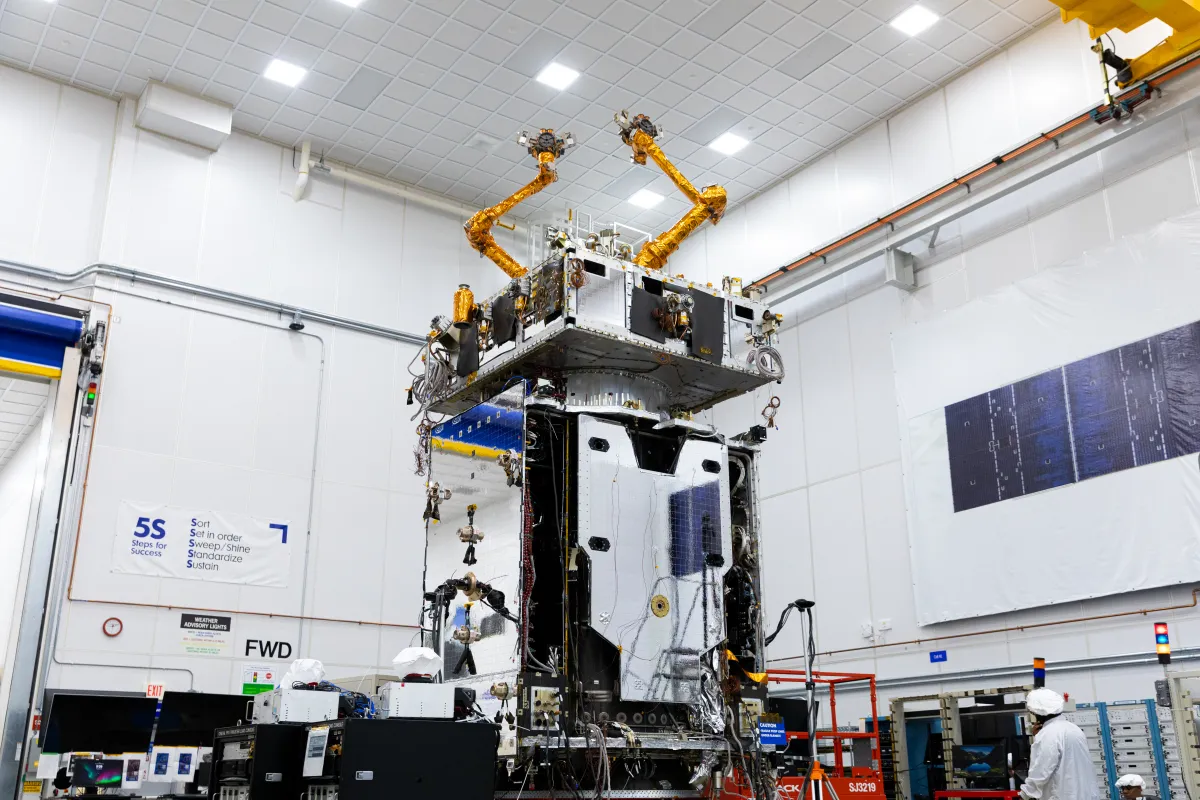
High above the Earth, a new generation of robots designed to keep satellites working longer is replacing its predecessor — quite literally.
Key Takeaways
- **A New Era of Space Sustainability:** Northrop Grumman’s next-gen Mission Robotic Vehicle (MRV) and Mission Extension Pods (MEPs) are ushering in a future where satellites can be repaired, refueled, and upgraded directly in orbit, fundamentally changing how we view space asset lifespans.
- **Economic & Operational Resilience:** By extending the operational life of expensive satellites that often fail due to fuel depletion rather than component failure, this technology promises significant cost savings for operators and a more resilient space infrastructure.
- **Technological Prowess Meets Geopolitical Nuance:** While overcoming immense engineering challenges like autonomous rendezvous and robotic precision in space, the dual-use nature of such advanced capabilities also brings strategic and defense considerations to the forefront.
Unplugging the Past, Plugging into the Future: How Robotic Spacecraft Are Revolutionizing Satellite Lifespans
The vast expanse above our heads is getting a high-tech overhaul. In a quiet but momentous maneuver this week, a Northrop Grumman Mission Extension Vehicle (MEV) gracefully detached itself from an Optus communications satellite, marking the end of one mission and the dawn of a new era in space maintenance. For over a year, this pioneering MEV acted as a celestial anchor, meticulously positioning the Australian satellite, extending its operational life far beyond its original design. The Optus satellite, launched in 2009, was initially designed for a 15-year lifespan. Thanks to the MEV, it has already exceeded that, generating revenue for longer than anticipated.
Now, as the MEV prepares for its next assignment, the stage is set for an even more advanced generation of orbital mechanics. This past July, a SpaceX Falcon 9 rocket launched four new Northrop Grumman spacecraft: the Mission Robotic Vehicle (MRV), a formidable machine equipped with advanced robotic arms developed by DARPA, and three Mission Extension Pods (MEPs), which are essentially modular propulsion systems. These four pioneers are currently en route to their geosynchronous targets, approximately 27,000 miles above Earth, promising to redefine the longevity and utility of our orbital assets. This paradigm shift, driven by increasingly cheaper launch costs and lower-cost space components, is transforming the once-unthinkable concept of spacecraft repair missions into a tangible reality.
The Evolution of In-Orbit Servicing
The concept of in-orbit servicing isn’t entirely new, but it’s rapidly maturing. The MEV program, with its two operational spacecraft launched in 2019 and 2020, has already demonstrated remarkable success. Collectively, these vehicles have added an impressive ten years of life extension to three different customers, including two Intelsat spacecraft and the Optus satellite now being prepared for its next upgrade. MEV-1 currently awaits a new client in a parking orbit, while MEV-2 remains steadfastly attached to its Intelsat customer, committed until 2030. These initial missions proved the viability of docking with and repositioning aging satellites, offering a crucial lifeline to assets that, while electronically sound, were simply running on fumes.
However, the MRV and MEPs represent a significant leap forward, signaling an evolution in both capability and business model. Unlike the MEVs, which act as temporary propulsion systems that physically attach for the duration of the extension, the MRV will permanently install MEPs onto client satellites. Operators will purchase and own these smaller, simpler MEPs, which essentially function as bolt-on propulsion modules. This approach frees up the highly advanced MRV, with its complex robotic arms, to service a greater number of vehicles more efficiently, offering a more flexible and, ultimately, more cost-effective solution for satellite life extension. In 2027, the MRV will use its precision arms to attach one of these MEPs to the very same Optus satellite it just departed, potentially adding another six years to its operational life, extending a satellite launched in 2009 well into the 2030s.
Why This Matters: A Paradigm Shift
The economic implications of this technology are profound. Satellites, particularly those in geosynchronous orbit providing critical communications or high-resolution imagery, represent multi-million, often multi-billion, dollar investments. Their typical failure mode isn’t a catastrophic system breakdown, but rather a gradual depletion of the propellant needed for station-keeping — maintaining their precise orbital position. Imagine a car running perfectly but stuck on a flat tire; that’s often the fate of an “end-of-life” satellite. This means that a significant portion of valuable space hardware is discarded not because it’s broken, but because it simply can’t stay in place.
By injecting new life into these otherwise functional assets, in-orbit servicing offers satellite operators a powerful alternative to the costly and time-consuming process of designing, launching, and commissioning entirely new spacecraft. Extending the revenue-generating lifespan of an existing satellite for several years can translate into hundreds of millions of dollars in sustained income and deferred capital expenditure. According to Cassie Wong, Northrop Grumman’s director of logistics and servicing, the overarching goal is nothing less than “a paradigm shift where we can see space as sustainable, with a more resilient architecture and infrastructure base where we can do things like spacecraft repairs, life extension, or even upgrades and maintenance of satellites.” This vision moves beyond mere life extension to a future where space assets are modular, adaptable, and repairable, much like terrestrial infrastructure. It also holds the promise of reducing the growing problem of space debris by keeping valuable assets working longer, rather than having them become defunct orbital junk.
Engineering Marvels & Future Frontiers
Bringing this vision to reality demands an extraordinary level of technological prowess. The sheer complexity of rendezvous and docking in orbit cannot be overstated. Picture two objects, both hurtling through space at velocities of thousands of miles per hour, needing to precisely approach and connect with delicate accuracy. The MEVs employed a robust docking probe that plugged into existing satellite thruster nozzles. The MRV, however, elevates this challenge, requiring its sophisticated robotic arms to carefully manipulate and attach MEPs to a target satellite, a feat demanding autonomous navigation, advanced sensing, and ultra-precise motion control in a zero-gravity, high-velocity environment. It’s a ballet of physics and engineering, performed 27,000 miles away with no human intervention.
Beyond the immediate goal of life extension, the MRV itself is designed with future capabilities in mind. Uniquely among most satellites, it is built to be refueled in orbit. This isn’t just a practical feature for the MRV; it serves as a critical proof of concept for the kind of adaptable infrastructure that will be necessary if in-orbit servicing becomes truly ubiquitous. Currently, the added cost and weight of designing satellites to be refuelable or serviceable deter most operators. However, as the ecosystem matures, these adaptations could become standard. Wong envisions a future where the MRV tackles even more ambitious missions, such as adding new components to satellites, upgrading their capabilities with modular payloads, or even adjusting their orbits to meet evolving mission requirements. This could unlock entirely new possibilities for satellite functionality and responsiveness.
The Broader Context: Markets, Geopolitics, and Beyond
The market for in-orbit servicing is evolving, reflecting diverse strategies within the space industry. While the current trend in Low Earth Orbit (LEO) often leans towards large constellations of cheaper, effectively replaceable spacecraft (think Starlink or Amazon Kuiper), the expensive, bespoke satellites residing in higher Geosynchronous Earth Orbit (GEO) are prime candidates for life extension. These are the assets that cost hundreds of millions or even billions to build and launch, making their continued operation economically paramount. The long lead times for new satellite construction further amplify the value of extending the life of existing GEO platforms.
This technology also exists within a complex geopolitical landscape. DARPA’s involvement in developing the MRV’s robotic arms highlights the strategic importance of these capabilities, especially given the number of expensive, high-orbit assets owned by defense organizations. Indeed, the U.S. Space Force has previously voiced concerns, characterizing Chinese servicing spacecraft with robotic arms as potential weapons, capable of grappling and potentially degrading rival satellites. Northrop Grumman firmly states that its vehicles are dedicated to peaceful servicing missions. Nevertheless, the dual-use nature of advanced robotics in space means these capabilities will always be viewed through a strategic lens, requiring careful diplomatic and operational protocols.
The potential for in-orbit servicing isn’t limited to GEO. Wong also sees applications in LEO for valuable assets there. For example, the startup Katalyst Space is currently attempting a similar mission to extend the life of a NASA space telescope after it experienced malfunctions last month. The company has a fix in place and hopes to complete the mission, demonstrating the versatility and growing necessity of orbital maintenance and repair across all orbital regimes, from critical scientific instruments to commercial constellations.
Bottom Line
The unplugging of the MEV from Optus is more than just a routine space operation; it’s a symbolic handover, signaling humanity’s growing mastery over the orbital environment. With the advent of the MRV and MEPs, we are moving decisively towards a future where space assets are no longer disposable, but rather part of a sustainable, resilient, and adaptive infrastructure. While significant technological hurdles and complex geopolitical considerations remain, the promise of extended operational lifespans, reduced costs, and a cleaner orbital environment positions in-orbit servicing as one of the most transformative technologies shaping the future of space. This new era promises to keep our eyes on the skies, and our satellites working longer, stronger, and smarter.
When you purchase through links in our articles, we may earn a small commission. This doesn’t affect our editorial independence.
{content}
Source:{feed_title}