
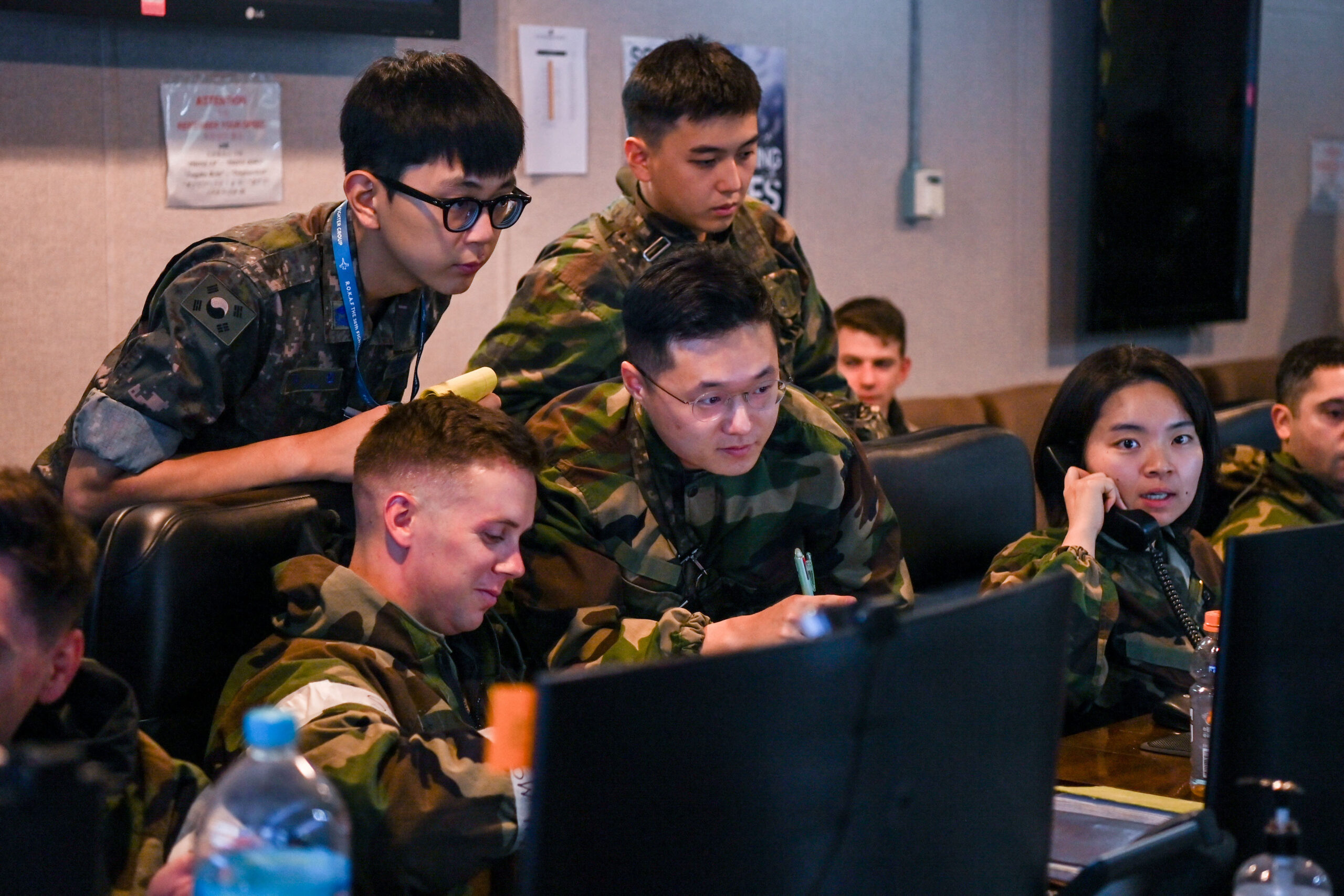
The joint United States-South Korea Ulchi Freedom Shield military exercise concluded on August 21, approximately one week earlier than initially scheduled. This adjustment followed a directive from then-President Donald Trump, and it occurred as the U.S. Air Force was already undertaking a broader review of its exercise schedule across the Pacific region.
Both the U.S. and South Korean militaries officially confirmed the revised schedule on August 19. The change came after President Trump publicly directed the Pentagon on August 16 via a social media post to “substantially reduce” the exercise. In his statement, Trump cited his diplomatic relationship with North Korean leader Kim Jong Un and what he described as South Korea’s refusal to participate in a U.S. military action against Iran as the reasons for his directive.
Ulchi Freedom Shield was originally planned to run from August 17 to August 27. As the largest annual joint military exercise on the Korean peninsula, it typically involves a significant contingent of approximately 18,000 uniformed personnel from the United States, the Republic of Korea (ROK), and other allied nations. The exercise encompasses a wide array of military assets operating across land, sea, and air domains. Historically, the U.S. Air Force has deployed advanced fighter aircraft such as F-16 Fighting Falcons, F-35 Lightning IIs, and F-22 Raptors in previous iterations. South Korea has similarly flown its F-35A, F-15 Slam Eagle, and FA-50 Golden Eagle fighters, highlighting the complex interoperability training undertaken.
In response to the U.S. request, South Korea’s Joint Chiefs of Staff (JCS) issued a statement confirming that the two countries “have decided to partially adjust the exercise period and scale.” This indicates a bilateral agreement to modify the drills, even if the impetus came from the U.S. executive branch.
A Pentagon spokesperson, addressing inquiries from Air & Space Forces Magazine, elaborated on the implementation of President Trump’s orders. The spokesperson stated that “the Department has substantially reduced Exercise Ulchi Freedom Shield while continuing training that enhances tactical capability. These adjustments preserve essential readiness and training objectives. There will be no degradation to U.S. training objectives.” This statement aimed to reassure observers that despite the reduction in scope, the core objectives of maintaining military preparedness were still being met.
The Pentagon’s emphasis on preserving readiness aligns with broader strategic discussions within the U.S. military. Last month, Pacific Air Forces (PACAF) Commander Gen. Kevin B. Schneider commented on his ongoing review of the more than 45 exercises PACAF participates in annually. During an event with AFA’s Mitchell Institute for Aerospace Studies, Gen. Schneider indicated that the purpose of this review was to evaluate which exercises genuinely contribute to military readiness versus those that might impose an undue strain without commensurate benefits.
“They’re all valuable, they all have benefits, but we’re taking a look at which ones are readiness gainers. What are the ones that are maybe not high on that list of building readiness for our Airmen?” Gen. Schneider explained, outlining the criteria for his assessment.
He further detailed that following the conclusion of the review, PACAF leadership would make informed decisions on continued participation in certain exercises. These decisions could range from discontinuing involvement in some drills to adjusting the level of participation, such as reducing the number of personnel or assets deployed. Spokespersons for PACAF and the 7th Air Force, which oversees U.S. Air Force units stationed in Korea, referred all specific queries regarding Ulchi Freedom Shield to the Pentagon, underscoring a unified departmental response to the presidential directive.
Regional Dynamics and Context
The reduction of Ulchi Freedom Shield occurred against a backdrop of heightened regional tensions. Prior to the exercise, North Korea conducted short-range ballistic missile tests on August 6 and August 12. These tests are a recurring pattern, as North Korea frequently conducts missile launches around the time of U.S.-South Korea joint exercises, consistently denouncing them as provocative actions and rehearsals for invasion.
China has also consistently voiced criticism of the U.S. alliance structure in the Pacific, characterizing it as an outdated vestige of a Cold War mentality. J. Michael Dahm, a retired Navy intelligence officer and an expert on China, commented on Beijing’s likely reaction to the reduced exercise. “The Chinese government and China’s military are likely pleased with the scaling back of U.S.-South Korean exercises on the peninsula,” Dahm, now a senior fellow at the Mitchell Institute, stated.
However, Dahm also offered a nuanced perspective on China’s strategic considerations. “On the other hand, Beijing recognizes that U.S.-South Korean military capacity and ability to defend itself against North Korean aggression is probably a necessary evil to deter Pyongyang and keep an unpredictable Kim Jong Un in check,” he added, suggesting that China also benefits from a stable, albeit U.S.-influenced, security architecture on the peninsula that prevents North Korean adventurism.
Despite the ultimate reduction in scale, Ulchi Freedom Shield was not expected to be significantly larger than previous drills. However, South Korean officials had previously articulated intentions to conduct a more technologically sophisticated exercise. They planned to incorporate tactical lessons gleaned from the ongoing conflict between Russia and Ukraine, aiming to modernize their joint operational capabilities.
Exercise plans also included a significant leadership change: a South Korean four-star general was slated to serve as the commander of the Combined Forces Command (CFC). The Republic of Korea had further intended for this particular exercise to finalize the full operational capability assessment. This assessment is a critical step in the process that allows for the eventual transfer of wartime operational control (OPCON) from Washington, D.C., to Seoul, a long-standing goal for South Korea, as reported by the Kyungyang Shinmun newspaper.
The Pentagon spokesperson declined to offer specific comments on these South Korean objectives, citing security protocols. “For operational security reasons, we do not publicly discuss details of bilateral assessments or certification activities,” the spokesperson stated. They added, however, that “The Republic of Korea and the United States continue to work toward [operational control] transition through longstanding bilateral coordination and joint assessments,” confirming ongoing efforts towards the OPCON transfer.
Concurrently, North Korea has actively bolstered its own military capabilities in recent months. Reports suggest it has sent troops to fight alongside Russian forces in Ukraine, potentially gaining combat experience. Experts also indicate that North Korea is adapting new tactics for its military use, including advanced cyberattacks, GPS jamming capabilities, and the deployment of drone swarms, showcasing a commitment to modernizing its asymmetrical warfare strategies.
Why This Matters
The early conclusion and reduction in scope of the Ulchi Freedom Shield exercise carry significant implications for regional security, international alliances, and U.S. foreign policy.
**Impact on U.S.-South Korea Alliance:** This decision, stemming from a direct presidential order rather than a mutual military assessment, could be perceived as potentially straining the robust U.S.-South Korea alliance. Joint military exercises are fundamental to maintaining interoperability, trust, and a shared defense posture. A unilateral decision to reduce their scale, even if agreed upon by the host nation, can raise questions about the predictability and reliability of the alliance, particularly in the face of ongoing threats from North Korea. South Korea’s long-term goal of regaining wartime operational control (OPCON) also hinges on these exercises serving as critical assessment milestones; any reduction or alteration could impact this delicate process.
**Deterrence Against North Korea:** Large-scale joint exercises like Ulchi Freedom Shield serve as a powerful deterrent against North Korean aggression. They signal the readiness and capability of the combined U.S. and ROK forces to respond to any provocation. A reduction in the size or duration of these drills, especially when explicitly linked to improving relations with Pyongyang, might be interpreted by North Korea as a weakening of resolve or a softening of the deterrence posture. This could potentially embolden North Korea to pursue its weapons programs more aggressively or engage in further provocative actions, as evidenced by its missile tests around the time of the exercise.
**U.S. Strategic Priorities and Global Commitments:** President Trump’s stated reasons, linking the exercise reduction to his relationship with Kim Jong Un and South Korea’s stance on Iran, highlight a broader shift in U.S. foreign policy. This approach demonstrated a willingness to leverage military cooperation as a bargaining chip in diplomatic negotiations and to link regional defense postures to unrelated global policy objectives. This can create uncertainty among allies about the consistency of U.S. security commitments and its overall strategic framework.
**Military Readiness vs. Political Directives:** The Pentagon’s assurance that “essential readiness and training objectives” would be preserved, despite a “substantially reduced” exercise, underscores a tension between political directives and military assessments of readiness. While tactical training might continue, large-scale, complex drills are crucial for rehearsing command and control, logistics, and large-unit maneuver in a simulated wartime environment. The ongoing PACAF review of exercises suggests a military-driven effort to optimize training, but presidential interventions introduce another layer of decision-making that may prioritize diplomatic or political optics over purely military efficacy.
**Regional Perceptions:** Beyond North Korea, other regional actors closely monitor these exercises. China, while often critical of U.S. alliances, also implicitly benefits from the stability and deterrence these exercises provide against an unpredictable Pyongyang. Any perceived weakening of the U.S.-ROK alliance could lead to a reassessment of the regional power balance, potentially influencing China’s own strategic calculations in Northeast Asia. Other U.S. allies in the Indo-Pacific may also view this development as a precedent for potential changes in their own security arrangements.