
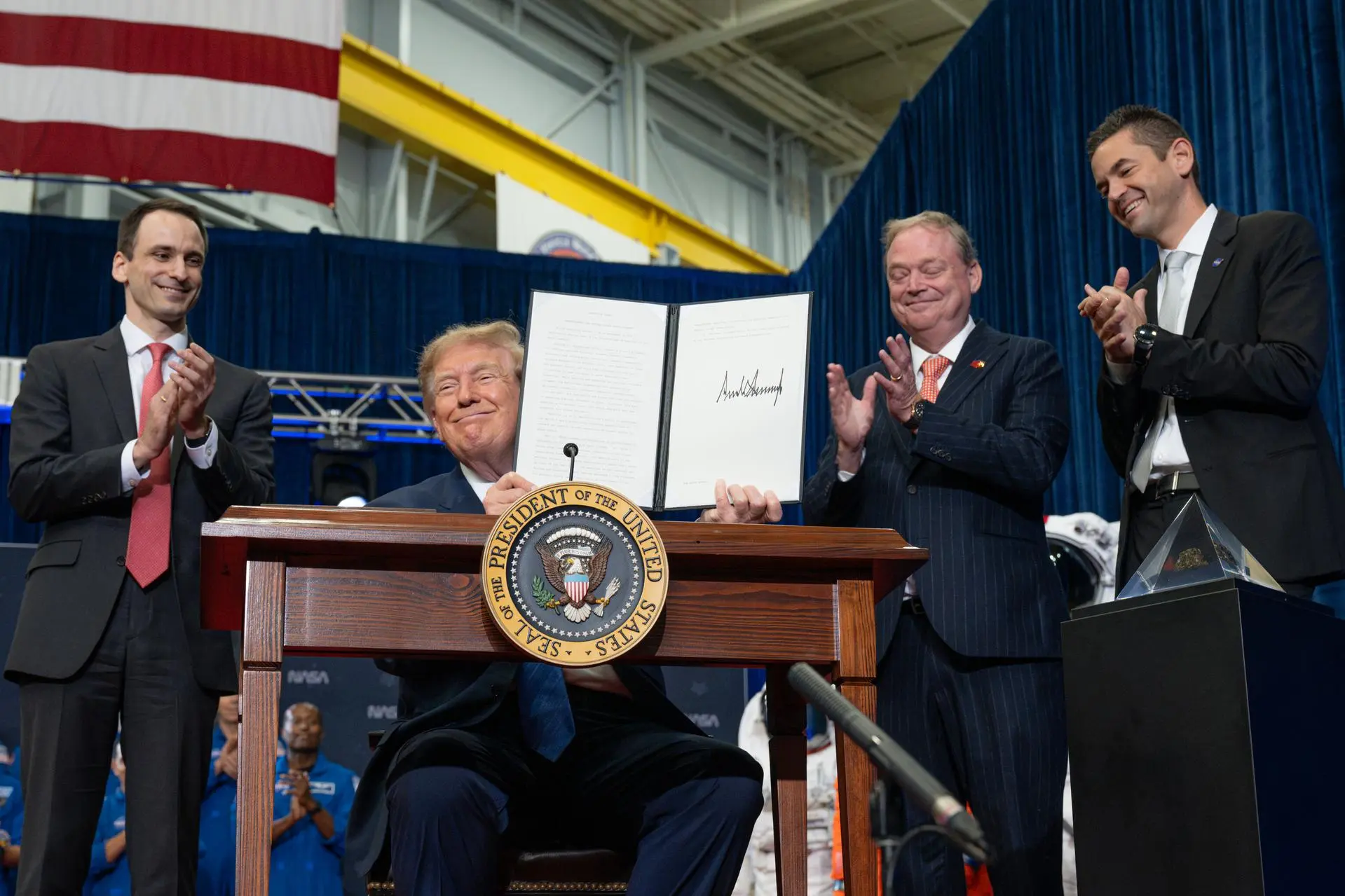
On August 28, 2022, then-President Donald Trump announced a proposal to establish a U.S. Space Academy, an initiative intended to strengthen the nation’s workforce and cultivate “the next generation” of experts across the burgeoning space sector. The announcement, made during a speech at NASA’s Lyndon B. Johnson Space Center in Houston, Texas, drew immediate parallels to existing military institutions, with President Trump himself likening it to the Army’s United States Military Academy at West Point.
However, the executive order issued concurrently with the presidential announcement outlined a vision for a distinct type of federal service academy. This proposed institution would be led by NASA and designed with a broad mandate: to train space operators and engineers serving in civil, military, and commercial capacities. The administration articulated its rationale in the order, stating, “To continue to lead the world in space exploration and technology, while securing and defending our national interests in space, the Nation must prepare the next generation of astronauts, scientists, engineers, operators, entrepreneurs, civil servants, and warfighters and ensure that they are capable of advancing American interests in space.” It further declared, “It is my administration’s policy to strengthen the nation’s space workforce by expanding opportunities to educate and develop the next generation of leaders across the space domain.”
Crucially, the President lacks the unilateral authority to create such an academy; its establishment would necessitate an act of Congress. To advance the proposal, the executive order instead formed a commission tasked with thoroughly exploring key questions surrounding the academy’s potential structure, its requirements for military or civil service, ideal location, funding mechanisms, and eligibility criteria. This commission was to be chaired by NASA Administrator Jared Isaacman and include other high-level officials from the White House and the Pentagon, such as the Secretary of Defense and the Secretary of the Air Force. The group was mandated to deliver a report containing its recommendations by late December of the same year.
As the commission prepared its recommendations, experts closely observed for further clarification on the academy’s precise mission and overall scope. They also emphasized the importance of engaging members of Congress in the process to build consensus. Another significant area of scrutiny was the potential role of the U.S. military within the proposed organization and how it might interact with or impact the U.S. Air Force Academy (USAFA), which, by its 2026 class, included 93 Space Force Guardians among its cadets. A spokesperson for the Department of the Air Force declined to comment on the matter at the time, while USAFA’s Association and Foundation, its alumni organization, issued a statement indicating it would “closely monitor developments” and share relevant information with its graduates.
Charles Galbreath, director of the Mitchell Institute’s Spacepower Advantage Center of Excellence, offered his perspective, suggesting that the concept of a NASA-led “space center of excellence” held merit given NASA’s extensive knowledge and long-standing legacy in space operations. “For decades, NASA has been the repository of knowledge when it comes to space operations,” Galbreath commented. “It stands to reason that it would be useful to codify that, to create an academy where NASA experts could pass on that knowledge to the next generation.”
While the presidential order did not explicitly define the primary audience for the new academy, Galbreath identified an opportunity to reach a diverse segment of the space community. This could range from undergraduate students to mid-career professionals, with programming spanning from specialized certifications to comprehensive academic degrees. Regarding the military aspect, Galbreath posited that the academy could eventually serve as a source for commissioning officers, though he suggested this might not be immediately necessary given the relatively small size of the Space Force. “At some point in the future, it could grow and become a commissioning source, I suppose,” he said. “But we’re still a long way from that.”
Conversely, Todd Harrison, a prominent space policy expert at the American Enterprise Institute, acknowledged the necessity of expanding the space workforce but expressed skepticism about whether a new federally operated academy represented the optimal solution. In an interview with Air & Space Forces Magazine, Harrison cited several concerns, including the substantial operational costs associated with establishing and maintaining such an institution, the potential for blurring the lines between military and civil space missions, and the risk of creating unnecessary competition with the numerous universities already engaged in training the aerospace workforce.
Harrison proposed an alternative approach: the administration could initiate a scholarship program, similar in concept to the Reserve Officers’ Training Corps (ROTC). Under this model, the government would provide scholarships to students pursuing relevant, space-related degrees at existing universities. In return, these students would commit to a period of service within the Space Force, NASA, or another federal agency. “Instead of competing with our world-class institutions . . . you would let them produce the best and the brightest talent with a commitment to go into the government and work for the government for a period of time,” Harrison explained. He highlighted the efficiency of this method, stating, “Establishing a physical academy is going to take years, whereas if you make it a scholarship program, you could literally start awarding scholarships next school year.”
While a scholarship program offers one pathway to address the government’s workforce pipeline needs, Galbreath maintained that there is also significant value in establishing a consolidated hub of space expertise, which an academy model inherently provides. “When you have people that are colocated, they’re going to breed new ideas as well,” he argued. He emphasized the quality of education, stating, “If you’re a student and you’re learning about orbital mechanics from a NASA PhD who designed the trajectories for a multi-planetary flyby, you’re getting the best.”
Another critical consideration for the commission was the academy’s potential location. Galbreath suggested exploring whether the academy should be situated on a single campus or distributed across multiple hubs, noting that cost would be a significant factor in determining its physical footprint. Harrison, however, cautioned against initiating the discussion on location too prematurely, recognizing that such debates often become entangled in parochial politics. Indeed, some lawmakers had already begun advocating for their districts to host the Space Academy; for instance, Rep. Dale Strong, a Republican from Alabama, indicated on August 31 that Huntsville, Alabama, had been suggested as a potential site. Despite the commission having several months to recommend a location, President Trump had previously hinted that he might select one sooner.
The political landscape presented potential challenges for the Space Academy proposal, particularly with the upcoming midterm elections in November. Harrison pointed out that if Republicans were to lose their majority in either the House or Senate, there might not be sufficient time for the commission to finalize its work and bring the decision to a vote before the end of that legislative session. However, Galbreath posited that creating a new academy could potentially attract bipartisan support, drawing a parallel to the establishment of the Space Force in 2019 during Trump’s first term, which also garnered cross-party backing. “It’s really going to come down to the cost-benefit—can they make a compelling case that this Space Academy is going to be worth the investment of time and money and personnel,” Galbreath stated. “If they can, then I think they’ll get bipartisan support. I don’t think this is one of those areas that you can get unilateral support.”
Indeed, some Democrats, including Rep. George Whitesides from California, expressed initial interest in the concept. In an August 28 post on the social media platform X, Whitesides noted that the idea “deserves consideration” but simultaneously raised concerns regarding funding and the lack of congressional representation on the commission. He urged, “I am open-minded to hear thoughtful answers to these questions, but I recommend that Congress be engaged quickly and substantively or else this intriguing idea will be stuck on the launch pad.”
Why This Matters
The proposal for a U.S. Space Academy underscores a significant national focus on maintaining and advancing American leadership in space, a domain increasingly critical for both national security and economic prosperity. The debate around its establishment reflects a broader strategic discussion about how best to cultivate a highly skilled workforce capable of navigating complex challenges in an evolving space environment. Should such an academy be realized, it would represent a substantial federal investment, impacting taxpayers, students seeking specialized education, and the existing ecosystem of aerospace higher education and industry. Its structure, whether a traditional military-style academy or a broader civilian institution, would define the future trajectory of training for astronauts, engineers, scientists, and military space operators.
Beyond education, the academy’s creation has implications for the U.S. Space Force and NASA, potentially altering their recruitment pipelines and the professional development paths of their personnel. It could solidify or redefine the collaboration between civil and military space endeavors, influencing how the nation approaches everything from planetary exploration to satellite defense. Furthermore, the political dynamics surrounding its approval, funding, and location highlight the challenges of major government initiatives, requiring bipartisan consensus and careful resource allocation. Ultimately, the decision on whether and how to establish a U.S. Space Academy will shape America’s ability to innovate, secure its interests, and compete on the global stage in the coming decades, determining who leads the next frontier of human endeavor.