
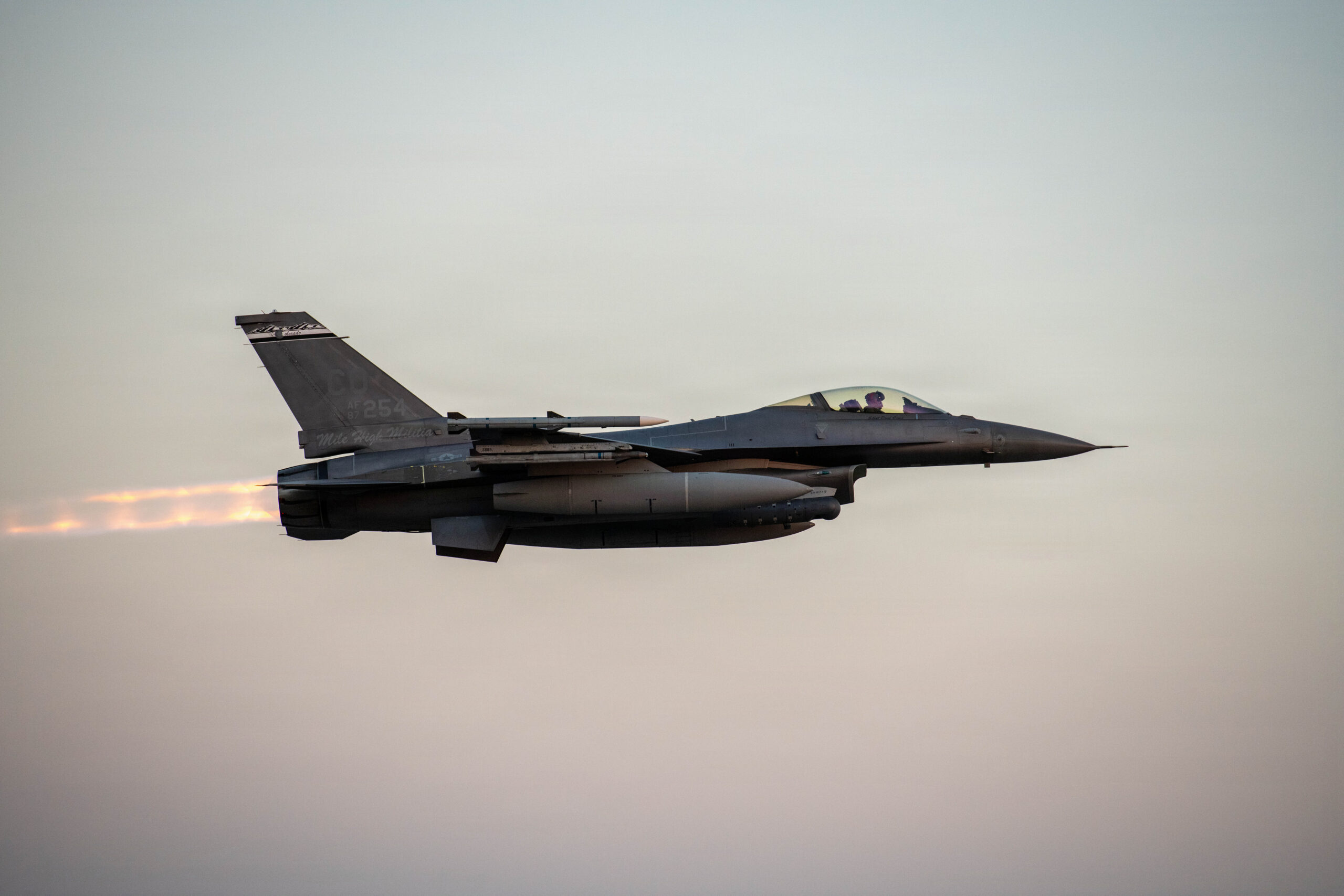
A recent six-month deployment by an F-16 Air National Guard unit to Kadena Air Base, Japan, has highlighted both the enduring capabilities and the escalating challenges faced by the Guard’s older fighter units. Officials have indicated that while the Colorado Air National Guard’s 120th Fighter Squadron demonstrated proficiency in modern combat strategies, its aging F-16s are increasingly demanding and possess limitations against advanced threats.
From January to June of this year, the 120th Fighter Squadron, equipped with 1980s-era F-16C Block 30 jets, integrated effectively with fifth-generation aircraft and significantly advanced its Agile Combat Employment (ACE) skills across the Pacific theater. However, leaders acknowledged that the four-decade-old airframes are approaching the limits of their operational lifespan, lacking critical high-end capabilities prioritized for potential conflicts with peer adversaries.
Lt. Col. Frank “Chester” Prokop, the squadron commander and detachment commander during the deployment, underscored this dichotomy. “We’re able to keep up, with the exception of obviously being a fourth-gen airplane,” Prokop stated. “We can’t get nearly as close to surface-to-air threats or air-to-air threats posed by China over there as some of the newer models. So, we’re kind of getting to the end of our capability. We’ve maxed it out. We played the perfect game.”
This deployment, part of a rotational presence of fighter units at Kadena while the base awaits its new F-15EX Eagle IIs, serves as a critical indicator for the U.S. Air Force’s total fighter fleet, especially for the Air National Guard. The broader fleet is experiencing an increase in average age, with new aircraft orders and deliveries progressing slowly. Consequently, the active-duty force often receives priority for modernization, pushing Guard units to extend the operational life and capabilities of their legacy aircraft.
Heather Penney, a former F-16 fighter pilot and current director of studies and research at the Mitchell Institute for Aerospace Studies, emphasized the practical impact of an aging fleet. “The first piece is that any aging airframe is going to negatively impact operational availability and daily ops tempo,” Penney explained. “I mean, you could talk about taking your 35-year-old car to an F1 race. Is that really what you want to do?”
Six Months at Kadena
The 120th Fighter Squadron’s original deployment schedule called for a dozen F-16C Block 30 jets to be stationed at Kadena from January to May. However, the deployment was extended by six weeks due to increased demands on Air Force assets, reportedly linked to Operation Epic Fury and regional tensions with Iran. This extension also disrupted plans for the squadron to participate in exercises in Thailand.
Despite these adjustments, the Guardsmen and their aircraft effectively implemented Agile Combat Employment (ACE) principles, a core tenet of modern Air Force doctrine. ACE involves dispersing smaller teams of Airmen and aircraft from central hubs to operate from various remote or austere airfields, enhancing survivability and operational flexibility. The 120th executed this through “small-package movements,” routinely repositioning two to six jets across the region.
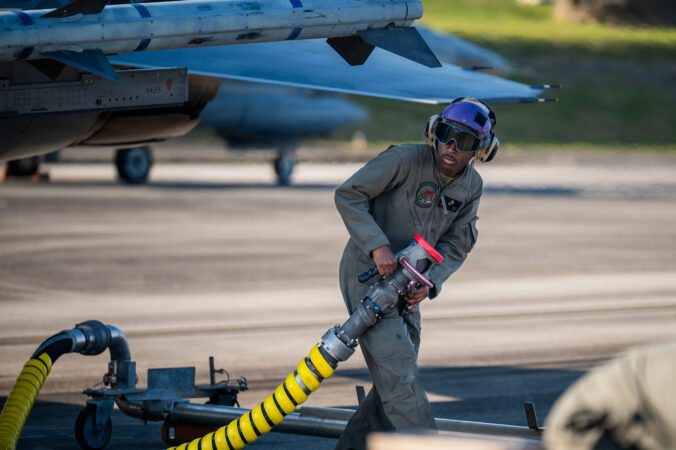
According to Lt. Col. Prokop and 140th Wing Commander Col. Christopher “KojaCk” Melka, the unit’s ability to generate detailed ACE deployment packages—including personnel, aircraft loadouts, and ground equipment requirements—improved dramatically, shrinking planning cycles from weeks to just 10-15 minutes. For instance, a deployment to the Philippines involved four F-16s supported by a C-130, collaborating with U.S. Marine Corps units. During Exercise Beverly Midnight at Marine Corps Air Station Futenma, Japan, the squadron conducted hot-pit refueling and rearming operations alongside F-35s, showcasing interoperability.
The squadron also applied the “Multi-Capable Airman” (MCA) concept to optimize its maintenance footprint. Col. Melka noted that a smaller contingent of cross-trained Airmen handled a broader spectrum of maintenance tasks while operating primarily out of Kadena, reducing the reliance on a larger force of highly specialized technicians. “We’ve actually exposed some of our Airmen to other career fields to give them a little bit more background on both, so that if, for whatever reason, they found themselves in a more austere environment where we could only send a certain package of maintainers and support personnel, maybe one person covered the duties of two,” Melka explained.
Recapitalization Ripple Effects
Despite the operational successes in applying modern combat concepts, the 120th faced significant logistical challenges in sustaining its F-16 fleet. Both Col. Melka and Lt. Col. Prokop highlighted the increased maintenance burden associated with the aging aircraft. “When these F-16s were first produced, it was roughly about six to eight maintenance man-hours per flight hour,” Prokop noted. “Now, our maintainers are averaging 15 to 20 maintenance man-hours for every hour of flight.”
This dramatic increase is attributed to more frequent and complex maintenance requirements, including structural failures such as cracks on the airframe, which are occurring at an escalating rate. Prokop emphasized this as “probably the biggest challenge that we face is our maintenance unit has not received any increase in manpower commensurate with the level of increased requirements for maintenance time on the aircraft.” The unit has relied heavily on its experienced, veteran maintainers to keep the airframes operational. This growing demand on maintenance personnel is also influencing operational decisions, with leadership opting for more simulator flight time over actual flying hours to maintain pilot proficiency.
While the F-16s have undergone numerous upgrades over their service life—incorporating advanced AESA radars, Link 16 data links, and continuous software enhancements, earning them the unofficial moniker of the “Burger King jet” for their adaptability—their fundamental airframes are nearing the end of their design life. The 120th is among approximately a dozen Guard squadrons awaiting official selection for fleet recapitalization with newer aircraft like the F-35A or F-15EX, leaving their long-term future uncertain.
Penney acknowledged that units like the 120th can continue flying their F-16s for the foreseeable future, but stressed that the Air Force’s long-term plan for these units remains unclear. Furthermore, the rate at which the Air Force is procuring new jets is insufficient to replace older aircraft promptly. “The Air Force has got to recapitalize at a meaningful rate, because they have deferred and delayed increasing their recapitalization rate,” Penney stated. “If you want to be recapitalized by 2035, you’ve got to buy more than 100 fighters a year.”
Air Force leaders have previously indicated a requirement to procure at least 72 fighters annually to prevent the fleet’s average age from increasing. However, the last time the service successfully budgeted for this target was in fiscal year 2024. Subsequent budget requests have fallen short: fiscal year 2025 requested 60 fighters, 2026 dropped to a low of 45, and the pending fiscal year 2027 request is for only 62 fighters.
Compounding this issue, the new fighters that are procured, primarily the F-35 and F-15EX, are largely allocated to the Active-Duty force, leaving Air National Guard units to contend with older platforms. This prioritization could have significant ripple effects, as the Guard plays an indispensable role in nearly every major contingency and large-scale operation, functioning as a critical component rather than a supplementary force. “If the Air Force does not recapitalize the Guard in a concurrent and proportional manner, they risk not only losing a key element of the total force, but they risk leaving the Guard with operationally irrelevant airframes,” Penney concluded.
Why This Matters
The experience of the 120th Fighter Squadron in Japan underscores several critical issues facing U.S. national security and defense strategy. Firstly, it highlights the growing operational challenges within the Indo-Pacific region, a primary focus for U.S. strategic competition. While the F-16s demonstrated impressive adaptability and tactical innovation through Agile Combat Employment, their inherent limitations against potential peer adversaries, particularly advanced air-to-air and surface-to-air threats posed by nations like China, are becoming increasingly apparent. Maintaining a credible deterrent and combat capability in this dynamic theater necessitates technologically superior platforms.
Secondly, the reliance on aging fourth-generation aircraft for front-line deployments exposes a critical gap in the Air Force’s overall readiness. The increasing maintenance burden and structural fatigue on these older jets not only drive up operational costs but also strain maintenance personnel and reduce aircraft availability. This situation points to a broader systemic issue of insufficient fighter recapitalization rates across the entire Air Force. If the service cannot replace aging aircraft at a sustainable pace, the readiness and technological edge of its combat air forces will continue to erode, potentially compromising its ability to project power and deter aggression effectively.
Thirdly, the impact on the Air National Guard is particularly significant. The Guard constitutes a vital, integral component of the “Total Force,” providing crucial capabilities and experienced personnel for both domestic emergencies and overseas deployments. If Guard units are consistently left with “operationally irrelevant airframes,” as Penney suggests, it risks alienating a critical pool of talent, diminishing their readiness, and ultimately weakening the entire Air Force’s capacity to respond to global contingencies. Neglecting the Guard’s modernization could lead to a fragmented force where a substantial portion is ill-equipped for high-end conflict, undermining the concept of a unified and capable fighting force.
Finally, this situation reflects broader budgetary and strategic prioritization debates within the Department of Defense. The consistent under-budgeting for fighter procurement, falling short of the identified requirement of 72 aircraft per year, signals a longer-term risk to air superiority. Delaying recapitalization is not a cost-saving measure in the long run; it inevitably leads to higher maintenance costs for older aircraft, increased risks to personnel, and a more expensive, urgent modernization bill in the future. The ability to maintain air superiority is foundational to all modern military operations, and the challenges faced by units like the 120th Fighter Squadron serve as a stark reminder of the urgent need for sustained and proportional investment in fighter aircraft modernization across the entire U.S. Air Force, including its critical Air National Guard component.