
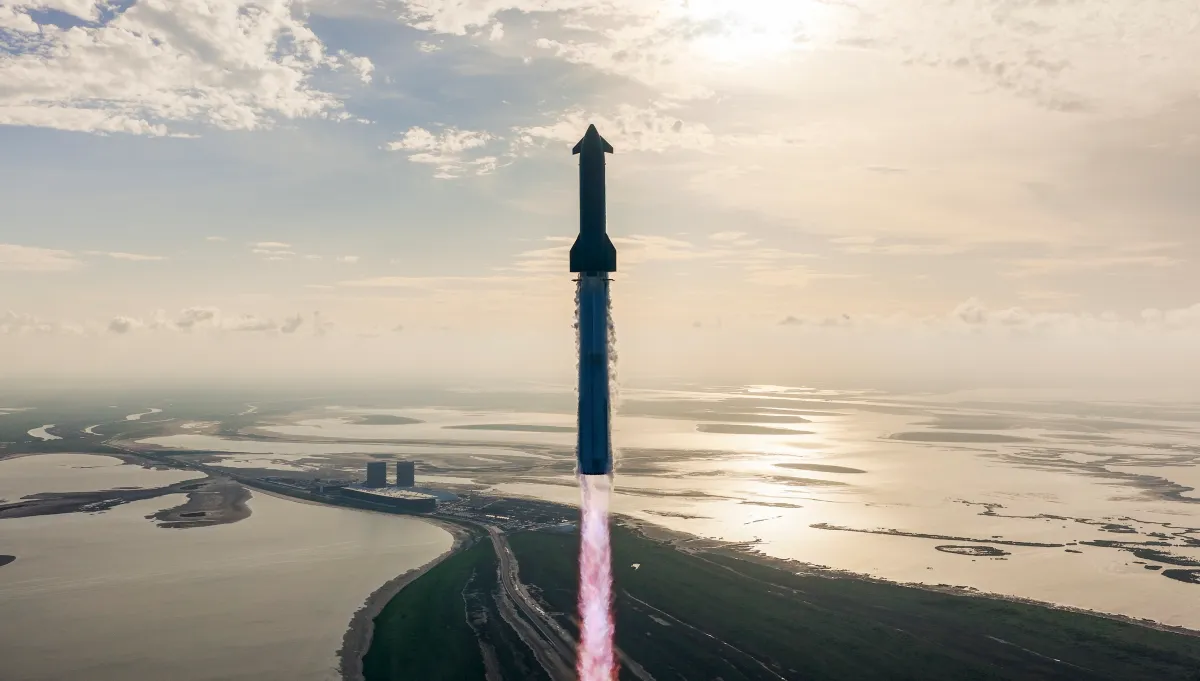
# Starship V3: SpaceX’s Next Giant Leap Poised for Mid-March Launch
The cosmos beckons, and SpaceX is preparing to answer with its most ambitious creation yet. After a series of dramatic tests and refinements, the highly anticipated third iteration of SpaceX’s colossal Starship rocket, affectionately dubbed V3, is reportedly set for its inaugural flight by mid-March. This eagerly awaited update comes directly from CEO Elon Musk, igniting renewed excitement across the aerospace community.
## The Dawn of Starship V3: A New Era in Spaceflight
This isn’t just another rocket; Starship V3 represents a significant evolutionary leap in space transportation. Designed to be larger and more powerful than its predecessors, V3 is engineered to tackle some of humanity’s most challenging space exploration goals.
### Powering the Future: Starlink and Beyond
A primary mission for this upgraded behemoth involves deploying SpaceX’s next-generation Starlink satellites. These advanced satellites promise unprecedented data speeds but come with increased size and weight – a challenge Starship V3 is uniquely equipped to handle. Beyond Earth orbit, V3 introduces a critical new capability: in-orbit docking with other Starship vehicles. This intricate maneuver is not merely a technical flex; it’s the lynchpin for refueling and enabling deep-space missions to the Moon and, ultimately, Mars. Without this orbital rendezvous capability, human interplanetary travel remains largely theoretical.
## Navigating the Pressures: IPO, Artemis, and Ambition
The stakes for Starship V3’s success extend far beyond its technical specifications. This launch occurs amidst a critical period for SpaceX. The company is reportedly gearing up for a momentous Initial Public Offering (IPO) later this year, making every major milestone a potential market-shaper.
Furthermore, Starship V3 is a cornerstone of NASA’s ambitious Artemis program, which aims to return U.S. astronauts to the lunar surface. With political pressure mounting to achieve this feat before the end of the Trump administration’s potential second term, Starship’s role as the designated lunar lander for the Artemis missions is under intense scrutiny. This makes the V3’s progress not just a SpaceX priority but a national one.
## Lessons from the Launchpad: Starship’s Developmental Journey
SpaceX’s philosophy of rapid iteration and “fail fast, learn faster” is well-documented, and Starship’s journey has been a testament to this high-stakes approach. Each test, whether soaring triumph or spectacular setback, provides invaluable data that propels the program forward.
### V3’s Recent Hurdle
The path to the mid-March launch wasn’t entirely smooth for V3. In November, a critical incident during “gas system pressure testing” saw the booster stage suffer a substantial explosion, compromising an entire side of the immense steel rocket. This unexpected event forced a recalibration of the development timeline, delaying progress from an initial late 2025 target. While SpaceX confirmed the nature of the test, a detailed breakdown of the exact cause behind the booster’s catastrophic failure has yet to be publicly disclosed, leaving many to speculate about the specifics of the engineering challenge.
### A Look Back: The Mixed Legacy of Starship V2
The preceding Starship V2 offered a compelling prelude to the current iteration, showcasing both remarkable achievements and significant hurdles. On the success side, V2 managed to achieve orbital flight, successfully deployed dummy versions of the next-generation Starlink satellites, and even demonstrated the impressive feat of catching multiple booster stages upon their return to the launchpad. These accomplishments underlined the incredible potential of the Starship architecture.
However, V2’s development was also marked by a series of dramatic explosions and unexpected setbacks. Some of these were deliberate outcomes of SpaceX’s iterative testing philosophy, where vehicles are pushed to their structural limits to gather crucial performance data. Others, however, were less anticipated, such as the massive fireball that engulfed one of the Starship upper stages during ground testing in June, illustrating the inherent risks in pushing the boundaries of rocket science.
## The Race to the Stars: Competition Heats Up
SpaceX has undeniably dominated the global launch market over the past decade, a position it intends to solidify with the unparalleled capabilities of Starship. Yet, the competitive landscape is evolving, with formidable challengers emerging on the horizon.
### Blue Origin’s Ascendancy with New Glenn
Jeff Bezos’s space venture, Blue Origin, is making significant strides with its own mega-rocket, New Glenn. While not as gargantuan as Starship, New Glenn marked its own inaugural flight in January 2025, followed by a second, successful mission in November of the same year. This second launch proudly carried its first commercial payload for NASA and achieved the crucial milestone of landing its booster stage, demonstrating a key reusability capability.
Blue Origin is not resting on its laurels, with a third New Glenn launch slated for late February, and plans to send its own lunar lander to the Moon sometime thereafter. Intriguingly, Blue Origin confirmed late last year that it is actively developing an even larger version of New Glenn, signalling a direct intent to compete head-on with SpaceX’s super-heavy rocket in the very near future. The space race, it seems, is only just beginning to warm up.