
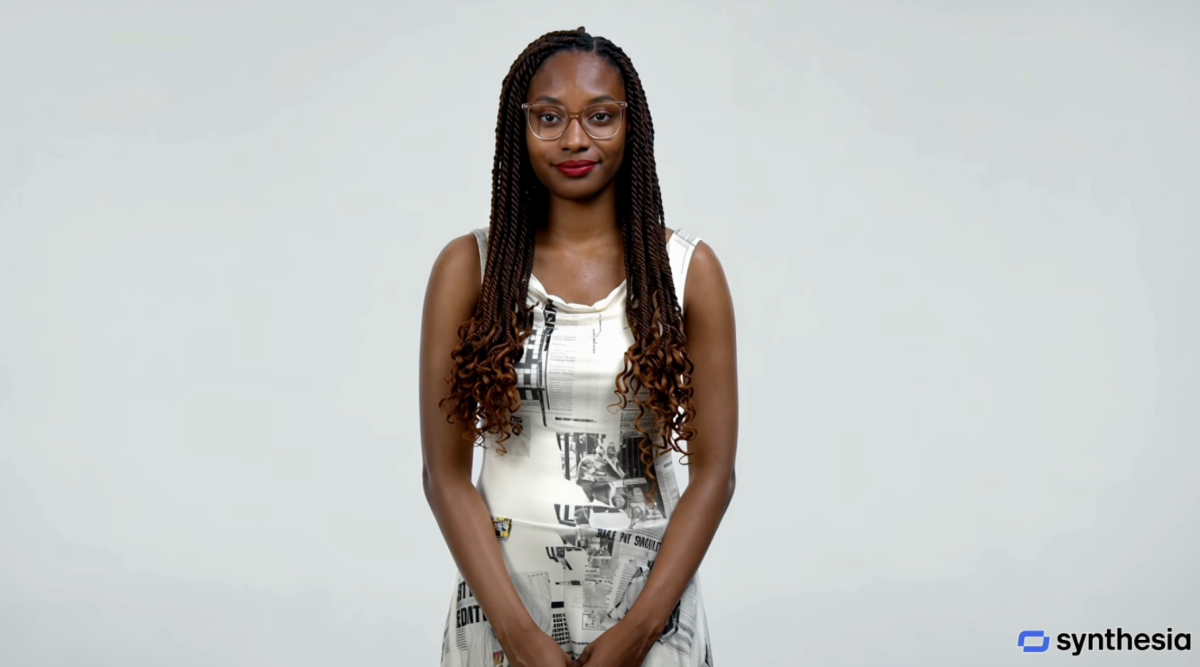
When Alexandru Voica, head of corporate affairs at the video-generation startup Synthesia, sent me a link this summer to the newest addition to their PR team, I was surprised. It was an interactive virtual avatar of him, trained to answer common press questions about Synthesia, like what it does and how it works. The day before, I was on a panel where PR people asked me if I minded pitches that used AI-generated text. But Alexandru’s avatar was beyond that — this seemed to me the final boss of using AI in PR.
In September, Synthesia invited me to its new office space in New York. Originally based in the U.K., Synthesia is a hot digital avatar startup alongside others like D-ID, HeyGen, and Colossyan. It hit a $4 billion valuation earlier this year and said last year it had crossed $100 million in ARR.
Synthesia lets enterprises build interactive training videos with AI avatars and recently launched a product called Roleplay Sessions that lets employees practice, for example, sales pitches with an interactive AI avatar that responds and scores their responses.
When I went to the new office opening and they asked me if I would like my own AI avatar, I didn’t even hesitate to say yes. Of course I would like my own digital twin. My outfit was cute that day, and my hair was in place.
Until I met my digital twin, I had been indifferent toward avatars, but I felt they would inevitably become part of everyday online life. I heard of people on Instagram creating them in their likenesses to help them make social content. I find it all to be very interesting, and it’s perhaps why I have no qualms now presenting to you my digital twin. This is the first time Synethsia has made a digital avatar for a journalist (or for anyone, period, outside of Voica). It is trained on my story about why venture-backed startups commit more fraud than non-VC-backed startups and will only answer questions about that story.
Below, simply press “start in a new window” to begin.
You can ask it questions like:
- Why did I decide to write this story?
- What is the research paper about?
- What did the researchers find?
To make this, I entered a mini film studio nestled inside Synthesia’s office where they took numerous photos of me and captured a two-minute recording of my voice. I had to consent to these avatars being made and, well, digital Dom was born. They created a personal avatar for me (one that just reads whatever script I give it) — with and without glasses — and they made two interactive avatars for me (ones that can talk back and listen to me), also with and without glasses.
We picked an article to train the interactive avatar on, and then one of the teams built my interactive avatar, which is powered by a combination of voice-to-text, video, language, and text-to-voice models. My avatar’s tech stack includes Synthesia’s own video and voice models, although the company also allows customers to choose alternatives from other labs like Cartesia, ElevenLabs, Google, or OpenAI. Enterprises can also choose to host their avatars on whatever cloud they want or pay Synthesia to host them.
The voice-to-text model turns what people say into text, the agentic language model makes sense of text and can take actions based on it, the text-to-voice model turns a response into audio, and finally a video model (built by Synthesia) animates the avatar as it talks.
Overall, Synthesia builds three types of products — a video-creation and distribution platform with classic avatars, where someone types in a script and the avatar repeats it; an agentic platform called Sessions where people can interact with the avatars in surveys or roleplay; and an API platform where people can take Synthesia video and voice models and combine them with other tech services to build interactive avatars or other types of products.
It took the Synthesia team a couple of days to make my avatars. I played first with the personal ones and typed a fairly generic script to see how my AI voice sounded. I had it talk about how fall has arrived in New York, my favorite time of year. The voice was fairly accurate, and I was glad it didn’t pick up any of the hoarseness I had when I recorded my audio sample.
I showed it to some non-tech friends who found it both interesting and creepy.
Then I showed them my interactive one, which is deterministic, meaning it will only say what it was trained to respond to. In this case, that was my venture fraud story. I asked it questions like where I was before TechCrunch and what part of New York I lived in, but each time it directed me back to the story.
My friends didn’t think the voice sounded much like mine and thought the likeness was not as good as the personal avatar, but nonetheless it was close enough to be somewhat creepy. My mom called it “amazing,” which is pretty high praise from her. She and my father kept trying to ask it questions “only they would know” about me — but the model didn’t answer, redirecting them each time to the venture fraud story.
“I don’t remember giving birth to two of you,” she joked after testing the model.
This experience has made me think about what the future of journalism could be. Would people be OK with turning on the news and it being presented by an avatar? One investor told me no immediately. Certainly there is a lot of pushback today on AI slop that has infiltrated social media and other news-sharing platforms. But others I asked weren’t so sure. Could avatars augment — or even replace — journalists? Would CEOs want to talk to an AI avatar of a journalist rather than a human one?
What I like about my career is connecting with people, writing stories, and researching new topics. But the biggest part of journalism is trust. That doesn’t seem like it could ever be outsourced to an AI.
Outside of journalism, I’m confident the idea of cloning yourself could be appealing. No more catching up on work after a holiday or vacation, because a version of you can always be around, answering questions.
We’ll have to see how avatar usage evolves in corporate America. But now that I have my own, I have mixed feelings. After I got over the initial novelty of it, I examined my avatar closely after it stopped talking and waited — for what, I’m not sure. Maybe I’m waiting for it to blink. Or to say something new, or to smile, or to just let me know that itknows.
Because my digital twins are deterministic, they will never do that. But I can see how easy it would be for someone to fall into a tinge of AI psychosis with one that was nondeterministic, meaning powered by a chatbot that was free to pontificate.
I told one investor that, whatever the future of digital twins is, I predict that my generation, Gen Z, likely won’t get used to them. They feel sci-fi: Everything we’ve ever seen in a movie is here now. But I will say, I find digital avatars less jarring than humanoids. At least with an avatar, if stuff gets weird, I can always log off.
Until then, however, here is my personal avatar, giving you a rundown of all the top stories on our site this week!
When you purchase through links in our articles, we may earn a small commission. This doesn’t affect our editorial independence.
Key Takeaways
- AI Avatars Are Here, and They’re Impressive (and Unsettling):Synthesia’s technology allows for highly realistic digital twins, challenging traditional interactions in PR, training, and beyond with its advanced voice, video, and language models.
- The Future of Professional Roles, Especially Journalism, is Being Reshaped:While AI avatars can augment tasks like content delivery and information dissemination, fundamental aspects of journalism—such as trust, empathy, and genuine human connection—remain inherently irreplaceable by AI.
- Beyond Novelty, Ethical and Psychological Questions Emerge:Interacting with one’s digital self prompts reflections on authenticity, control, and the potential for “AI psychosis” with non-deterministic models, raising concerns about the boundary between human and machine.
My Digital Double: Facing the “Final Boss” of AI in PR
The Initial Shockwave: My First Encounter with AI in PR
This summer, an email from Alexandru Voica, head of corporate affairs at the video-generation startup Synthesia, landed in my inbox, presenting me with what felt like the ultimate frontier of AI integration in public relations. Attached was a link to a virtual avatar of Alexandru himself, meticulously trained to field common press inquiries about Synthesia’s operations and technology. Just a day prior, I’d been on a panel, fielding questions from PR professionals curious about my stance on AI-generated text in pitches. But this? This interactive digital doppelgänger wasn’t just AI-generated text; it was the “final boss” of AI in PR, a fully embodied, responsive virtual representative.
Synthesia, a burgeoning digital avatar startup from the U.K., has rapidly ascended alongside peers like D-ID, HeyGen, and Colossyan. Their ascent culminated in a staggering $4 billion valuation earlier this year, building on last year’s milestone of crossing $100 million in Annual Recurring Revenue (ARR). Their core offering allows enterprises to construct interactive training videos featuring AI avatars, exemplified by their recent “Roleplay Sessions” product. This innovation lets employees, say, practice a sales pitch against an interactive AI avatar that not only responds dynamically but also scores their performance. The implications for corporate training and communication are immense.
Stepping into the Digital Looking Glass: Creating My Own Avatar
When Synthesia extended an invitation to their new New York office in September, and then offered me the chance to create my own AI avatar, my response was an immediate, resounding yes. The allure of a digital twin was undeniable, especially on a day where my outfit was on point and my hair cooperated perfectly.
Until that moment, my stance on avatars had been largely indifferent, though I harbored a quiet certainty that they would eventually weave themselves into the fabric of our everyday online lives. I’d heard murmurs of Instagram users leveraging AI likenesses to churn out social content. Yet, witnessing my own creation transformed indifference into fascination. This marked a significant milestone: Synthesia’s first digital avatar crafted for a journalist, or indeed, for anyone outside of their internal team like Voica. My interactive twin was specifically trained on an article I penned about venture-backed startups and fraud, designed to answer only questions pertinent to that story.
To bring “digital Dom” to life, I stepped into a compact film studio within Synthesia’s office. There, I underwent a series of photo captures and recorded a two-minute voice sample. My explicit consent was crucial for the avatar’s creation. The result was a suite of digital selves: a “personal” avatar capable of reading any script I provided (with and without glasses), and two “interactive” avatars designed to engage in two-way conversations (also with and without glasses).
The Anatomy of a Digital Self: Synthesia’s Tech Stack
The interactive avatar, in particular, is a marvel of technological synergy. Its intelligence is derived from a sophisticated combination of voice-to-text, video, language, and text-to-voice models. While Synthesia leverages its proprietary video and voice models, their platform offers customers the flexibility to integrate alternatives from other leading labs, including Cartesia, ElevenLabs, Google, or OpenAI. Furthermore, enterprises can choose to host their avatars on their preferred cloud infrastructure or opt for Synthesia’s hosting services.
The process is intricate: a voice-to-text model transcribes spoken queries into text. An agentic language model then interprets this text, comprehends its intent, and formulates a response. This response is subsequently fed into a text-to-voice model, generating audio, which a Synthesia-built video model then synchronizes with the avatar’s movements, animating it as it speaks.
Synthesia’s Ecosystem: Beyond the Journalist’s Twin
Synthesia’s product offerings extend across three distinct platforms:
1. **Video-Creation and Distribution Platform:** This is their classic offering, where users input a script, and an avatar delivers it.
2. **Agentic Platform (Sessions):** This innovative platform allows for genuine interaction, facilitating surveys, and advanced roleplay scenarios, such as the aforementioned sales pitch practice.
3. **API Platform:** For developers and enterprises, this platform enables the integration of Synthesia’s video and voice models with other tech services, fostering the creation of custom interactive avatars and diverse AI-powered applications.
Meeting My Doppelgänger: Initial Reactions and Uncanny Valleys
The Synthesia team took only a couple of days to manifest my digital avatars. My first foray was with the personal avatar, for which I crafted a simple script about the arrival of fall in New York. The generated voice was remarkably accurate, even pleasantly devoid of the hoarseness I recalled from my recording session. My non-tech savvy friends found it both “interesting and creepy.”
Then came the interactive avatar, a deterministic model strictly confined to its training data—my venture fraud story. I tested its boundaries, asking about my previous employers or my residential neighborhood in New York. Each time, it gracefully, but firmly, redirected me back to the article. My friends observed that the interactive avatar’s voice wasn’t quite as convincing as the personal one, and its likeness, while close, wasn’t perfectly congruent, contributing to an unsettling “close enough to be somewhat creepy” sensation. My mother, however, offered high praise, deeming it “amazing.” She and my father playfully attempted to stump it with questions “only they would know” about me, yet the model steadfastly adhered to its script, leading my mother to quip, “I don’t remember giving birth to two of you.”
Journalism at the Precipice: Trust, Avatars, and the Human Element
This profound personal experience ignited a critical introspection into the future of journalism. Would audiences accept news delivered by an avatar? One investor I spoke with vehemently rejected the notion, a sentiment echoed by the current public backlash against “AI slop” permeating social media. Yet, others I queried were less certain. Could avatars augment, or even outright replace, human journalists? Would busy CEOs opt to converse with an AI avatar of a journalist over a flesh-and-blood one?
My career as a journalist is deeply rooted in human connection, the craft of storytelling, and the thrill of unearthing new knowledge. But the bedrock of journalism, the irreplaceable cornerstone, is trust. This fundamental pillar, I believe, can never be outsourced to an AI. It is built through consistent human effort, ethical practice, and genuine interaction.
The Broader Appeal: A Glimpse into the “Cloned” Future
Beyond journalism, the concept of cloning oneself holds a potent appeal. Imagine returning from a holiday without a mountain of work, because a digital version of you has been diligently answering questions and handling routine tasks in your absence. The potential for such applications in corporate America, and indeed, in personal life management, is vast and intriguing.
The Unsettling Gaze: Lingering Thoughts on My Digital Twin
Possessing my own digital twins has left me with a cocktail of mixed feelings. Once the initial novelty waned, I found myself scrutinizing my avatar after it finished speaking, waiting—though for what, I couldn’t precisely articulate. Perhaps a blink? A spontaneous new utterance? A genuine smile? A flicker of self-awareness?
Because my digital twins are deterministic, trained to specific responses, they will never exhibit such spontaneity. This realization highlights a subtle, yet significant, danger: the ease with which one could slip into a “tinge of AI psychosis” if interacting with a nondeterministic avatar, one powered by a chatbot free to pontificate and simulate consciousness.
I shared this thought with an investor, predicting that my generation, Gen Z, might struggle to fully acclimate to digital twins. They feel like sci-fi made real, a convergence of cinematic fantasy and present-day technology. However, I find digital avatars less jarring than physical humanoids. At the very least, if the interaction with an avatar veers into the uncanny or unsettling, there’s always the option to simply log off.
Until then, I present to you my personal avatar, ready to deliver this week’s top stories from our site!
When you purchase through links in our articles, we may earn a small commission. This doesn’t affect our editorial independence.
{content}
Source:{feed_title}
Bottom Line
The advent of sophisticated AI avatars, epitomized by Synthesia’s technology, marks a profound shift in how we interact with information and each other, blurring the lines between the virtual and the real. While these digital twins offer unprecedented efficiency and new possibilities for communication, training, and even personal representation, my experience underscores a critical truth: the intrinsic human elements of trust, empathy, and genuine connection remain indispensable. For journalism and many other fields, AI will undoubtedly augment our capabilities, but the irreplaceable value of human discernment and the emotional resonance of authentic interaction ensure that the “final boss” of AI in professional life still bows to the enduring power of humanity.