
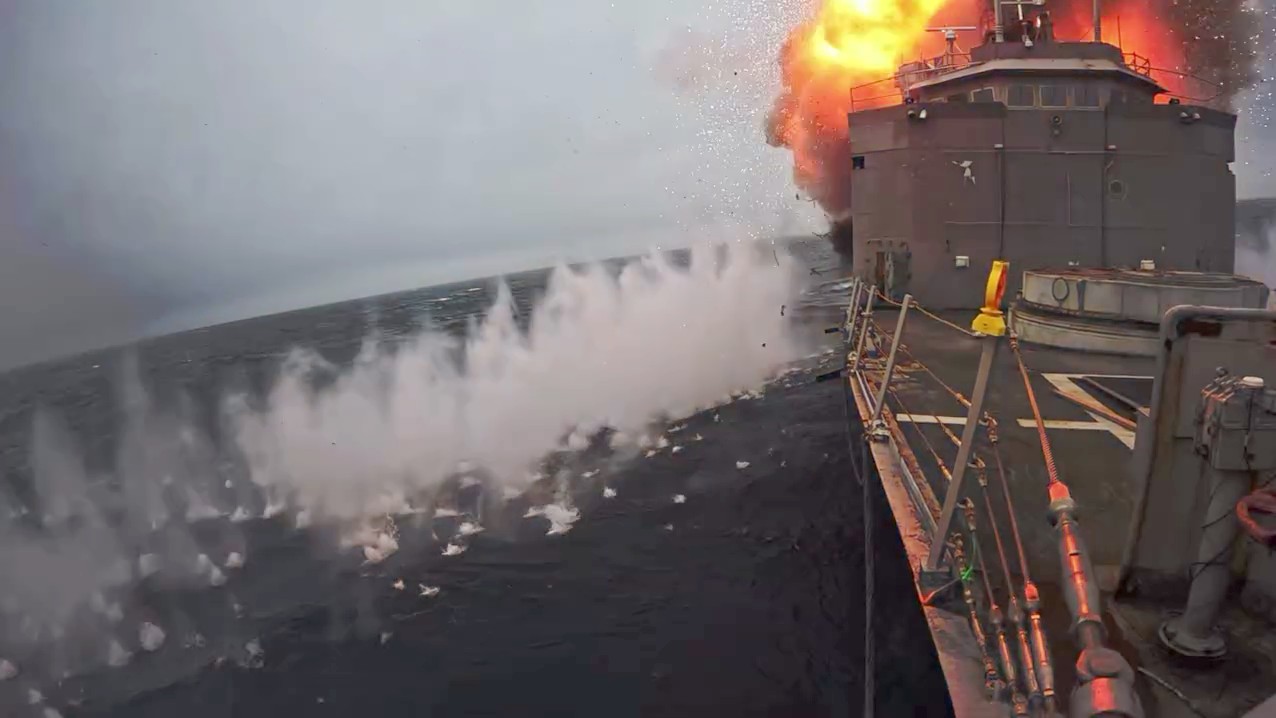
Decommissioned USS Klakring Sunk in Joint Exercise, Designated Future Artificial Reef
The decommissioned U.S. Navy frigate USS Klakring was intentionally sunk this month during a joint live-fire exercise conducted by British and American forces off the Hebrides archipelago. Following the exercise, the vessel is expected to become a natural reef on the seabed, a transformation that received full environmental approval prior to the operation, according to the commanding officer overseeing the exercise.
Captain Kelechi Ndukwe, commander of Task Force 65 based at Naval Station Rota in Spain, addressed questions about the fate and responsibility of the sunken wreck during a recent media roundtable. Captain Ndukwe affirmed, “For the environmental side, it was all done during the course of the planning. It was approved by the EPA in advance, and it’ll become a natural reef. It’s sunk in a deep, deep valley there, right off the Hebrides.” This statement underscores the meticulous preparation and regulatory adherence involved in such military exercises, particularly concerning their ecological impact and the intent for the wreck to foster marine biodiversity.
The USS Klakring (FFG-42) went down on September 21st, approximately 150 nautical miles offshore of the Hebrides, a remote island chain northwest of mainland Scotland. The sinking operation was a key component of a broader naval exercise that ran from September 14th to 25th. During the event, the frigate’s hull was engaged by a range of advanced weaponry designed to test the capabilities of both navies. These included the SM-6 missile, the Mark 48 Advanced Capability Torpedo, the Naval Strike Missile, and the Sea Venom missile. The weapons were launched from various platforms: the guided-missile destroyer USS Paul Ignatius, the submarine USS Massachusetts, the Royal Navy Type 23 frigate HMS Portland, and aircraft from both the U.S. and UK air forces, demonstrating a multi-domain strike capability against a realistic target.
The decision to tow an American vessel across the Atlantic for the Sinking Exercise (SINKEX), rather than utilizing a British ship, garnered attention, especially given the Royal Navy’s ongoing process of decommissioning and scrapping its own Type 23 frigates. Captain Ndukwe clarified that this arrangement was part of a specific cost-sharing agreement between the two governments. “Speaking specifically to towing the ship, that was part of the agreement between the two navies and the departments of defense, was that we would pay for the tow of the ship across, and then the Royal Navy or the UK would pay for the range, so that was planned into the whole exercise,” he explained. This collaborative approach highlights the strong alliance and interoperability between the U.S. and UK militaries, allowing for shared burdens and benefits in complex training scenarios.
The USS Klakring, an Oliver Hazard Perry-class guided-missile frigate, had a distinguished career before its decommissioning in 2013. These frigates, known for their versatility and anti-submarine warfare capabilities, served the U.S. Navy for decades. Following its retirement, the Klakring was laid up at the Philadelphia Naval Inactive Ship Maintenance Facility. The vessel began its final journey on August 12th, when it was towed down the Delaware River, embarking on its transatlantic crossing with an initial stop in Campbeltown, Scotland, before reaching its final destination off the Hebrides.
Sinking exercises are a long-standing and regulated practice used by navies worldwide to dispose of hulls that no longer hold sale, museum, or training value. More importantly, they serve as crucial live-fire training opportunities, allowing naval forces to test new weapons systems, validate tactics, and improve target acquisition and engagement against a realistic, full-scale target. Strict environmental protocols govern these operations. Before a vessel is used as a target, it undergoes a comprehensive stripping process to remove all fuel, oils, and hazardous materials, including polychlorinated biphenyls (PCBs) and other potential pollutants. This is conducted under a general permit issued by the United States Environmental Protection Agency (EPA), which also mandates specific minimum water depths and distances from land for the sinking location to mitigate environmental impact. Subsequent surveys of wrecks sunk in this manner have, in many instances, revealed the growth of marine life, substantiating the “natural reef” designation and showcasing the potential for these sites to evolve into new underwater ecosystems.
Sensors strategically fitted to the USS Klakring prior to the exercise meticulously recorded the effects of each weapon strike. Captain Ndukwe indicated that this invaluable data, alongside battle damage assessment shared between the U.S. and UK navies, would be subject to extensive analysis over the coming months. This analysis is critical for refining future weapon systems and tactical approaches. He acknowledged that challenging North Atlantic weather conditions presented obstacles during the serial but confirmed that all primary objectives of the exercise were met and the frigate sank as planned without complications.
Looking ahead, planning has already commenced for the next iteration of ‘Atlantic Thunder,’ a recurring joint exercise aimed at maintaining peak operational readiness. Captain Ndukwe stated that the U.S. and UK navies aim to conduct this future exercise in 2028, underscoring a continued commitment to enhancing their combined operational readiness and military capabilities through such collaborative training events.
Why This Matters
The sinking of the USS Klakring in a joint U.S.-UK exercise, ‘Atlantic Thunder,’ holds multi-faceted significance across military, environmental, and diplomatic spheres. It is far more than simply the disposal of an old warship; it represents a critical intersection of modern naval strategy, environmental stewardship, and international cooperation.
Military Readiness and Capabilities Testing:At its core, the Sinking Exercise (SINKEX) is a vital component of military readiness. Engaging a full-sized, realistic target like the USS Klakring allows naval forces to test the effectiveness of their most advanced weaponry – from anti-ship missiles to precision torpedoes – in a live-fire scenario. This isn’t just about destroying a target; it’s about collecting invaluable data on weapon performance, terminal effects, and target vulnerability. Such data is instrumental in refining existing weapon systems, developing new ones, and validating tactical procedures. It provides an unparalleled training opportunity for crews to practice target acquisition, command and control, and multi-platform coordination in a high-stakes, realistic environment that cannot be fully replicated in simulations. The ability to conduct such complex, integrated strikes against a tangible target is crucial for maintaining a credible deterrent and effective combat capability.
Strengthening Alliances and Interoperability:The joint nature of ‘Atlantic Thunder’ underscores the enduring strategic alliance between the United States and the United Kingdom. This exercise enhances interoperability – the ability of different military forces to operate together seamlessly – which is paramount for effective coalition operations in a complex global security landscape. The cost-sharing agreement for towing the vessel and utilizing the range demonstrates a mutual commitment to shared defense objectives and efficient resource allocation. Such collaborative training events reinforce diplomatic ties, build trust, and ensure that both nations are prepared to act in concert during real-world contingencies, from humanitarian aid to combat operations. In an era of shifting geopolitical power dynamics, strong alliances are more critical than ever.
Environmental Stewardship in Military Operations:The explicit focus on environmental approvals from the U.S. EPA and the intention for the USS Klakring to become a “natural reef” highlights a growing emphasis on environmental responsibility within military operations. While SINKEX events are inherently destructive, the rigorous process of stripping hazardous materials prior to sinking reflects a commitment to minimizing ecological impact. The potential for these wrecks to foster new marine ecosystems, attracting diverse species and supporting biodiversity, transforms an act of disposal into a contribution to oceanic health. This balance between operational necessity and ecological consideration sets a precedent for how future military training exercises can be conducted responsibly, aligning defense priorities with broader environmental goals.
Naval Modernization and Fleet Management:The sinking of the USS Klakring is also indicative of ongoing naval modernization efforts. As older classes of warships, like the Oliver Hazard Perry-class frigates, are retired, navies must efficiently manage their decommissioning. SINKEX offers a practical and cost-effective method of disposal, particularly for vessels that have no further utility. This process allows resources to be reallocated towards newer, more technologically advanced platforms, ensuring that naval forces remain at the cutting edge of defense capabilities. It represents a cyclical aspect of naval power, where past assets pave the way for future strength.
Strategic Significance in the North Atlantic:Conducting this exercise off the Hebrides in the North Atlantic also carries strategic weight. This region is vital for transatlantic security, maritime trade, and submarine operations, especially given renewed attention to Arctic routes and potential undersea infrastructure vulnerabilities. Training in such an environment prepares forces for potential challenges in a strategically important area, demonstrating presence and capability to both allies and potential adversaries. The planning for a future ‘Atlantic Thunder’ in 2028 signals a long-term commitment to maintaining a robust and integrated naval presence in this critical domain, reinforcing the stability of the Euro-Atlantic security architecture.