
**Key Takeaways**
1. **Energy Security Premium & Inflation:** The EU has incurred an additional €100 billion for the same volume of fossil fuel imports, primarily driven by surging diesel prices and exacerbated by geopolitical tensions. This financial strain highlights Europe’s acute energy vulnerability and feeds directly into persistent inflationary pressures across the bloc.
2. **Policy Response & Fiscal Headroom:** Member states are deploying diverse, often costly, fiscal interventions like price caps and subsidies to shield consumers. However, these measures raise concerns about market distortion, fiscal sustainability, and the potential for an EU-wide windfall tax, impacting energy company valuations and investor confidence.
3. **Accelerated Energy Transition:** The current crisis reinforces the imperative for Europe to aggressively pursue electrification and homegrown renewable energy. While offering a long-term solution to dependency and price volatility, this transition requires significant capital investment, policy stability, and presents both opportunities and challenges for various market sectors.
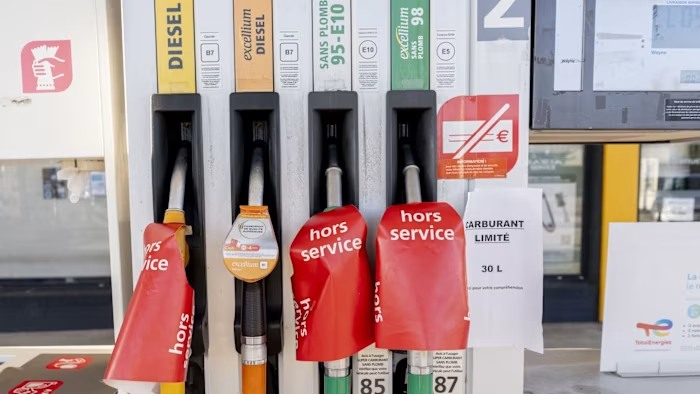
Against a backdrop of heightened geopolitical tensions, which the EU estimates have cost the bloc an extra €100 billion on fossil fuels since the start of the US-Iran war for the same import volume, Europe finds itself grappling with an acute energy vulnerability. This staggering expenditure, primarily driven by a sharp escalation in diesel prices, underscores the profound market sensitivity of the region and its susceptibility to global supply shocks as winter approaches. EU Energy Commissioner Dan Jørgensen starkly articulated the situation: “It’s now €100bn that we’ve paid extra for our energy this year, without receiving one extra molecule of gas or oil.” This statement resonates loudly in financial markets, signalling a significant drain on European capital and a persistent inflationary impulse, directly impacting the bloc’s trade balance and economic competitiveness.
The recent threat by former US President Donald Trump regarding a potential export ban on diesel sent immediate ripples through already taut refined oil product markets. While US Energy Secretary Chris Wright later tempered expectations, expressing scepticism about a full ban, the mere possibility was enough to ignite price volatility and trigger a risk premium in futures contracts. For Europe, heavily reliant on imported refined products, particularly diesel, any disruption to transatlantic supply channels carries severe economic consequences. Diesel is not merely a fuel for passenger vehicles; it is the lifeblood of industrial operations, freight transport, and agricultural machinery, making its price a critical determinant of manufacturing costs, logistical efficiency, and ultimately, consumer prices across a myriad of goods and services. Market participants closely monitor such pronouncements, as they directly impact futures contracts and forward pricing for crucial commodities, influencing investment decisions and hedging strategies.
EU officials, while acknowledging the threat, have sought to de-escalate concerns publicly. Jørgensen expressed satisfaction with Wright’s clarifying comments, and Ireland’s energy minister, Darragh O’Brien, reported similar assurances from US administration officials. Yet, the underlying fragility remains. The conversation at the recent gathering of the bloc’s energy ministers in Dublin was not about averting a crisis, but preparing for a winter of high energy prices. This strategic pivot involves a multi-pronged approach: urging member states to propose demand-reduction measures, continuing the effort to fill gas storage facilities to at least 80% capacity, and deploying “targeted and temporary” interventions to mitigate price spikes. These actions reflect a careful balancing act between market intervention aimed at social protection and allowing price signals to guide consumption and investment in energy efficiency.
Beyond immediate crisis management, the long-term vision for European energy security gained renewed emphasis. Commissioner Jørgensen reiterated the critical need to accelerate the rate of electrification across the continent. “We need to get out of that dependency, we need to replace the fossil fuels — the imported, polluting, expensive molecules — with homegrown energy,” he asserted. This strategic imperative presents a massive investment opportunity for renewable energy developers, grid infrastructure companies, and manufacturers of electric vehicles and heat pumps. However, it also demands robust regulatory frameworks, substantial capital deployment, and a coordinated approach across member states to overcome grid constraints and ensure supply stability during the transition, all of which will have significant implications for capital markets.
The fiscal implications of the energy crisis are profound and multifaceted. The OECD has issued a cautionary note, highlighting that only half of global government fiscal interventions are effectively targeted, leading to undue pressure on public finances. This observation is particularly pertinent for the Eurozone, where varying national approaches risk distorting the single market, exacerbating sovereign debt concerns, and potentially impacting bond yields. Governments face the unenviable task of supporting households and businesses without further fuelling inflation or undermining long-term fiscal stability.
Individual member states are responding with diverse policy tools, often walking a tightrope between protecting citizens and maintaining fiscal discipline. Spain’s energy minister, Sara Aagesen Muñoz, announced measures to cap the increase in a regulated gas tariff at 15% for households. While aimed at protecting vulnerable consumers, such caps can artificially depress price signals, potentially encouraging higher demand at a time when conservation is paramount. This creates a challenging dilemma for policymakers: market efficiency versus social equity, with direct consequences for utility companies’ revenue streams and investment capacities.
In Italy, Prime Minister Giorgia Meloni’s government has resorted to direct appeals to major energy companies. After spending an estimated €2.8 billion this year on fuel excise tax cuts, Italy’s limited fiscal headroom has necessitated a different approach. Agreements with Azerbaijan’s Socar and Kuwait Petroleum International to temporarily cap fuel pump prices at their Italian retail networks (IP and Q8), followed by a similar “gesture of solidarity” from state-controlled Eni, illustrate the extraordinary measures being taken. These interventions, while providing temporary relief, introduce an element of uncertainty for private sector energy firms, raising questions about contractual stability, profit margins, and future investment incentives in a critical market. Furthermore, the spectre of windfall taxes, as raised by Italy’s deputy prime minister Matteo Salvini and echoed by other governments including Austria, Germany, Spain, and Poland, looms large over the sector. Such taxes, while popular politically, can deter long-term investment in energy infrastructure and production at a time when increased supply and diversification are desperately needed.
The confluence of high energy prices, governmental interventions, and the push for decarbonisation creates a complex environment for market participants. The €100 billion “energy bill” is not just a statistical figure; it represents a tangible transfer of wealth from Europe, a drag on economic growth, and a significant challenge to the region’s industrial competitiveness on the global stage.
**Market Impact**
The sustained high cost of energy imports, underscored by the additional €100 billion outlay, will continue to exert significant inflationary pressure across the Eurozone, impacting consumer purchasing power and potentially forcing the European Central Bank to maintain a hawkish stance for longer. This situation, combined with varying national fiscal responses, could widen sovereign bond spreads within the EU as markets differentiate between countries with stronger and weaker fiscal positions. For the corporate sector, energy-intensive industries face continued margin compression and may accelerate relocation or decarbonisation investment decisions, while the immediate threat of windfall taxes introduces policy risk for energy producers and distributors, potentially dampening investment in conventional energy supply. Conversely, the intensified focus on energy independence and electrification creates substantial tailwinds for companies in the renewable energy, energy storage, smart grid technology, and electric vehicle sectors, positioning them for increased capital allocation, government support, and growth, albeit within a volatile regulatory landscape. Investors should anticipate continued market volatility, driven by geopolitical headlines and evolving energy policy, and closely monitor the delicate balance between short-term consumer protection and long-term energy market reform.
Stay informed with free updates
Simply sign up to the EU energy myFT Digest — delivered directly to your inbox.
The EU has spent an extra €100bn on fossil fuels since the start of the US-Iran war for the same volume of imports, underlining the region’s vulnerability to surging diesel prices in particular this winter.
“It’s now €100bn that we’ve paid extra for our energy this year, without receiving one extra molecule of gas or oil,” the EU’s energy commissioner, Dan Jørgensen, told journalists at a gathering of the bloc’s energy ministers in Dublin on Tuesday.
The warning comes after US President Donald Trump threatened an export ban on diesel. The threat has pushed up already high prices for refined oil products, even though US energy secretary Chris Wright later expressed scepticism about the merits of a full diesel ban.
EU officials played down the risk ahead of the Dublin meeting. Jørgensen said he was “happy” about Wright’s comments last week.
Darragh O’Brien, energy minister of Ireland, which holds the rotating presidency of the EU, said he had spoken to US administration officials in meetings at last week’s UN General Assembly. “It doesn’t look like a [90-day ban] is something that’s going to happen,” he suggested.
However, EU member states will discuss how to prepare for a winter of high energy prices. Jørgensen has urged member states to suggest measures to cut demand, to continue filling gas stores so they are at least 80 per cent full and to use “targeted and temporary” measures to tackle high prices.
He also repeated the need to increase the rate of electrification in Europe on Tuesday. “We need to get out of that dependency, we need to replace the fossil fuels — the imported, polluting, expensive molecules — with homegrown energy,” he said.
The OECD has warned that only half of the fiscal interventions by governments globally are being properly targeted, adding to pressures on public finances.
On Tuesday, Spain’s energy minister Sara Aagesen Muñoz announced further measures to protect households, saying that Madrid would limit the increase in a regulated gas tariff to 15 per cent.
Asked whether those measures would push up demand, she said: “In this situation, we have to protect. The Spanish people can always count on the support of the government.”

In Italy, Prime Minister Giorgia Meloni’s government has persuaded Azerbaijan’s state oil and gas company, Socar, and the state-owned Kuwait Petroleum International to temporarily cap fuel pump prices at their Italian retail distribution networks, IP and Q8.
The decision came days after Italy’s state-controlled energy company Eni announced a cap on its own domestic petrol prices for at least a month in what it called a “gesture of solidarity towards the country, consumers and its customers”.
Rome has spent an estimated €2.8bn so far this year in fuel excise tax cuts but has little fiscal space for continued largesse, forcing Meloni’s government to instead appeal to its major fuel suppliers for support.
Italy’s deputy prime minister Matteo Salvini has also raised the spectre of windfall taxes on energy companies in the next budget. Other governments, including Austria, Germany, Spain and Poland, have called for an EU-wide windfall tax.