
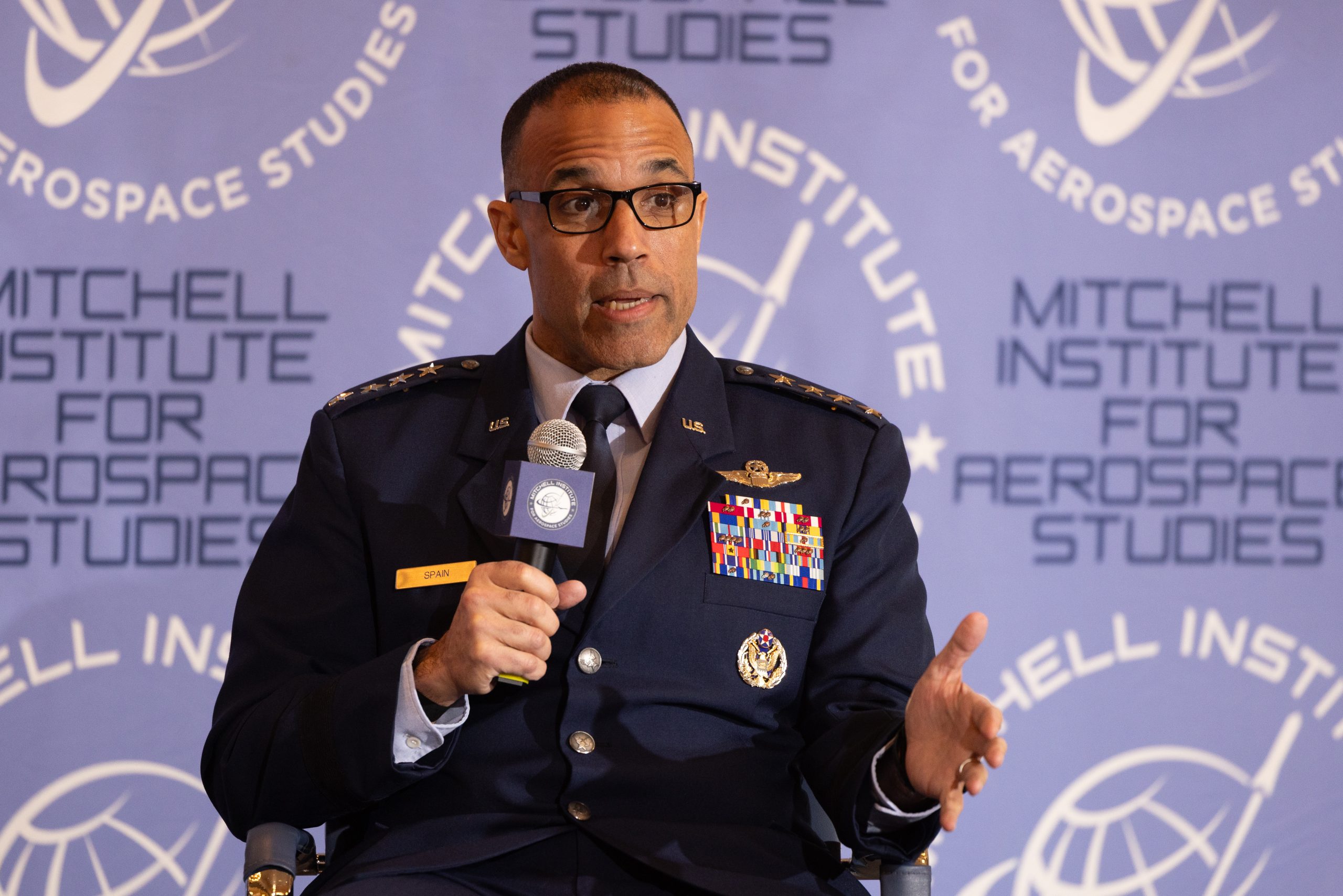
## General Spain’s Blueprint: Reclaiming Air Superiority and Forging Future Readiness
General Adrian “Elmo” Spain, the commanding force behind Air Combat Command (ACC), has laid out a compelling vision for the U.S. Air Force. While **readiness and sustainment** stand as his undisputed top priorities, the seasoned fighter pilot emphasizes three additional critical areas: adapting to an evolving global landscape, aggressively modernizing for tomorrow’s challenges, and fostering empowered leadership at every operational tier.
### The Uphill Battle for Readiness: Confronting a Decade of Compromise
“If we are called to fight, it will be with the assets we possess today, and that force must be unequivocally ready,” Spain declared at the Mitchell Institute’s Airpower Forum in Arlington, Va. He stressed his unwavering commitment to safeguarding the current force, asserting, “I’m unwilling to take more risk on that force. In fact, we need to grow it back.”
Spain contends that strategic decisions made over the last ten years inadvertently compromised future preparedness, diverting resources towards immediate demands and modernization initiatives. This accumulated risk, he insists, must now be systematically addressed to ensure the contemporary force is fully capable of future engagements.
Restoring readiness levels is no swift endeavor. “You don’t get to bring back the readiness levels that you had [in the past] immediately,” Spain noted, highlighting that “It takes time, and it takes resources. … There’s no quick fix.” The Air Force has experienced a gradual reduction in size while modernization has lagged expectations. This stagnation means “the older airplanes that we had are going to get worn out more and more often,” Spain explained. Even when modernization efforts did occur, they often involved calculated risks. Now, all these factors are converging. While there’s no lack of understanding regarding the problem, nor a shortage of energy or willingness to allocate resources, the crucial missing element remains **time**.
“We understand the predicament we’re in, and we know the solutions to navigate our way out,” Spain affirmed. The path to recovery demands discipline and consistent effort to improve the state of readiness.
### Sustaining Combat: Beyond Capability to Capacity
Recent operations, such as Midnight Hammer (targeting Iranian nuclear facilities) and Absolute Resolve (to apprehend Venezuela’s former president Nicolás Maduro), unequivocally demonstrate the exceptional capability and effectiveness of the Air Force’s frontline operators. However, the true hurdle lies in ensuring a robust supply chain – adequate parts, skilled maintainers, proficient pilots, functional aircraft, and sufficient munitions – to execute **sustained combat operations** against a sophisticated adversary.
Spain articulated ACC’s mission: “It’s our job to buy down the risk as much as possible so that we can win quickly and decisively, get out of the current fight, and deter anybody else who’s watching from starting another fight.” He emphasized that every Air Force and joint force operation must be executed with overwhelming efficiency and effectiveness. This decisive demonstration of power sends a clear message to potential adversaries, compelling them to reconsider challenging the U.S. and ultimately reinforcing the deterrent posture that prevents conflict in the first place.
### The Parts Shortage and a Return to Fundamentals
General Spain meticulously tracks a range of readiness indicators, from mission capability rates and aircraft availability to squadron experience levels. The most pressing deficiency, he reveals, is a critical **shortage of spare parts**. This isn’t merely a matter of funding; these parts aren’t readily available on shelves. They must be ordered, manufactured, and delivered, with some supply chain bottlenecks so complex they could take years to resolve.
In the interim, squadron and wing commanders are urged to proactively address issues. Spain highlighted a historical precedent, looking to the leadership of General William Creech during his tenure as head of Tactical Air Command (TAC) from 1978 to 1984 – a command that later evolved into ACC. Creech’s nearly unprecedented six-year leadership was marked by a fierce dedication to reversing the training and preparedness shortcomings identified after the Vietnam era. His approach centered on rigorous flying, meticulous review, and intensive drills to ensure only the most effective tactics were employed, enabling pilots to respond automatically and correctly under pressure.
“So a lot of what we’re focusing on is really just back to basics,” Spain remarked. Many of these fundamental improvements “don’t involve money. They involve behavior. They involve attention. They involve skill sets. They involve partnering.” The goal is to maximize efficiency and effectiveness within wings, so that when resources do become available, they can be leveraged to their fullest potential.
Air Force Chief of Staff General Kenneth Wilsbach, Spain’s predecessor at ACC, experienced these same frustrations. Upon taking office as Chief, Wilsbach charged Airmen to “fly and fix so we’re ready to fight and win.” The current parts scarcity is a direct consequence of years of “just-in-time” delivery models, which, while efficient in peacetime, inadvertently discouraged contractors and suppliers from maintaining readily available spare inventories. Spain stressed the imperative to “refill the stock of spare parts and support equipment” and to streamline depot repair and modification processes.
### Beyond Readiness: Spain’s Three Strategic Pillars
Beyond the immediate imperative of readiness, General Spain is sharpening ACC’s focus on three additional strategic areas:
### 1. Adapting to a Dynamic Strategic Environment
The Air Force can no longer presume to operate with impunity from bases safe from attack. “We have to defend them, and I have to be able to move and maneuver within contact, whether that’s from a rocket force or from a long-range fires force of some other type,” Spain stated. Furthermore, deployed units must master **Agile Combat Employment (ACE)**, a concept designed for dispersing forces to smaller, more remote operating locations. This demands the ability to “still generate airpower … while things are blowing up and while people are dying all around you,” such as swiftly arming an aircraft that just landed and launching it within minutes.
### 2. Accelerating Future Capabilities
When new capabilities are delivered to Air Combat Command, Spain demands rapid integration. “I have to be able to catch it normally, get an operational capability very quickly,” he explained. This requires meticulous preparation: “Are the people prepared to receive it? Is the infrastructure in place to support [it] at the base?” The aim is to bridge the gap between innovation and operational reality seamlessly.
### 3. Fostering Empowered Leadership
Spain advocates for pushing decision-making authority down to the lowest possible accountable level of expertise. “I don’t just want to push down authority. I want to push down authority to the right person who needs it at the right time and who can own the risk of using it,” he clarified. This approach marks a significant departure from the centralization seen over the past three decades. It necessitates leaders who are comfortable taking calculated risks without constant oversight, understanding that mistakes will occur. “They can’t be fired every time somebody makes a mistake,” Spain underscored.
### The Imperative of Daily Progress
In each of these critical areas, Spain’s objective is consistent: make incremental progress every day. While he acknowledged he “would love to have two to four years of sanctuary to make all that stuff happen,” the reality dictates that fundamental change must occur concurrently with ongoing, uninterrupted missions.
“We have to execute while we’re trying to get better,” Spain concluded. Resources may materialize quickly or slowly, but the path forward remains clear: focus on what can be fixed immediately. “You’re operating without a net and without a road, and we have to get better anyway,” he asserted. “So I’ve got 24 hours today to get a little bit better so I can be more ready tomorrow. What are you doing with your 24 hours? And if I stack those day after day after day, week after week, month after month, a year from now, we’re going to be better, resources or not.”