
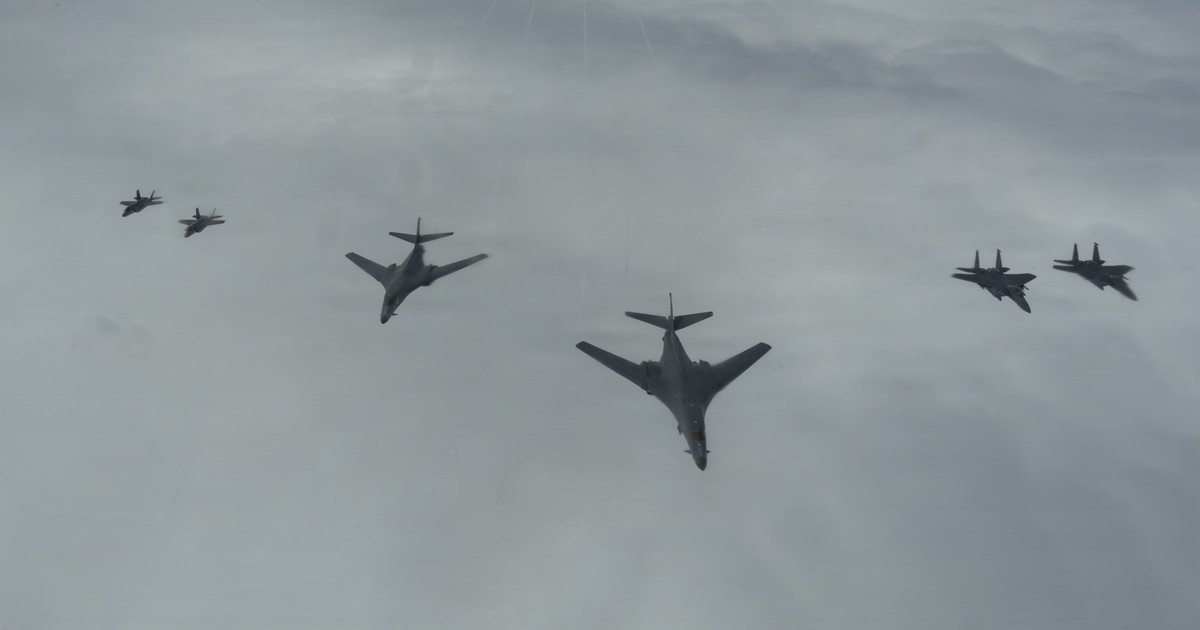
All US Strategic Bombers Depart RAF Fairford, Ending Latest Sustained European Deployment
All United States strategic bombers previously deployed to Royal Air Force (RAF) Fairford in Gloucestershire, United Kingdom, have returned to their home stations in the United States, concluding the latest sustained presence of American heavy bombers at the critical British airbase. This redeployment was confirmed by US European Command (EUCOM) on October 4.
European Command officially stated on October 4 that the aircraft “are redeploying to their home stations.” Separately, a US Department of Defense official provided further confirmation, asserting that every American bomber that had been deployed to Fairford had now departed the base. A US Air Force statement reiterated this, noting,“While operational security precluded us from confirming the movement of our assets and forces in real-time, we can acknowledge now that all US bombers that were deployed to RAF Fairford have redeployed to their home stations in the United States.”
The final contingent of aircraft to depart Fairford were B-1B Lancer bombers. While official numbers were not publicly released by the Pentagon, The New York Times, citing two US officials familiar with the movements, reported that approximately 12 B-1s were involved in this latest redeployment. At least three of these supersonic bombers were reported to have reached Ellsworth Air Force Base in South Dakota by the preceding Sunday. No explicit reason for this significant withdrawal has been publicly provided by either the Pentagon or US European Command.
In response to inquiries, European Command offered a generalized explanation, stating that American bombers routinely deploy internationally as an integral part of global readiness initiatives and to fulfill various operational requirements. The US Air Force statement echoed this sentiment, asserting,“US Air Force bombers routinely operate around the world to support global force readiness and operational requirements.”This standard explanation offers little specific insight into the timing or strategic rationale behind the decision to recall the Fairford aircraft.
The service further emphasized the inherent flexibility and capability of its bomber fleet, stressing that it remains fully capable of executing long-range operations directly from the continental United States (CONUS).“The Airmen that operate America’s bomber force, including B-1s, B-2s, and B-52s, remain ready to deliver precision global strike capabilities – including through operations that launch and recover from the continental United States – anywhere, anytime,”the statement concluded. This highlights the Pentagon’s long-standing doctrine of global reach, where strategic assets can project power across vast distances without necessarily requiring forward-deployed bases for every mission.
RAF Fairford holds a unique and crucial position within the transatlantic security architecture. As a Royal Air Force station, it is extensively utilized by the United States Air Force and functions as a primary forward operating location (FOL) for US strategic bomber deployments to Europe. Its extensive 10,000-foot runway and robust supporting infrastructure are specifically designed to accommodate heavy, long-range aircraft such as the B-1B Lancer, the stealth B-2 Spirit, and the venerable B-52 Stratofortress, enabling them to operate effectively from the Gloucestershire base.
The airfield has been a crucial hub for US power projection, having hosted a substantial American bomber presence during various periods. For instance, the original text indicates that during 2026, B-1 and B-52 aircraft operated from Fairford during American military operations connected with a “war with Iran.” This historical (or future-historical, as per the provided text) context underscores the base’s role as one of the principal European locations supporting the deployment of US long-range strike aircraft for significant global contingencies.
Prior to the departure of the B-1 Lancers, RAF Fairford had already seen a reduction in its bomber complement earlier in the year. Six B-52 Stratofortress bombers had concluded their deployment and departed the base, leaving the B-1 Lancers as the sole remaining deployed bomber force at Fairford by the beginning of October. This gradual reduction preceded the complete withdrawal now confirmed by US European Command.
The B-1B Lancer, often referred to as the “Bone,” is a supersonic, long-range conventional bomber operated by the US Air Force. Originally developed during the Cold War with a primary nuclear role, the aircraft underwent significant modifications in the 1990s, converting it to an exclusively conventional mission. Since then, the B-1B has been extensively used for long-range strike operations in various conflicts, prized for its speed, payload capacity, and ability to deliver precision-guided munitions over vast distances. Its presence at Fairford historically provided a rapidly deployable deep-strike capability within the European theatre.
Why This Matters
The complete withdrawal of US strategic bombers from RAF Fairford signifies more than just a routine rotation of assets; it reflects potential shifts in American strategic priorities and force posture, with significant implications for European security, allied reassurance, and global power projection. The absence of a publicly stated specific reason for this full withdrawal, beyond general statements about “global readiness” and “operational requirements,” invites analysis and raises questions among allies and potential adversaries alike.
Firstly, the sustained presence of strategic bombers at RAF Fairford serves as a visible and tangible symbol of the United States’ commitment to European security. In an era of heightened geopolitical tensions, particularly following Russia’s full-scale invasion of Ukraine, the forward deployment of such high-value assets provides critical deterrence and reassurance to NATO allies, especially those on the alliance’s eastern flank. Their presence enables quicker response times, facilitates joint exercises with allied air forces, and projects an undeniable image of American resolve. Their departure, even if temporary, could be perceived by some as a reduction in that immediate forward-deployed commitment.
Secondly, RAF Fairford is not merely a parking lot for aircraft; it is a strategically vital forward operating location. Its unique capabilities allow the US to pre-position bombers, reducing transit times for missions into Europe, Africa, and parts of the Middle East. This strategic advantage enhances operational flexibility and responsiveness. While the US Air Force rightly asserts its ability to launch precision global strike capabilities directly from the continental United States, operating from CONUS entails longer flight paths, increased logistical demands, and potentially less immediate engagement capability compared to forward-basing.
Thirdly, the timing of this withdrawal is noteworthy. With ongoing conflicts and persistent security challenges globally, particularly in Europe, the decision to remove a key strategic asset without explicit context could lead to various interpretations. It might signal a reallocation of resources to other theaters, such as the Indo-Pacific, where the US is increasingly focusing its attention on containing China. Alternatively, it could be part of a broader re-evaluation of force readiness, perhaps indicating that the US military is comfortable with its ability to rapidly deploy these assets from CONUS should the need arise, rather than maintaining a continuous forward presence.
Finally, the type of aircraft involved – the B-1B Lancer – is significant. While no longer nuclear-capable, its role as a fast, long-range conventional bomber makes it a potent tool for precision strikes and shows of force. Its consistent deployment in Europe underscored the availability of high-end strike capabilities. The departure of both B-52s and now B-1s means a temporary absence of all US strategic bomber types from their primary European forward operating base. Future deployments, rotations, and the overall strategic messaging accompanying them will be closely watched by international observers, seeking to understand the evolving contours of US global military strategy.