
Former Army special ops intel analyst Brett Velicovich analyzes the partial restoration of SpaceX Starlink access to Ukraine, its impact on the battlefield and reports of a Russian drone attack base on ‘Varney & Co.’
**Key Takeaways:**
* **Geopolitical Risk & Corporate Autonomy:** The Starlink disruption highlights the increasing entanglement of private tech firms like SpaceX with state-level geopolitical conflicts, raising questions about corporate autonomy, regulatory oversight, and the ‘risk premium’ for companies operating critical infrastructure in volatile zones.
* **Defense Technology Evolution:** The reliance on high-speed satellite communications for military drones underscores a significant shift in modern warfare, creating a robust and growing market for dual-use commercial technologies within the defense sector, and driving innovation in satellite services.
* **Market Volatility & Peace Prospects:** While the Starlink restoration offers operational relief, the broader market remains sensitive to the conflict’s trajectory. Any credible signs of de-escalation or resolution could significantly impact commodity prices, ease geopolitical risk premiums on global equities, and unlock reconstruction investment opportunities.
Ukraine’s Ministry of Defense announced Saturday that it had regained broader access to Starlink, a critical service for military drones, battlefield communications and other fast-moving equipment. This partial restoration not only provides crucial operational relief for Kyiv but also offers a temporary boost to the perceived reliability of SpaceX’s Starlink and its dedicated government service, Starshield. For investors and defense strategists, the incident underscores the growing strategic importance of commercial satellite constellations in modern warfare and the inherent risks of relying on private sector innovation for national security.
The restoration comes after more than a week of speed restrictions on SpaceX’s Starlink and Starshield services that severely disrupted Ukraine’s war effort against Russia. Such disruptions, whether technical or politically motivated, can have profound implications for the operational effectiveness of modern militaries and, by extension, for the stock valuations of defense contractors whose systems often integrate these commercial technologies. The incident serves as a stark reminder of the fragile nature of critical digital infrastructure in contested environments.
It remains unclear what led to the slowdown in service, with Ukraine having accused both President Donald Trump and SpaceX CEO Elon Musk of being behind it. Both men have denied involvement, and The Wall Street Journal reported that Trump called Musk on Wednesday and asked him to address the slowdown. The ambiguity surrounding the slowdown’s origins introduces an element of geopolitical risk premium for companies operating critical infrastructure in conflict zones. For SpaceX, a private entity increasingly intertwined with global security, such incidents raise questions about governance, operational autonomy, and the potential for political pressure to influence service delivery – factors that would undoubtedly be scrutinized by investors if the company were publicly traded or seeking significant public funding.
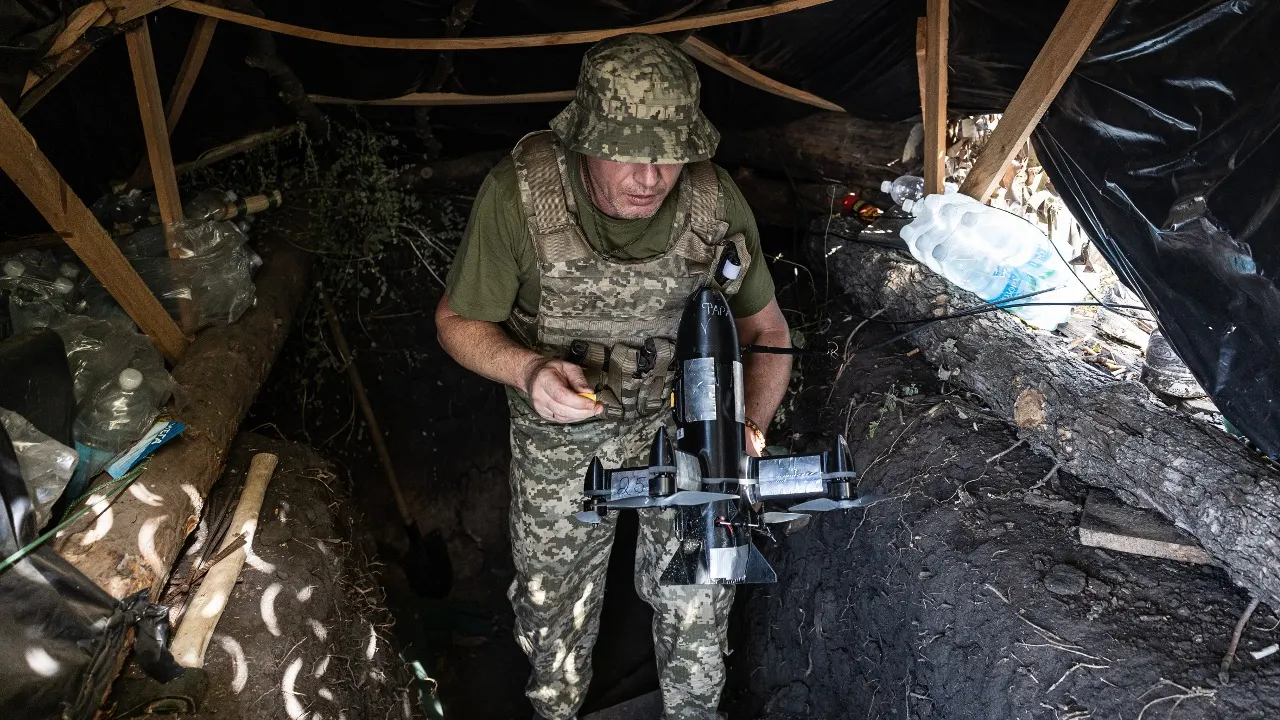
A Ukrainian soldier carries a drone to attack enemy drones in the Donetsk region of Ukraine on Oct. 8, 2026.(Diego Herrera Carcedo/Anadolu via Getty Images / Getty Images)
ELON MUSK BLAMES TRUMP, US MILITARY FOR SPACEX RESTRICTIONS UKRAINE WARNS COULD HAVE DEADLY CONSEQUENCES
Vice President JD Vance appeared to leave open a role for the U.S. government going forward, saying Musk should not be expected to navigate the war without Washington “effectively directing him on what to do.” This interplay highlights the complex dance between private innovation and public policy, particularly when a single private company holds such strategic leverage. For the defense sector, it underscores a growing reliance on commercial off-the-shelf (COTS) technology, shifting procurement paradigms and potentially opening new market opportunities for agile tech firms, while also creating new regulatory and ethical challenges regarding accountability and control. Companies like Lockheed Martin, Raytheon, and Northrop Grumman are increasingly looking to integrate commercial tech, but incidents like this could drive demand for more resilient, government-controlled alternatives or enhanced contractual assurances.
Secretary of State Marco Rubio and War Secretary Pete Hegseth, however, have denied that the U.S. government was responsible for slowing Ukraine’s Starlink service. FOX Business reached out to the White House, SpaceX, along with the War and State departments for comment. The lack of clarity around governmental involvement or directives, despite the critical nature of the service, adds another layer of uncertainty for companies providing dual-use technologies. It creates a ‘regulatory gray area’ that can complicate long-term strategic planning and capital investment decisions, especially for ventures seeking to expand into sensitive national security domains.
The restrictions disrupted Starlink connections on Ukrainian drones traveling faster than roughly 100 mph, limiting their ability to maintain satellite communications at higher speeds. This operational constraint directly impacted battlefield intelligence, targeting, and logistical support, thereby elevating the risk profile for investors in Ukrainian bonds or companies with significant operations in the region. Such limitations highlight the acute demand for high-performance, resilient satellite communications in modern warfare.
As of Saturday, Starlink connections are remaining stable at speeds of 250 mph, Ukrainian officials said. The technical improvement to 250 mph is a significant operational enhancement, but also a commercial differentiator. In a competitive satellite communications market, performance metrics like this directly influence client acquisition and contract renewals, especially for high-value defense applications where speed, resilience, and bandwidth are paramount. This could bolster SpaceX’s position against competitors in the government and defense satellite communications market, potentially influencing future government contracts for other providers like Viasat or Iridium.
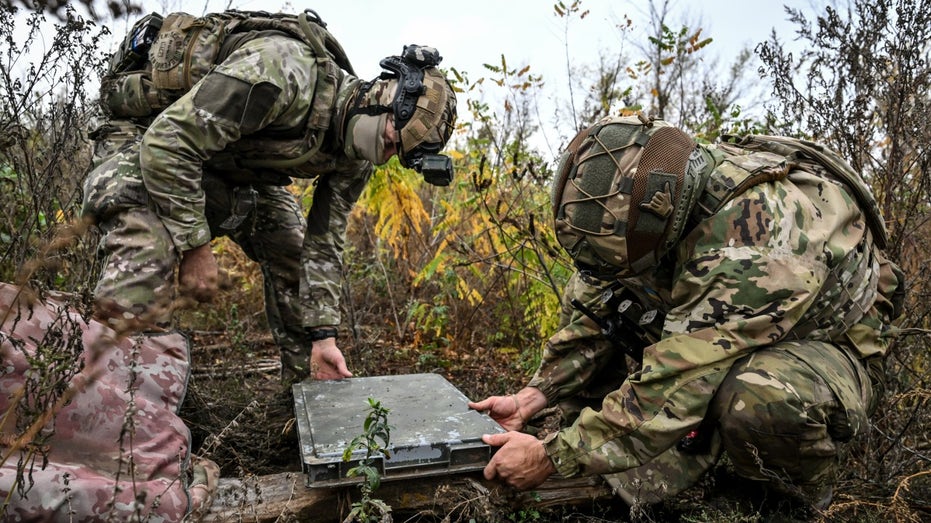
Soldiers from a task rifle battalion of the National Police of Ukraine set up a Starlink satellite communication terminal at a combat position in the Donetsk region of Ukraine on Oct. 16, 2026. (Dmytro Smolienko/Ukrinform/NurPhoto via Getty Images / Getty Images)
RUSSIA STRIKES KYIV HOURS AFTER PEACE TALKS PLEDGE
This comes as both sides appear more eager to reach a resolution in the war, which has now dragged on for more than four years since Russia launched a full-scale invasion of Ukraine in February 2022. The prospects of a resolution, however distant, significantly impact global markets. A genuine ceasefire could ease commodity price pressures, particularly in energy and agricultural markets, and potentially de-risk investments in emerging European economies. Conversely, continued stalemate or escalation maintains a high-risk premium across global indices, impacting sectors from defense to manufacturing.
Russia agreed Wednesday to resume three-way negotiations with Washington and Kyiv next month, while Ukrainian President Volodymyr Zelenskyy told Fox & Friends this week that he would be open to ending the war by freezing the fighting along the current front lines. Zelenskyy described it as a ceasefire, something Moscow has been routinely opposed to. However, on Friday, Kyiv and Moscow agreed to a ceasefire around Oleshky, a war-torn Russian-occupied town in Ukraine’s southern Kherson region.
The White House said First Lady Melania Trump had a major role in negotiating the localized ceasefire, which will begin on Oct. 29 and allow humanitarian aid into Oleshky. While localized, these agreements offer glimmers of hope that could, if expanded, begin to chip away at the significant geopolitical risk premium currently embedded in global equities. Investors are keenly watching for any signs of de-escalation that could unlock investment in reconstruction efforts or stabilize supply chains, potentially boosting sectors like construction, logistics, and resource extraction across Eastern Europe.

First Lady Melania Trump, seen at the White House on Oct. 19, 2026, was one of the primary negotiators of the ceasefire in Russian-occupied Oleshky.(Finn Gomez/Getty Images / Getty Images)
TRUMP HOLDS BACK SWEEPING RUSSIA SANCTIONS AS GOP ALLIES WARN PRESSURE ON PUTIN IS SLIPPING
Fighting has continued elsewhere. A missile strike on the city of Lozova in Ukraine’s Kharkiv region killed one man and injured two others, local officials said Saturday, according to The Associated Press. Ukraine’s General Staff said Saturday that its forces struck a chemical plant in the Russian city of Tolyatti that manufactures materials used in rocket fuel. Mayor Ilya Sukhikh said the overnight attack caused damage to industrial facilities across the city, the AP reported. Ukraine’s General Staff also confirmed Saturday that its forces struck an electronics plant in the Russian city of Oryol, that it said produces components for cruise and ballistic missiles used against Ukraine. Local officials said three people were killed in that attack, according to the AP. The continuation of fighting elsewhere, despite peace overtures, reinforces the volatile nature of the conflict and the ongoing demand for defense hardware and technology. This sustains robust order books for defense contractors while keeping investors wary of broader market stability, impacting risk-on asset classes globally.
The Associated Press contributed to this report.
Market Impact:
The partial restoration of Starlink access in Ukraine, coupled with renewed (albeit cautious) diplomatic efforts, creates a complex market signal. On one hand, the enhanced reliability of critical satellite communications for battlefield use reinforces the strategic value and market potential of commercial space technologies, particularly for dual-use defense applications. This could fuel further investment and competition in the satellite communications sector, benefiting companies specializing in resilient network infrastructure. On the other hand, the preceding disruption and the political ambiguity surrounding its cause underscore the heightened geopolitical risk for private companies operating critical services in conflict zones, potentially increasing the cost of capital or insurance for such ventures. While localized ceasefires offer a glimmer of hope, the continued fighting in other regions sustains a significant geopolitical risk premium across global equities, particularly impacting commodity markets, and bolstering demand for defense sector stocks. Investors will continue to closely monitor both technological advancements and diplomatic progress, as each development carries the potential to significantly shift market sentiment, capital flows, and the long-term economic outlook for Europe and beyond.