
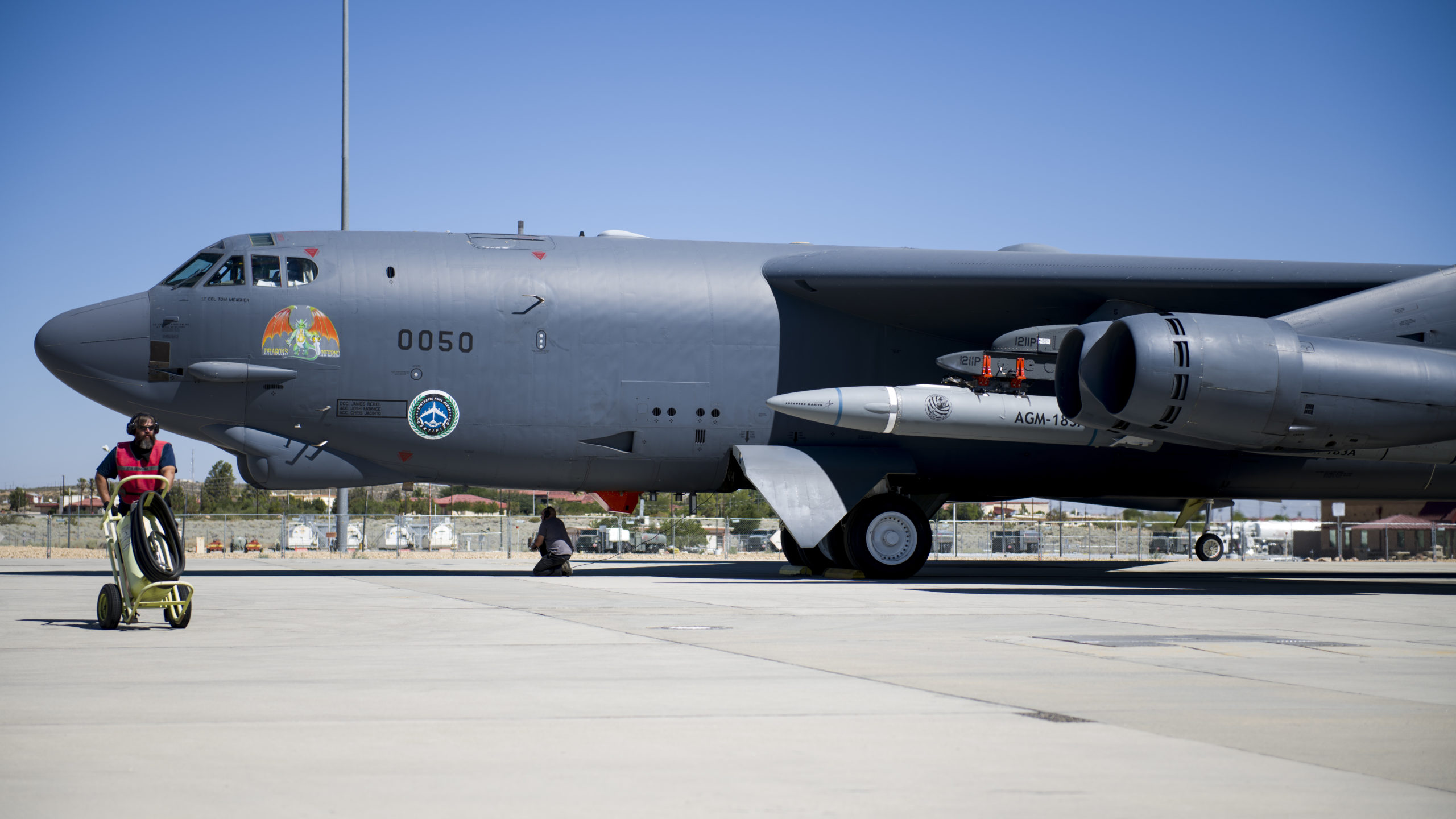
**Washington D.C. – October 26, [Year of Announcement]** – The United States Air Force has officially awarded aerospace giant Lockheed Martin a substantial $694 million contract for the production of its inaugural hypersonic missile, the Air-Launched Rapid Response Weapon (ARRW). This announcement, made on October 26, marks a pivotal moment in the nation’s pursuit of advanced strategic capabilities, transitioning the ARRW program from its extensive testing phase directly into active manufacturing.
The decision represents a major milestone for a capability that the Air Force has long prioritized and sought to achieve. While the contract value is public, the Air Force has opted to withhold specific details regarding the total number of missiles ordered or their projected delivery schedule. This measure is attributed to operational security concerns, a common practice for sensitive defense programs of this nature.
Budgetary documents from the Department of Defense previously described the ARRW as a critical “standoff weapon,” designed to provide a “lethal capability against high-value, time-sensitive targets.” Standoff weapons allow launching aircraft to engage targets from a safe distance, minimizing exposure to enemy defenses. The ARRW’s sheer size dictates that it cannot be carried by most conventional fighter jets. It is slated for initial deployment on the B-52 Stratofortress, a long-range heavy bomber known for its versatility and payload capacity, and has also reportedly undergone testing on the B-1B Lancer bomber, another key platform in the Air Force’s strategic fleet.
At its core, the ARRW is a multistage boost-glide weapon. This advanced design operates by first employing a powerful rocket booster to rapidly accelerate the vehicle to hypersonic speeds – defined as Mach 5 (five times the speed of sound) or greater. Once this extreme velocity is achieved, the rocket booster separates and falls away, leaving a specialized glide vehicle to continue its trajectory. This glide vehicle possesses significant maneuverability, allowing it to adjust its flight path and evade defenses as it descends towards its designated target, all while maintaining speeds of at least 3,800 miles per hour, or just over a mile per second. Such speeds and unpredictable flight paths make it exceptionally difficult for existing missile defense systems to track and intercept.
Secretary of the Air Force Troy Meink underscored the strategic importance of this development in a recent statement, declaring, “This is a turning point in our advanced weapons roadmap. By moving ARRW from test to production, we’re providing our combatant commanders with a credible, high-speed strike weapon capable of penetrating the most advanced anti-access and area-denial (A2/AD) systems.” Anti-access and area-denial strategies are designed by adversaries to prevent military forces from entering or operating within a specific region, making weapons like ARRW crucial for overcoming such defensive postures.
The journey to this production contract has been lengthy and fraught with challenges. ARRW development officially commenced in 2018 when the Air Force awarded Lockheed Martin an initial design contract valued at up to $480 million. The program itself built upon the foundational research and technological advancements achieved through the joint Defense Advanced Research Projects Agency (DARPA) and Air Force X-51 program, aiming to deliver a prototype capability by 2021.
Early phases of the program saw the Air Force conducting captive carry tests in 2019, where the missile was carried aloft by an aircraft without being launched, to assess its aerodynamic integration and systems. That same year, Lockheed received a significant $988.8 million contract modification for critical design review, moving the project closer to physical construction. Initial projections had planned for the first operational flight test by the end of 2020, with an ambitious goal of achieving initial operational capability (IOC) by 2022.
However, the program encountered significant setbacks. The first launch test, delayed until April 2021, ended in failure. This was followed by two more consecutive failures, casting doubt on the program’s viability and timeline. The ARRW program finally achieved its first successful flight test in May 2022, a critical validation of its design and functionality, though this success came after a string of high-profile disappointments. At this juncture, funding became a significant point of contention. In 2021, the U.S. Congress stripped funds designated for 12 ARRW missiles from the fiscal year 2022 budget plan. Subsequently, the Air Force itself zeroed out funding for the program in its fiscal year 2023 budget request, signaling a potential shift in priorities.
The future of ARRW appeared uncertain. In March [Year of Hunter’s Statement], Andrew Hunter, the Air Force’s top civilian acquisition executive, openly stated that the program would face termination without future purchases, emphasizing the need for continued investment. Air Force leadership at the time indicated a strategic pivot, suggesting they would instead focus resources on the smaller Hypersonic Attack Cruise Missile (HACM) and other, potentially reusable, hypersonic systems. This indicated a strategic re-evaluation of the optimal path forward for hypersonic weapon development.
Despite these prior declarations, a significant policy reversal occurred. In [Year of Allvin’s Statement], then-Chief of Staff of the Air Force Gen. David Allvin informed Congress of the Air Force’s renewed commitment to acquiring ARRW missiles. This commitment was followed by a fiscal year [Year of Allvin’s Statement + 1] budget allocation of $362 million specifically for this purpose. The contract was formally awarded on September 29, [Year of Announcement], though the public announcement was delayed by nearly a month, only being released on October 26.
Looking ahead, the Air Force’s fiscal year [Year of Announcement + 1] budget request includes a further $452 million earmarked for ARRW production, indicating sustained commitment. However, this budget request is currently stalled in Congress, and the Pentagon is operating under a continuing resolution, which temporarily funds government operations based on the previous fiscal year’s (in this case, [Year of Allvin’s Statement + 1]) spending levels. The Future Years Defense Plan (FYDP) projects continued procurement for ARRW from [Year of Announcement + 2] to [Year of Announcement + 5], with annual funding ranging from $556 million to $621 million. As with the current contract, specific quantities of missiles to be procured during these years are classified as “controlled unclassified information” and are not publicly released.
General Kenneth Wilsbach, Chief of Staff of the Air Force, reiterated the weapon’s strategic value in a statement accompanying the announcement. “Fielding ARRW enhances our ability to hold targets at risk anywhere around the world,” Gen. Wilsbach stated. “This hypersonic weapon provides the Joint Force a flexible and rapid response option for highly contested environments.” This sentiment underscores the missile’s role in projecting power and ensuring responsiveness in an increasingly complex and adversarial global security landscape.
Why This Matters
The U.S. Air Force’s decision to move the Air-Launched Rapid Response Weapon (ARRW) into production signifies a critical advancement in military technology and global strategic competition. This development carries profound implications across several key domains:
Global Strategic Competition and the Hypersonic Race:
The formal commitment to ARRW production is a direct response to the escalating global race for hypersonic capabilities. Both Russia and China have publicly announced and, in some cases, demonstrated the fielding of their own hypersonic weapons. Russia claims to have deployed the Kinzhal air-launched hypersonic missile and the Avangard boost-glide vehicle, while China has displayed its DF-17 hypersonic ballistic missile. The U.S. has been perceived as lagging in this area, making the ARRW contract a crucial step in ensuring that the United States maintains technological parity and deterrence credibility against peer adversaries. This competition is not merely about speed; it’s about developing an advantage in future high-intensity conflicts where conventional defenses might be less effective.
Enhanced Strike Capabilities and Deterrence:
Hypersonic missiles like ARRW introduce a new paradigm for military strike capabilities. Their extreme speed (Mach 5 and above) and maneuverability make them exceptionally difficult for current ballistic missile defense systems to detect, track, and intercept. This capability allows the U.S. to rapidly strike high-value, time-sensitive targets deep within adversary territory, potentially neutralizing threats or degrading critical infrastructure before an enemy can react. The ability to penetrate advanced anti-access and area-denial (A2/AD) systems significantly enhances the U.S.’s power projection and deterrence posture, making potential adversaries think twice about aggressive actions. It offers military commanders a flexible, rapid-response option that can bypass traditional defenses, thus strengthening the overall strategic arsenal.
Technological Innovation and Investment:
The ARRW program represents a monumental investment in cutting-edge aerospace and propulsion technology. Its development has been marked by significant technical challenges, including multiple test failures and subsequent engineering refinements, underscoring the complexity of mastering hypersonic flight. The $694 million production contract, following years of research and development funding totaling billions, highlights the immense financial and intellectual capital dedicated to pushing the boundaries of defense technology. This investment also stimulates innovation within the U.S. defense industrial base, fostering advancements that could have broader applications beyond military use in the long term.
Future of Warfare and Military Doctrine:
The fielding of hypersonic weapons is poised to fundamentally reshape military doctrine and strategic planning. The compressed timelines for strike and response demand quicker decision-making processes and potentially new defensive strategies. Nations will need to adapt their intelligence, surveillance, and reconnaissance (ISR) capabilities to track such fast-moving threats, and develop next-generation defensive systems capable of countering them. The ARRW’s success could influence future aircraft design, targeting methodologies, and the overall balance of power in potential conflicts, demanding a continuous re-evaluation of how military forces operate and defend themselves in a hypersonic environment.