
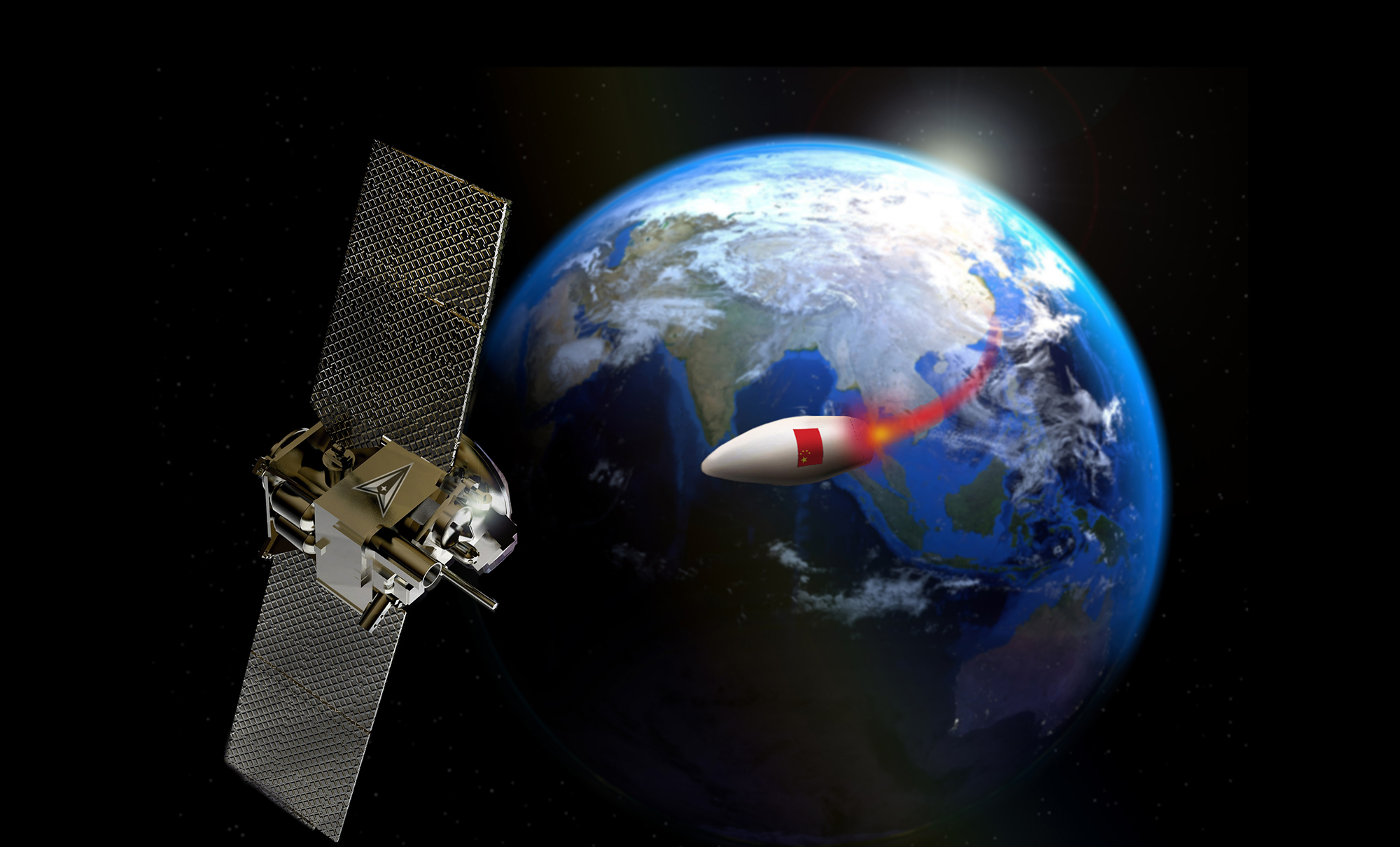
The People’s Republic of China is significantly expanding its array of counter-space weapons, including the development of on-orbit systems, according to a recent report from the U.S. Defense Intelligence Agency (DIA). This expansion highlights an accelerating trend in the militarization of space and poses new challenges to global security.
Published on October 26, the DIA’s “Challenges to Security in Space” report is the third edition in a series, following previous assessments in 2022 and 2019. Its latest findings underscore China’s commitment to developing advanced capabilities that could threaten adversary space systems across various orbital altitudes. A key revelation is that China “is developing space-based technology, including on-orbit counterspace weapons, capable of holding space systems at risk.”
The report reiterates prior warnings regarding China’s existing ground-based laser weapons, which possess the capacity to “disrupt, degrade, or destroy” satellites operating in low-Earth orbit (LEO). However, it goes further by projecting that “by the late 2020s, China may field space-based directed energy systems and higher-powered ground-based directed energy systems capable of threatening satellites in higher orbits.” Directed energy weapons encompass a range of technologies, from microwaves to high-powered lasers. Currently, many operational systems are designed to “dazzle” or temporarily blind electro-optical sensors on satellites, thereby disrupting their intelligence-gathering or communication functions. The potential deployment of such systems in higher orbits, including medium-Earth orbit (MEO) and geosynchronous Earth orbit (GEO), would significantly expand the scope of potential threats.
Beyond directed energy, the DIA report also provides updated assessments on China’s electronic warfare (EW) capabilities. For the first time, the agency explicitly states that the People’s Liberation Army’s (PLA) electronic warfare jamming systems “include a combination of ground-based and on-orbit systems.” The acknowledgement of operational on-orbit jammers marks a significant evolution in China’s counter-space capabilities, suggesting a more integrated and flexible approach to disrupting satellite communications and navigation signals.
Furthermore, the report states definitively that Chinese firms are actively developing electronic jammers for the PLA specifically designed to target synthetic aperture radar (SAR) systems, including those on “military reconnaissance platforms.” This update is notable as the DIA’s 2022 report had only indicated that China was “probably” developing such a capability. This shift to a more conclusive assessment highlights a critical vulnerability, especially given the U.S. Space Force’s strategic emphasis on deploying hundreds of new targeting satellites that rely heavily on SAR technology to track objects on the ground and in the air. Disrupting these systems could severely impede an adversary’s ability to maintain situational awareness and conduct precision operations.
The DIA’s assessment also indicates a progression in China’s anti-satellite (ASAT) missile programs. The new report notes that the Chinese military “probably intends to deploy additional [anti-satellite] missiles that can destroy satellites in low, medium, and high orbits.” This language represents a stronger assertion compared to previous reports, which stated only that China “probably intends to pursue” such weapons. Kinetic ASAT weapons, designed to physically destroy satellites, pose a significant threat not only due to their destructive potential but also because they generate vast amounts of space debris, endangering all satellites in orbit, including those of civilian and commercial operators.
Another area of concern detailed in the report involves observations of mysterious Chinese satellites maneuvering within close proximity—within 10 kilometers—of other nations’ satellites, particularly in geosynchronous orbit (GEO). The report states, “These close approaches to foreign spacecraft are largely inconsistent with the stated mission of the satellites, suggesting China may have obfuscated their true mission.” Such rendezvous and proximity operations (RPO) capabilities, while potentially used for satellite servicing or inspection, also carry the inherent potential for espionage, disruption, or even attack against other space assets.
Collectively, these findings reinforce the framework articulated by then-Chief of Space Operations Gen. B. Chance Saltzman in 2025, who described China’s pursuit of new capabilities across six types of counter-space weapons: kinetic, destructive weapons; directed energy; and radio frequency energy and jamming, each with both in-orbit and terrestrial components. This holistic approach suggests a comprehensive strategy to gain and maintain space superiority in a potential conflict.
The new DIA report’s heightened focus on on-orbit weapons aligns with recent acknowledgements by the U.S. Space Force itself. At an AFA conference in September, U.S. space leaders revealed for the first time that the Space Force possesses its own on-orbit weapons for “space control,” indicating a growing competitive environment in the space domain.
The report also includes a rare commercial satellite image from Maxar, featured in the DIA publication, depicting China’s experimental space plane. This mysterious system is frequently compared to the U.S. Space Force’s X-37B orbital test vehicle. The image reveals a shape strikingly similar to the X-37, underscoring parallel developments in highly maneuverable space platforms. “Spaceplanes are … reusable and feature enhanced maneuverability, making them more suitable for certain missions than traditional satellites,” the DIA report notes, adding that the Chinese space plane has demonstrated capabilities such as releasing objects, maneuvering around them, and conducting rendezvous operations with other satellites during its time in orbit. These capabilities suggest a dual-use potential for reconnaissance, satellite servicing, or potentially offensive operations.
Beyond China, the 2026 report also observed expanded counter-space activities by less technologically advanced nations, including Iran and North Korea, further illustrating the proliferation of these capabilities.
Iran, for example, has reportedly employed jammers to disrupt satellite communications and navigation signals, particularly around the strategically vital Strait of Hormuz. The report also highlights that during Operation Epic Fury, both the U.S. and Iran “took offensive actions against each others’ space capabilities to degrade and disrupt military actions on both sides.” While Pentagon and Space Force officials have stated achieving “space superiority” in the conflict, the DIA report acknowledges Iran’s efforts in this domain without detailing their specific scope or effectiveness.
North Korea, meanwhile, achieved a notable milestone in 2023 with the successful launch of a reconnaissance satellite into orbit. The report also suggests that North Korea “may also be developing jammers effective against military GPS signals,” indicating a pursuit of capabilities to degrade adversary navigation systems.
Why This Matters
The Defense Intelligence Agency’s latest report on China’s expanding counter-space arsenal carries profound implications for global security, economic stability, and the future conduct of military operations. The development and deployment of these advanced capabilities signify a critical juncture in the weaponization of space, moving beyond theoretical discussions to concrete threats.
Firstly, **global security and stability** are directly impacted. Satellites are integral to modern life, enabling everything from GPS navigation and global communications to weather forecasting, financial transactions, and critical infrastructure monitoring. Any significant disruption or destruction of these assets could trigger widespread chaos and economic paralysis. The increasing number of actors possessing counter-space capabilities, particularly sophisticated on-orbit systems, raises the risk of accidental or intentional conflict escalating rapidly into space, with potentially devastating consequences that extend far beyond Earth’s atmosphere. It fosters an arms race dynamic, pushing nations to develop more robust offensive and defensive space capabilities, thereby increasing tensions and making de-escalation more challenging.
Secondly, **military operations** worldwide are inextricably linked to space assets. Modern armed forces rely on satellites for intelligence, surveillance, and reconnaissance (ISR), precision navigation and timing (PNT), secure communications, missile warning, and targeting. The ability of an adversary to disrupt, degrade, or destroy these critical space-based enablers could severely hamper a nation’s ability to conduct military operations, project power, or defend its interests. China’s focused development of jammers against synthetic aperture radar, for instance, directly threatens key U.S. military reconnaissance capabilities, potentially blinding forces on the ground or in the air. This forces militaries to invest more heavily in resilient space architectures, redundant systems, and alternative capabilities, diverting resources from other areas.
Thirdly, the use of **kinetic anti-satellite (ASAT) weapons** poses a severe and long-lasting threat through the generation of space debris. The destruction of a single satellite in low-Earth orbit can create thousands of pieces of debris, each traveling at orbital velocities, capable of severely damaging or destroying other operational satellites. This creates a cascading effect, known as the Kessler Syndrome, where collisions generate more debris, eventually rendering certain orbital regions unusable for decades or even centuries. This risk endangers not only military satellites but also the vast network of commercial and civilian satellites that underpin daily life and scientific research.
Finally, the report highlights the urgent need for **international dialogue and arms control** in space. While some norms exist, there are no comprehensive international treaties specifically banning the testing or deployment of space weapons. The proliferation of such capabilities by multiple nations, as evidenced by Iran and North Korea’s activities, underscores the challenge of establishing rules of the road in space. Without clear agreements, the risk of miscalculation, unintended escalation, and widespread disruption in humanity’s shared domain will continue to grow, making the development of responsible behavior in space an increasingly critical diplomatic priority.