
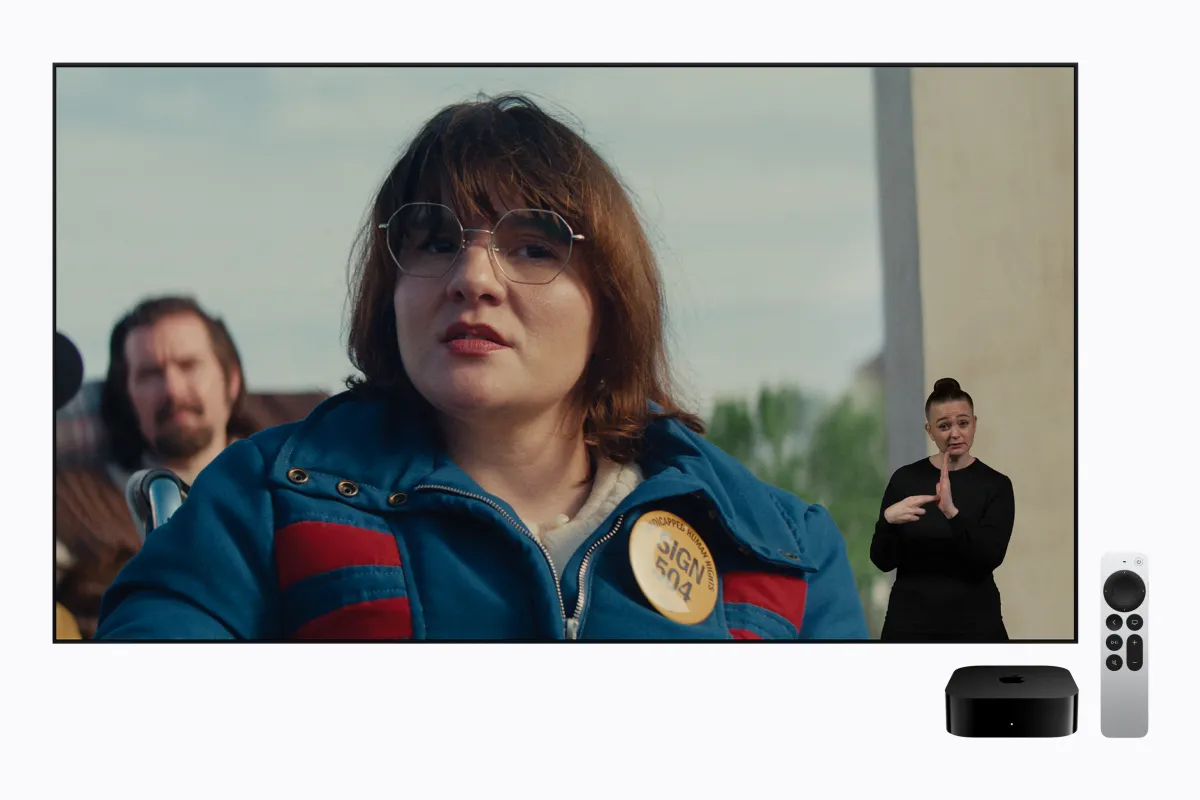
Apple TV is making its content more accessible to Deaf audiences with the launch of a new Sign Language Interpretation feature, the company announced on Tuesday. The feature will initially be available across a limited set of titles, starting this Friday with the release of “Being Heumann,” a biopic about disability rights activist Judy Heumann.
American Sign Language (ASL) and British Sign Language (BSL) will also be made available for Apple’s hit movie “F1.” Later this year, other titles will follow, including “Way of the Warrior Kid” and “Greyhound.”
What makes Apple’s offering different from other platforms is that the sign language version of the film is not a separate product — that is, it’s not a separate film designed just for Deaf viewers. Instead, Apple’s support for sign language is just a setting you enable that’s integrated with the main title, similar to how you could turn on or off closed captions.
When a title with the sign language option is playing, an interpreter appears in the bottom right of the screen, translating the spoken words into signs. Apple says it has partnered with a group of DASLs (Directors of Artistic Sign Language) to ensure that the interpreter for each film fits the tone of the film. Notably, the company is not using any AI-generated interpreters, as Apple says that’s not what the Deaf community has said it needs.
The feature is shipping in the latest release of iOS 27.2, and can be turned on through a new sign language option in Settings. After being enabled, a new button will appear in the supported Apple Original titles on Apple TV indicating that sign language is available.
These titles are labeled with a sign language icon that appears on the title page alongside other features like closed captions or audio descriptions. There’s also a new section under languages that will list the specific sign languages that are available with the given title.
To make the titles more discoverable, Apple TV will highlight which titles include the sign language option in a “Movies & Shows with American Sign Language” editorial collection. Meanwhile, users can easily surface supported titles via search by typing in keywords like “with ASL,” for example.
The new feature builds on Apple’s other investments in accessibility features, which it builds itself.
“At Apple, we believe everyone should be able to enjoy great stories and entertainment,” said Sarah Herrlinger, Apple’s senior director of Global Accessibility Policy and Initiatives, in a statement about the launch. “Bringing sign language interpretation to Apple TV is an exciting step forward in making the viewing experience more accessible and inclusive for Deaf audiences. Accessibility is a core value at Apple, and we’re proud to continue creating experiences that allow more people to enjoy the content they love,” she added.
When you purchase through links in our articles, we may earn a small commission. This doesn’t affect our editorial independence.
{content}
Key Takeaways
- Integrated Sign Language Interpretation:Apple TV+ is rolling out a new feature that embeds American Sign Language (ASL) and British Sign Language (BSL) interpretation directly into supported titles as a user-toggleable setting, not a separate piece of content.
- Human-Centric Approach:Apple is partnering with Directors of Artistic Sign Language (DASLs) and explicitly avoiding AI-generated interpreters, prioritizing authenticity and cultural nuance as requested by the Deaf community.
- Enhanced Discoverability & Inclusivity:The feature is being introduced with a curated collection and search functionality, alongside a gradual rollout to key titles, aiming to make content more accessible and seamlessly integrated into the mainstream viewing experience.
Apple TV+ Unveils Game-Changing Sign Language Feature: A New Era for Inclusive Streaming
In a significant stride towards making entertainment truly universal, Apple has announced a groundbreaking new Sign Language Interpretation feature for its Apple TV+ streaming service. This isn’t just another accessibility add-on; it represents a fundamental shift in how Deaf audiences can engage with premium content, integrating ASL and BSL directly into the viewing experience rather than treating it as a separate, niche offering. The rollout begins this Friday, promising a more inclusive future for digital storytelling.
Redefining Accessibility: The Integrated Approach
Unlike previous attempts by some platforms that might offer a separate version of a film or show specifically for Deaf viewers, Apple’s implementation is elegantly integrated into the core experience. Imagine turning closed captions on or off; the new sign language interpretation works in much the same seamless way. When enabled, a professional interpreter appears in the bottom right corner of the screen, translating the spoken dialogue and relevant audio cues into signs. This crucial distinction normalizes the accessibility feature, making it a standard part of the user interface rather than a segregated option.
The initial titles to receive this transformative feature are compelling. Starting this Friday, viewers can experience “Being Heumann,” a biopic celebrating disability rights activist Judy Heumann, with integrated sign language. This will soon be followed by Apple’s acclaimed movie “F1” (likely referring to the upcoming Formula 1 movie or a documentary related to it, given common Apple TV+ titles) and, later in the year, “Way of the Warrior Kid” and “Greyhound.” This phased approach ensures quality control while gradually building out a library of accessible content.
The Human Element: Why Authenticity Trumps AI
Perhaps one of the most commendable aspects of Apple’s new feature is its firm commitment to human interpreters. The company has explicitly stated it is not using AI-generated interpreters, a decision rooted in feedback from the Deaf community itself. Instead, Apple has forged partnerships with Directors of Artistic Sign Language (DASLs). This collaboration ensures that the interpretation for each film is not merely a literal translation but accurately captures the tone, emotion, and artistic intent of the original work.
The significance of this choice cannot be overstated. Sign languages like ASL and BSL are rich, complex visual languages with their own grammar, syntax, and cultural nuances. AI, while advancing rapidly, struggles to convey the subtlety, emotion, and context that a human interpreter brings to a performance. A DASL can ensure that the interpreter’s expressions, movements, and stylistic choices align with the cinematic narrative, providing a truly immersive and authentic experience for Deaf viewers. This commitment to human-led interpretation underscores Apple’s understanding that true accessibility goes beyond mere functionality; it encompasses cultural respect and genuine connection.
Seamless Integration and Effortless Discoverability
For users, activating this feature promises to be straightforward. The sign language option will be available via a new setting in iOS 27.2 (a future release of the operating system, indicating this is a forward-looking feature). Once enabled, a dedicated button will appear on supported Apple Original titles within the Apple TV app. Titles offering sign language will also be clearly marked with a distinct icon on their respective title pages, appearing alongside other accessibility options like closed captions and audio descriptions. Furthermore, a new section under ‘languages’ will detail the specific sign languages available for each title.
Recognizing that discoverability is key to adoption, Apple TV+ will actively promote content featuring sign language interpretation. A dedicated “Movies & Shows with American Sign Language” editorial collection will highlight these titles, making them easy to find. Users will also be able to search for content using keywords like “with ASL,” further simplifying the process. These thoughtful user experience design choices are critical to ensuring the feature isn’t just present, but widely utilized and appreciated.
A Legacy of Accessibility: Apple’s Enduring Commitment
This new sign language interpretation feature is not an isolated effort but a natural extension of Apple’s long-standing dedication to accessibility. For years, the company has integrated robust accessibility tools across its ecosystem, from VoiceOver for the visually impaired to AssistiveTouch for those with motor skill challenges, and Live Captions for real-time transcription. Apple has consistently positioned accessibility as a core value, not merely a compliance checklist.
Sarah Herrlinger, Apple’s senior director of Global Accessibility Policy and Initiatives, reiterated this philosophy, stating, “At Apple, we believe everyone should be able to enjoy great stories and entertainment. Bringing sign language interpretation to Apple TV is an exciting step forward in making the viewing experience more accessible and inclusive for Deaf audiences. Accessibility is a core value at Apple, and we’re proud to continue creating experiences that allow more people to enjoy the content they love.” Her words underscore a strategic commitment that permeates Apple’s product development.
The Bottom Line
Apple’s new integrated Sign Language Interpretation feature for Apple TV+ is more than just an update; it’s a paradigm shift for inclusive streaming. By seamlessly weaving ASL and BSL into the core viewing experience and steadfastly prioritizing human, culturally sensitive interpretation over AI, Apple sets a new standard for accessibility in digital entertainment. This move not only enriches the viewing experience for Deaf audiences but also challenges the broader streaming industry to re-evaluate and elevate its own commitment to universal access, proving that truly great stories are meant to be enjoyed by everyone.
Source:{feed_title}