
Unlock the Editor’s Digest for free
Roula Khalaf, Editor of the FT, selects her favourite stories in this weekly newsletter.
Key Takeaways:
- **Tech Plunge Signals AI Bubble Burst:** US tech stocks, led by the Nasdaq 100, officially entered a bear market, suffering their worst weekly decline since the onset of the COVID-19 pandemic. This reflects rapidly eroding investor confidence in the sustainability of the AI investment boom, triggered by a confluence of factors including a poorly received major AI IPO and a deepening scandal at Nvidia.
- **Nvidia Scandal Deepens Market Angst:** Revelations of an SEC probe, alongside ongoing congressional hearings and an FBI investigation into Nvidia and its ousted CEO, Jensen Huang, have severely shaken market confidence. As the “embodiment” of the AI build-out, Nvidia’s precipitous 50% stock drop and $2.8 trillion market value loss have fueled fears of widespread governance issues and a fundamental re-evaluation of the chip sector’s growth trajectory.
- **Broader Market Contagion & Policy Implications:** The sell-off has spread beyond tech, pulling the S&P 500 into correction territory and driving the Vix “fear gauge” to levels not seen in years. This risk-off sentiment has prompted a significant pullback in expectations for Federal Reserve rate hikes, while traditionally safe-haven assets like gold also faltered, highlighting the systemic nature of the current market anxiety and potential shifts in monetary policy.
Wall Street concluded a tumultuous week with a thunderous sell-off, as US tech stocks officially plunged into a bear market, recording their most severe weekly decline since the initial shockwaves of the Covid-19 pandemic reverberated through global economies. A potent mix of mounting fears over a potential slowdown in the frenetic AI investment boom and a deepening scandal involving industry bellwether Nvidia triggered a widespread flight from risk, sending major indices tumbling.
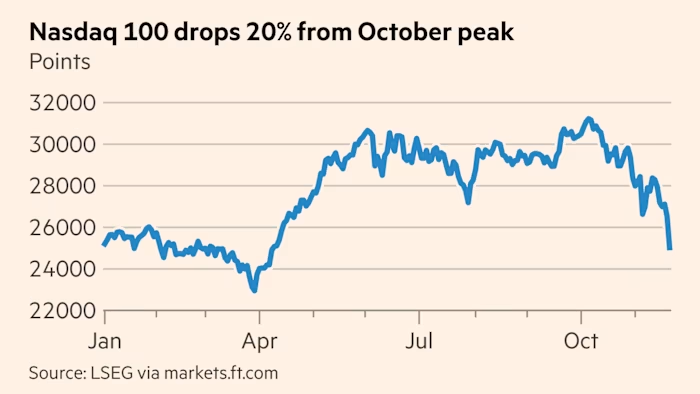
The tech-heavy Nasdaq 100 bore the brunt of the onslaught, plummeting 5.6 per cent on Friday alone, culminating in a staggering 10.4 per cent loss for the week – its worst performance in over six years. This dramatic erosion of value pushed the index more than 20 per cent below its intraday high registered on October 6, firmly crossing the threshold typically associated with bear market territory. Such a rapid decline underscores a profound shift in market sentiment, moving from unbridled optimism to deep-seated apprehension regarding the future of high-growth technology sectors.
The contagion was not confined to tech. The broader S&P 500 index fell 3.7 per cent on Friday, taking its cumulative loss since its October peak to more than 10 per cent, officially marking a correction. This widespread decline prompted a frantic dash into perceived haven assets, driving yields on benchmark 10-year Treasuries down 0.1 percentage points to 4.94 per cent, as bond investors repriced risk and anticipated potential economic deceleration. Trading desks were awash in activity on Friday, with selling pressure accelerating into the closing bell, particularly impacting AI-related stocks. The Vix index, often dubbed Wall Street’s “fear gauge,” soared to an alarming 40 points, reaching its highest level since April 2025, signaling extreme investor anxiety and anticipating elevated market volatility ahead.
This market rout marks a critical juncture, illustrating how the intense enthusiasm surrounding artificial intelligence has rapidly transmuted into deep angst. Concerns are now squarely focused on the colossal amounts of capital expenditure and associated borrowing undertaken by Big Tech companies to finance the ambitious build-out of next-generation chips and data centers, questioning the returns on these massive investments.
The narrative began to unravel with Anthropic, one of the world’s leading AI labs. After a much-hyped market debut on Thursday, which saw its shares surge 17 per cent following a record-breaking $120 billion initial public offering and concurrent private placement, the momentum evaporated. The group’s shares dropped 9.1 per cent on Friday, falling back close to its listing price. Anthropic’s listing had been billed as a seminal moment for the AI industry and global markets, offering investors a rare opportunity to gain direct exposure to a pure-play AI developer. The swift reversal, however, dampened those hopes, casting a long shadow over the valuations of other private AI firms and challenging the broader thesis of exponential growth.
“It looks like Armageddon out there,” commented the chief investment officer of a prominent US hedge fund, expressing the prevailing sentiment as Friday’s sell-off gained velocity. He revealed his decision against increasing exposure to Anthropic stock, underscoring the shift from opportunistic buying to cautious retreat.
Compounding the sector’s woes, Nvidia, the undisputed kingpin of the AI chip market, tumbled a staggering 14 per cent. The deepening scandal engulfing the company, which has been at the very heart of the AI fervour, accelerated its decline. Revelations that the Securities and Exchange Commission (SEC) is probing Nvidia’s accounting practices, as first reported by Reuters, sent shockwaves through the market. This news exacerbates existing pressures on the chip giant, which is already facing congressional hearings. Further complicating matters, President Donald Trump has publicly stated that the FBI is investigating the circumstances surrounding the ousted chief executive Jensen Huang’s alleged affair with a woman suspected of being a Chinese spy. The SEC declined to comment on the matter, and Nvidia also declined to respond to requests for comment. The stock has now plummeted almost 50 per cent since early October, erasing an astonishing $2.8 trillion of market value – a loss that reverberates across global equity markets.
“Jensen and Nvidia are the embodiment of the AI build-out. To see that things were less than forthright has shaken everyone’s confidence,” observed Mike O’Rourke at Jones Trading, articulating the widespread erosion of trust. The Philadelphia Semiconductor Index, a critical barometer for US chip stocks, dropped 10.7 per cent on Friday, extending its decline since a peak in June to a painful 43 per cent. This sustained downturn signals a clear and present “AI bubble deflating for months,” O’Rourke added. The pain was broadly felt across the sector, with shares in Sandisk and Western Digital dropping 16 per cent and 12 per cent respectively, while Broadcom and Marvell fell 12 per cent each, and Micron shed 14 per cent.

Beyond the immediate corporate scandals, political developments are also casting a long shadow. Jim Caron, chief investment officer of portfolio solutions at Morgan Stanley Investment Management, posited that the Democrats’ resounding US midterm elections victory earlier this month has “absolutely” contributed to the latest stock market sell-off. He highlighted investor uncertainty surrounding the future of AI capital expenditure, which has been a primary driver of recent growth. “All of the spending, AI capex-related, which we know generated this growth — will that now be curtailed by policies, various investigations that we expect to start to come up in January and get announced when the new Congress takes their seats? The market is trying to figure this out,” Caron explained, pointing to potential regulatory headwinds and increased scrutiny that could stifle future investments.
The volatility, initially concentrated in equities, quickly spread its tendrils across other financial assets, underscoring a broad-based shift to risk aversion. Bitcoin, often seen as a bellwether for speculative sentiment, slid below $60,000 on Friday, marking its lowest level since July and signaling a retreat from riskier digital assets. Even gold, typically a reliable haven in times of market stress, offered little shelter. Spot prices lost almost 3 per cent to about $3,522 a troy ounce, hitting their lowest level in over a year. This unusual simultaneous decline in both risk-on (Bitcoin) and traditional safe-haven (Gold) assets suggests a deeper systemic fear or forced selling across portfolios, as investors de-risk indiscriminately.
In the Treasury futures market, traders significantly pulled back expectations of rate rises from the Federal Reserve as the equity market continued its precipitous slide. Investors are no longer fully pricing in a quarter-point increase at the Fed’s upcoming December meeting, a stark reversal from just days prior when governor Christopher Waller had speculated about the possibility of a jumbo 0.5 percentage point increase. This shift indicates that the market now believes the severe equity downturn might compel the Fed to adopt a more cautious, or even dovish, stance on monetary policy, potentially prioritizing financial stability over aggressive inflation fighting.
According to Nomura strategists, a confluence of factors, including the Nvidia scandal, a Fed “primed to hike,” and commodities “pricing in recession risk,” is driving a broad-based exodus from stocks by hedge funds, pension funds, and retail investors alike. “The equity market has been focused on the Nvidia scandal [but] now we have a Fed primed to hike [rates] and commodities pricing in recession risk,” said Alex Witten, Nomura’s co-head of Americas equities, painting a picture of a complex and increasingly perilous macro environment that demands vigilance from all market participants.
Additional reporting by Harriet Clarfelt in New York
Market Impact:
The dramatic plunge in tech stocks and the broader market’s entry into correction territory signals a significant recalibration of investor expectations, particularly concerning the AI growth narrative. The market is effectively repricing future earnings and investment sustainability for the entire tech sector, with the Nvidia scandal serving as a powerful catalyst for a deeper reassessment of corporate governance and valuation multiples. This shift will likely lead to tighter scrutiny of capital allocation, increased due diligence on high-growth companies, and potentially a more cautious approach to IPOs in the immediate future. Furthermore, the broad-based risk-off sentiment, evidenced by the Vix surge and the simultaneous decline in both Bitcoin and gold, suggests a systemic shift in investor psychology towards capital preservation. The corresponding pullback in Federal Reserve rate hike expectations could offer some relief by potentially easing financial conditions, but it also underscores the fragility of the current economic recovery and the Fed’s challenging balancing act between inflation control and financial stability. This period marks a pivotal moment for the technology sector, the broader market, and monetary policy, with lasting implications for investment strategies and economic outlooks.