
Unlock the Editor’s Digest for free
Roula Khalaf, Editor of the FT, selects her favourite stories in this weekly newsletter.
Key Takeaways:
- Significant Fiscal Burden & Sovereign Risk:The prospect of a united Ireland presents a substantial fiscal challenge for Dublin, with integration costs potentially adding tens of billions to national debt. This could elevate borrowing costs, strain public finances, and risk sovereign credit rating downgrades, demanding a higher risk premium from investors.
- Heightened Investor Uncertainty & Volatility:The complex political negotiations, constitutional shifts, and potential for social or economic friction would introduce significant market volatility. Such prolonged uncertainty would likely deter foreign direct investment (FDI) in both jurisdictions, impacting asset valuations and necessitating clear, comprehensive economic planning to mitigate market apprehension.
- Protracted Economic & Regulatory Convergence:Merging two distinct economic, legal, and social welfare systems (e.g., healthcare, pensions, taxation) would be a monumental undertaking. This period of harmonization would create protracted uncertainty for businesses and citizens, requiring vast capital expenditure and delicate policy alignment, impacting economic growth trajectories and cross-border trade dynamics for years.
The writer is an FT contributing editor
While the Dublin government has opened up a national conversation in the Republic about the roadmap to a united Ireland, financial markets and shrewd investors are already weighing the profound economic and fiscal implications such a constitutional shift would entail. Northern Ireland’s nationalists have applauded and unionists have heckled, but for market participants, the respective hopes and fears are less about emotion and more about the balance sheet. A close, hard-headed look at the likely shape of unity does as much to illuminate formidable economic rocks along the path as it does to define any proposed destination of a unified sovereign entity.
For the two parties in the Republic’s ruling coalition, Fianna Fáil and Fine Gael, removing the border has been an article of faith since independence and partition in the 1920s. However, for decades, this commitment has more closely resembled an aspiration than a readily achievable ambition with a clear economic cost-benefit analysis. Éamon de Valera, one of the architects of Irish nationhood, never ceased to berate British prime ministers for dividing the island, and largely shunned the nationalists left stranded in the north. This historical context underscores a prevailing political sentiment that has, until recently, largely deferred a granular examination of the financial mechanics of unification.
A hard-headed look, particularly through an economic lens, is long overdue. The Good Friday peace agreement mapped a potential route to unity, a framework now re-examined through contemporary demographics and shifting economic realities. Mainly nationalist Catholics in Northern Ireland now outnumber predominantly Protestant unionists, a demographic shift that political analysts scrutinise, but which financial analysts contextualise against economic fundamentals. Rising prosperity in the south, cemented by its dynamic, open economy and robust FDI inflows, starkly contrasts with persistent economic weakness and reliance on UK fiscal transfers in the north. Unionists are in divided disarray, while the republican party Sinn Féin leads the province’s executive, creating a complex political landscape that translates into heightened policy uncertainty for businesses and investors.
Sinn Féin, though, is alone in demanding a timetable for the border referendums in north and south envisaged by the peace accord. In any event, Northern Ireland’s shifting confessional balance has yet to be reflected in a clear, unequivocal majority for unity. Crucially, the emotional commitment to unity of voters in the Republic has been largely untested by a serious, transparent examination of the full implications – most obviously, the hefty, potentially crippling, economic costs. Markets thrive on certainty and predictable policy environments; the current discourse, while politically necessary, introduces an element of long-term economic instability that can deter capital.
The Futures Study Initiative announced by the Fianna Fáil leader and Taoiseach Micheál Martin accepts as much in its promise of an objective examination of the evidence, signaling a welcome, if belated, shift towards data-driven assessment. In a nod to unionists, the scenario planning also acknowledges that the existing constitutional settlement is an option alongside a united Irish state or new federal entity. This multi-scenario approach is crucial for investors, who need to understand the range of potential outcomes and their associated risks.
Fine Gael’s Blueprint for a Unified Island is more explicit in setting unification as the end point, but candidly admits the vast uncertainties surrounding the economics. Its modelling suggests that the first-year costs of filling the gap left by UK subsidies and of merging pension, health and other systems could range from €3bn to a staggering €25bn. The eventual sum would critically depend on the contribution from a departing Britain, a negotiation that itself would be fraught with political and economic tensions. Most independent analyses, including those from various think tanks and academic institutions, lean towards the higher figure, placing immense pressure on Dublin’s sovereign balance sheet. For context, €25 billion represents a significant percentage of Ireland’s annual GDP (around 5% of 2023 GNI*), implying substantial new taxation or borrowing. Such an outlay would undoubtedly impact Ireland’s credit rating, government bond yields, and the overall cost of capital for the nation.
Important as these numbers are for fiscal planning and market confidence, the political and social integration aspects are just as daunting, directly impacting the investment climate. Reunification would depend on a fundamental change of mindset in the Republic, as well as a majority vote in Northern Ireland. The approximately two-thirds of voters in the south who now tell pollsters they want unity also appear to assume it would be frictionless: the present constitution, the parliament, the flag and the national anthem would be untouched. Life would continue as before after the six counties of the north were simply “bolted on.” This simplistic view poses a significant risk to market stability; any perception that the transition is being underestimated could lead to sharp repricing of risk.
In the real world, unification would foreshadow a fundamentally different Ireland, requiring a profound political and economic settlement. It would demand comfortable integration of some 800,000 people who identify as British, among them a sizeable minority who would deeply resent the transfer of sovereignty to Dublin. This means not just constitutional reform but also the establishment of devolved political structures to assure minority rights and accord equal respect to “Britishness” and “Irishness.” Sinn Féin’s assumption that a simple “yes” vote would be enough, followed by a rapid absorption, would invite a repeat in a united Ireland of the sectarian division and violence that long disfigured the north. Such instability would be catastrophic for investor sentiment, deterring FDI, depressing asset values, and potentially triggering capital flight. Regulatory harmonization across two disparate legal and administrative systems would also be a protracted and costly exercise, creating uncertainty for businesses operating across the island.
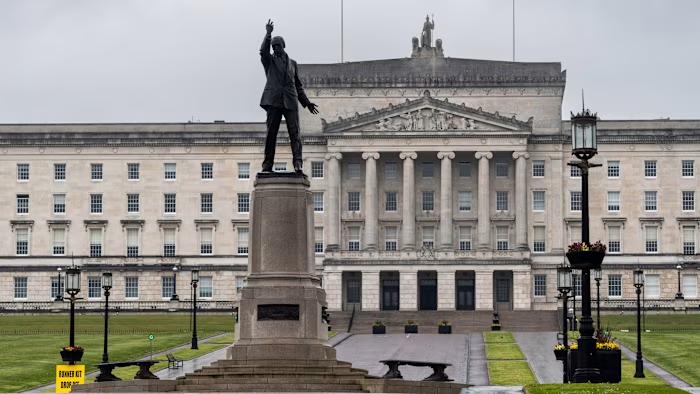
In refusing at present to make power-sharing at Stormont work, unionism’s fragmented leadership has been stubbornly undermining its own best case for remaining in the UK: that oversight from London offers the surest guarantee of prosperity and good governance for Protestants and Catholics alike. Conversely, Sinn Féin’s assumption that Ireland should jump before it thinks, without a meticulously planned economic and social integration strategy, is equally irresponsible from a market perspective. A referendum vote is one thing; those steering the Dublin government’s initiative will find that drawing the parameters of a successful, economically viable united Ireland that garners investor confidence is a daunting, multi-decade project.
During the 1950s, the distinguished Irish essayist Hubert Butler argued against a rush to unity, advising nationalists to concentrate on fostering harmony between north and south. Over time, he suggested, the border would slip into the shadows, either falling off painlessly like a sticking plaster over a healed wound or persisting only as a line on the map “which distinguishes but not does divide.” His words seem as wise now as then, particularly for financial markets that prioritize stability, gradual integration, and predictable policy evolution over abrupt, costly, and potentially destabilizing political upheavals. For economic prosperity, a slow, deliberate convergence may prove far more beneficial than a hasty political divorce.
Market Impact:
The current national conversation, while still in its nascent stages, has already introduced an element of long-term policy risk into the Irish market landscape. Any perceived acceleration towards a border poll without comprehensive economic planning would likely trigger an immediate and adverse reaction. Investors would demand a higher risk premium for Irish sovereign debt, leading to increased bond yields and higher borrowing costs for the state and potentially for corporations. Equity markets, particularly those with significant exposure to the island of Ireland, would face increased volatility and potential de-rating as companies grapple with regulatory uncertainty, potential tax changes, and the broader economic disruption. Foreign Direct Investment, a cornerstone of Ireland’s economic success, could stagnate or even decline as international firms seek more stable and predictable operating environments. Real estate markets, particularly in border regions, could experience significant fluctuations based on speculative sentiment rather than fundamental value. Ultimately, financial markets require clarity, detailed economic blueprints, and a credible path to fiscal sustainability. Without these, the ambitious political project of a united Ireland risks being overshadowed by prolonged economic headwinds and a significant erosion of investor confidence.