
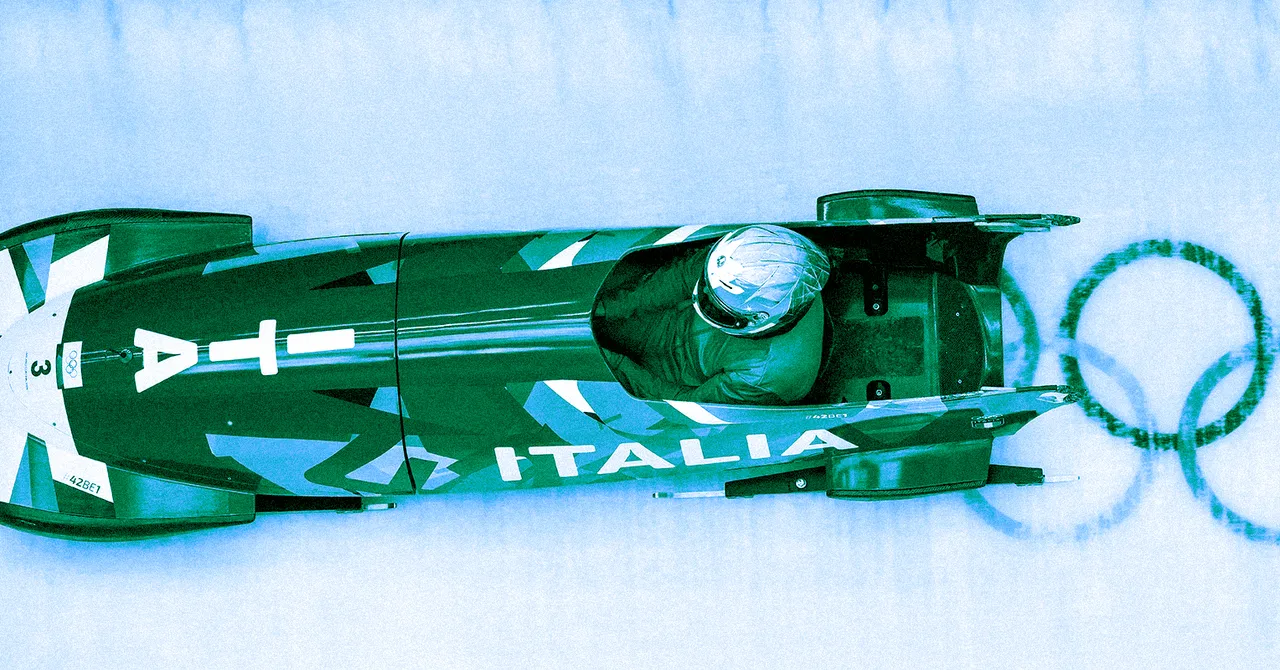
Competitive bobsled racing is frequently dubbed the “Formula 1 on frozen tracks.”The courses stretch over 1.5 kilometers (almost a mile), with competitors routinely hurtling downwards at velocities approaching 145 kilometers per hour (90 mph). Participants in bobsledding—whether maneuvering in quartets, duos, or individually—frequently endure gravitational pressures exceeding 5g. For the 2026 Milano Cortina Winter Games, technology is being deployed to enhance the exactness of every segment of the competition, from the initial propulsion and skilled piloting to the ultimate deceleration, aiming for greater accuracy compared to past Games.
Four-man bobsleigh for males first appeared at the Olympics in Chamonix, France, in 1924; however, two-woman bobsleigh for females was not introduced to the Games until 2002 in Salt Lake City. The solo monobob event for women was included in 2022. Initially, bobsleighs were crafted from timber, but for many years, the discipline was linked with steel; nevertheless, in contemporary times, carbon fiber has become the material of choice, offering superior lightness and robustness.
Every novel technological advancement within the sport has emerged within the limits essential for competitor safety, including mass and sled dimensions. A two-person bobsleigh is permitted a maximum length of 2.7 meters (approximately 8.9 feet) and a maximum mass of 390 kilograms (859.8 pounds), inclusive of its occupants. Conversely, a four-person bobsleigh must not surpass 630 kilograms (1,388.9 pounds) in total weight, including the team members, nor exceed 3.8 meters (12.47 feet) in overall length.
Implementing the mass restriction was a crucial step to level the playing field in competitions and restrict the engagement of specialized athletes who, despite not being traditional bobsledders, had previously demonstrated critical influence on their teams’ victories during the initial push. This outcome is hardly accidental, as this particular phase represents one of the most significant arenas for technological influence in bobsledding.
During the 2022 Beijing Olympic Games, Germany secured 27 medals, with 16 originating from bobsleigh, luge, and skeleton events. German competitors frequently distinguish themselves in bobsledding, not merely due to the sport’s extensive heritage in Germany, but also because the nation has consistently prioritized advancements within the discipline. For instance, the automotive manufacturer BMW acts as a key associate of the German federation governing bobsledding, luge, and skeleton (Bob- und Schlittenverband für Deutschland), and is recognized for pioneering specialized spiked footwear, an indispensable aid for bobsledders’ prowess.
The initial 30 to 50 meters of an Olympic bobsled competition frequently determine the outcome, as this is the sole interval during which competitors can propel the sled to attain maximum velocity. Several years prior, BMW recognized that advancements in the bobsledders’ specialized shoes had the potential to boost their execution during this pivotal period.
Considering the specific preferences of every team participant, BMW crafted bespoke spiked inserts capable of being incorporated into various shoe styles. Employing 3D printing technology, the firm successfully customized the rigidity and configuration of the spikes to suit diverse footwear and requirements. This methodology enabled rapid experimentation and modification of designs. To avert undue abrasion or fracture, the spikes receive enhanced durability via plasma nitriding, a process where nitrogen undergoes ionization within a high-temperature vacuum and subsequently permeates the steel.
{content}
Source:{feed_title}