
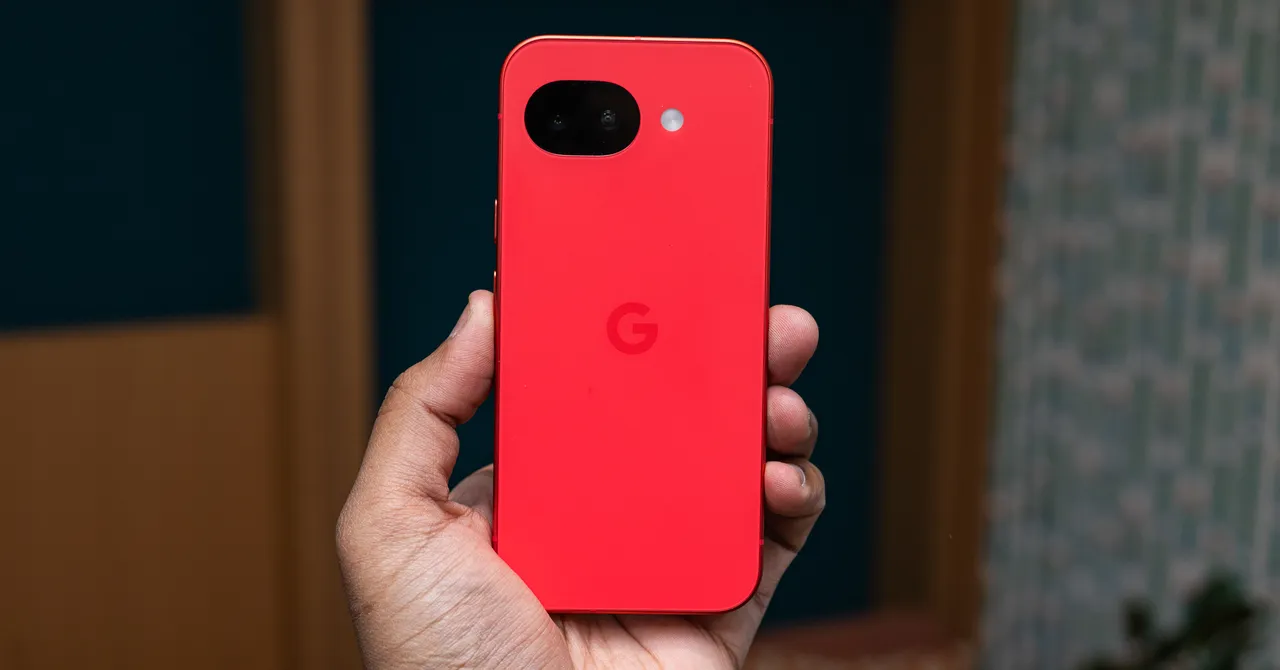
Google has implemented these types of enhancements on the Pixel 10a. Its pOLED screen is almost identical, though it can now achieve a maximum luminance of 3,000 nits, compared to the 9a’s 2,700 nits. The glass shielding the screen employs Corning’s Gorilla Glass 7i, an upgrade from the outdated Gorilla Glass 3, offering improved scratch resilience.
The battery’s capacity stays at 5,100 mAh, yet Google has boosted charging rates to 30 watts for wired connections and 10 watts for wireless power. Google omitted the Pixelsnap magnetic Qi2 charging here, a capability the firm first introduced with its premium Pixel 10 series. Apple is anticipated to release its mid-tier mobile device, the iPhone 17e, in a few weeks—and speculation indicates it will feature MagSafe/Qi2 compatibility, in contrast to the iPhone 16e, thus granting it an advantage over Google’s phone, even despite its higher cost.
Regarding the battery, Google states it employs an updated “pull jacket” method to facilitate the removal of the battery’s adhesive, a methodology first seen in the Pixel 10 series. Similar to the Pixel 9a, this device also includes a required Battery Health Assistance feature designed to reduce the maximum voltage level the battery attains following a specific quantity of charging cycles, thereby extending the battery’s operational life. Google conceived this approach subsequent to discovering thermal management problems in previous Pixel A-series models.
Although the Pixel 10a continues to only facilitate Wi-Fi 6E, similar to its forerunner, rather than the newer Wi-Fi 7 standard, Google integrated a novel modem for enabling Satellite SOS. This permits the device to link up with urgent response teams in the absence of Wi-Fi or mobile network coverage.
Google asserts the Pixel 10a is constructed using “a higher proportion of recycled content than any prior A-series Pixel,” encompassing the incorporation of recycled cobalt, copper, gold, and tungsten for the initial occasion. (Apple has already incorporated these reclaimed substances for multiple years.) The aluminum chassis consists of entirely recycled material, and the rear panel comprises 81 percent reclaimed plastic.
These constitute the extent of the physical modifications. The phone is available in novel hues—Obsidian, Fog, Lavender, and Berry—with the last option serving as an homage to the Berry color in recent Nest offerings Google unveiled towards the end of 2025.
Software Enhancement
Google recognizes the Pixel 10a’s enhancements are minimal; consequently, it’s incorporating a few Pixel 10 program functionalities such as Camera Coach and Auto Best Take. The company is not migrating these capabilities to the Pixel 9a, even though both handsets utilize the identical Tensor G4 processor and 8 GB of random access memory—at least for now. Google frequently reserves a few software features for a limited period on its latest gadgets, then subsequently transfers them back to previous Pixel models through Pixel Drop firmware updates. However, Google has not verified whether this scenario will actually materialize.
{content}
Source:{feed_title}