
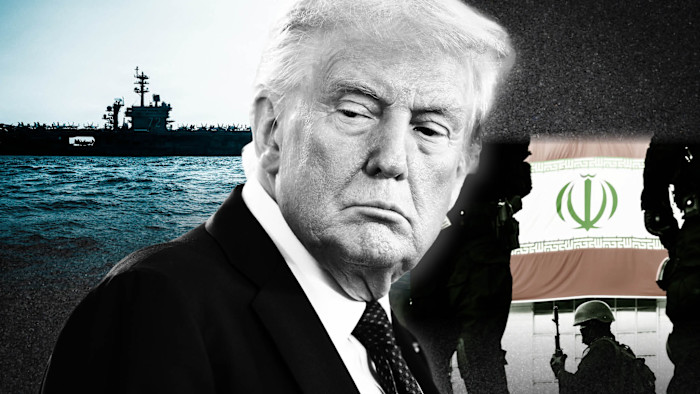
After urging Iran for weeks to finalize an agreement, Donald Trump on Monday uploaded a video featuring Fox News presenter Mark Levin, asserting that discussions with Iran had become fruitless.
The footage underscored the US president’s mounting exasperation that his torrent of warnings had, to date, failed to secure any tangible compromises from the Islamic Republic.
It also encapsulated the predicament Trump now faces as he contemplates the most significant foreign policy maneuver of his second term: a full-scale offensive against Iran.
“I believe the reality is the president has cornered himself,” remarked Aaron David Miller, a Middle East specialist at the Carnegie Endowment for International Peace, and a former US-Middle East peace negotiator.
Trump has restricted his own options, Miller explained, by pledging support to Iranian protestors and deploying a range of military assets within striking distance of Tehran.
Furthermore, the US’s successful intervention to depose Venezuela’s Nicolás Maduro has instilled in Trump an excessive confidence regarding his prospects in Iran.
“He has placed himself in a predicament where, unless he manages to extract a substantial concession from the Iranians to avert a conflict he wishes to avoid, he will be compelled into one,” Miller stated. “This predicament is entirely of his own making.”
What began as a vow to “aid” Iranian demonstrators against the regime’s deadly suppression in December has morphed into a coercive strategy — even though Trump’s underlying motivations remain ambiguous.
Over the past two months, Trump had cited a “revolving list of justifications” for targeting Iran, noted Rosemary Kelanic, a political scientist and Middle East expert at Defense Priorities, a Washington think-tank that advocates against interventionism.
The reasons have spanned from the imperative to dismantle a nuclear initiative that Trump asserted had already been “annihilated,” to neutralizing the Iranian proxy militias that US and Israeli officials claim have also been significantly weakened.
Inflicting damage on Iran’s ballistic missiles is another objective — despite them lacking the range to reach the US. And for a period in January, the rationale, communicated via Truth Social, was a promise to the protesters that “ASSISTANCE IS EN ROUTE”.
“There are, I believe, enormous questions surrounding why the United States is undertaking this in the first place,” Kelanic commented.

Zealots in Trump’s inner circle, such as Levin, have made it clear that the ultimate aim should be regime transformation, and that the US ought to act immediately, while Tehran was “more vulnerable than ever.”
The US cannot “postpone it for the next generation” to act. “That government must be eradicated,” he implored Trump on his Fox News program, a video of which Trump disseminated online.
The president has, in recent weeks, deployed the most substantial aggregation of US military hardware to the Middle East since the conflict in Iraq. On Monday, a second aircraft carrier strike group, the USS Gerald R Ford, was observed off the coast of Crete in the eastern Mediterranean.
Despite this military buildup and Trump’s recurrent threats to employ these assets — including for potential limited strikes — Iran has yet to consent to any form of accord, much to the bewilderment of US officials.
“[Trump is] inquisitive as to . . . why, under this sort of duress, with the quantity of naval power we have stationed there, they haven’t approached us proclaiming, ‘We affirm that we do not seek a weapon?’” Trump’s special envoy Steve Witkoff declared on Saturday on Fox News.
Witkoff also asserted that Iran was “likely a mere week away from possessing industrial-grade material for bomb construction,” an assessment not shared by experts.

Trump has unequivocally stated that Iran cannot possess nuclear armaments or the capability to forge them, and that they are prohibited from enriching uranium, a White House official confirmed on Monday.
“The president desires to see an agreement negotiated, but he has been explicit that either we will reach an accord, or we will have to resort to something extremely harsh, akin to the last instance.”
Despite the swift escalation, however, Trump is also grappling with the dangers that fresh assaults or a full-blown conflict against Iran could entail.
Regional specialists and administration personnel have cautioned him that Iran would likely target US military installations, allies, and energy infrastructure in the area in any retaliatory action.
Trump on Monday dismissed reports alleging that General Dan Caine, the chairman of the joint chiefs of staff, had argued against an attack on Iran.
“Everything published about a potential War with Iran has been inaccurately written, and deliberately so,” Trump conveyed on Truth Social. “I am the ultimate decision-maker; I would prefer a Settlement over none, but if we fail to secure a Settlement, it will be a grim day for that Nation and, regrettably, its populace.”
Defence secretary Pete Hegseth on Monday similarly pressed Iran to accept a deal, but affirmed that any strike would ultimately rest with Trump. “Our mandate is to present alternatives, and we will have options for the president should Iran opt not to accept a deal,” he stated. “Every possibility is under consideration; it is the president’s prerogative.”
Nevertheless, Israeli intelligence has concluded that even with the imminent arrival of the USS Gerald R Ford later this week, the US possesses sufficient military capability to sustain only a four-to-five-day intensive aerial offensive, or a week of less intense strikes, an Israeli intelligence official informed the FT.

Any American fatalities would likewise provoke a national outcry among Trump’s MAGA base and the wider electorate, who are typically more cautious about conflict than about refraining from action against Iran. According to a recent University of Maryland survey, one-fourth of Republicans express disapproval of a US military involvement in Iran given the present conditions, whereas forty percent endorse it. The overwhelming majority of Democrats, conversely, voiced their opposition.
“Who desires this? No one seeks this,” remarked Miller of the Carnegie Endowment. “We are inadvertently drifting into a conflict, without a clear plan.”
However, Trump has felt more confident due to his triumph in Venezuela and, according to analysts, Tehran’s subdued reaction to actions his advisors similarly viewed as hazardous. These actions encompass his pullout from the 2018 nuclear agreement with Iran, the US’s targeted killing of Revolutionary Guards commander Qassem Soleimani in 2020, and the aerial bombardment of Iranian nuclear facilities last year.
In every instance, Trump took a gamble concerning Iran and perceived himself as justified, noted Karim Sadjadpour, a specialist in Iran and US policy at the Carnegie Endowment.
“In his view, the severe cautions about igniting a regional conflict were exaggerated, and Iran demonstrated itself to be a mere paper tiger. I do not believe his preferred result is military engagement, yet should he opt for that path, he likely favors his chances.”
Further reporting provided by Mehul Srivastava in London. Data visualization and mapmaking executed by Steven Bernard