
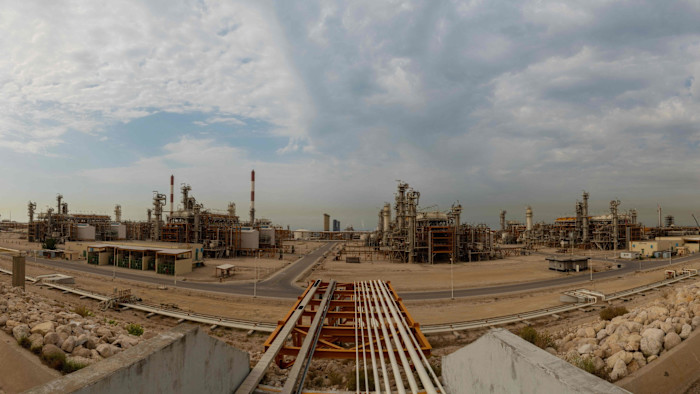
Tehran is endeavoring to entice Donald Trump with monetary inducements, such as capital injections into its extensive petroleum and natural gas deposits, as a component of its efforts to persuade the American leader to sanction an agreement concerning its atomic initiative and circumvent hostilities.
An individual privy to the situation characterized the potential for a “commercial bonanza”, with Iran aiming to leverage Trump’s affinity for transactions offering an economic payout for the US.
Tehran’s chief diplomat, Abbas Araghchi, is slated to conduct a further series of mediated discussions with American representatives Steve Witkoff and Jared Kushner in Geneva on Thursday.
A high-ranking American government representative stated that no trade proposal had, as yet, been extended to the US. “This was never discussed. President Trump has been clear that Iran cannot have a nuclear weapon or the capacity to build one,” the official conveyed.
The potential for capital infusion avenues was “specifically directed at Trump, a significant financial windfall in petroleum and natural gas extraction privileges, crucial mineral resources and all of that,” the individual acquainted with the issue disclosed.
Another source indicated that deliberations had occurred concerning Iran extending US capital injections into natural gas and petroleum sectors but noted that the proposition had not been formally submitted to the US capital.
“[Iran is] observing Venezuela as a precedent,” the individual stated, alluding to Trump’s advocacy for American corporations to secure petroleum agreements within the South American nation subsequent to the US government’s actions against Nicolás Maduro the previous month.
This concept constitutes a segment of Iran’s endeavors to persuade the US capital of its earnestness regarding an accord and avert American military interventions, particularly amid increasing duress from Trump.
Furthermore, this occurs while Tehran’s authorities have vowed to intensify any confrontation with the US following an American offensive, suggesting a re-evaluation of their prior policy of constrained reprisal.
Trump, who has orchestrated the most substantial military amassing in the Middle East since the 2003 American-spearheaded incursion into Iraq, cautioned Tehran the prior week that it possessed a “maximum” of 15 days to forge an accord or “bad things will happen”.
During his Tuesday address on the State of the Union, Trump denounced what he termed Iran’s “sinister” atomic aspirations and charged Tehran with “working to build missiles that will soon reach” the US.
“My preference is to solve this problem through diplomacy,” he stated. “But one thing is certain, I will never allow the world’s number one sponsor of terror, which they are . . . to have a nuclear weapon. Can’t let that happen.”
Tehran asserts its initiative is for peaceful applications, however, it was augmenting uranium to near armaments-grade purity prior to the US and Israel bombarding its atomic installations the previous year.
Those informed about the discussions mentioned that Iran was furthermore deliberating the potential for a global oversight framework for its atomic initiative, potentially incorporating an American contingent or a proxy nation, in conjunction with the International Atomic Energy Agency, the UN’s regulatory body.
Araghchi stated on Tuesday that Tehran “will under no circumstances ever develop a nuclear weapon” and would pursue a “fair and equitable deal — in the shortest possible time”.

“We possess a momentous chance to forge a singular accord which tackles shared worries and fulfills common objectives,” Araghchi communicated via X. “An agreement is attainable, but solely if diplomatic avenues are prioritized.”
The spokesperson for Iran’s diplomatic corps, Esmail Baghaei, refused to elaborate on particulars regarding Tehran’s proposition but yet referenced editorial works by Araghchi concerning prospective financial collaboration with the US.
“In those articles, Araghchi discusses petroleum, natural gas and power, wherein we hold benefits and require contemporary expertise, and where robust capability exists,” Baghaei informed the FT.
In 2023, Iran was classified as the globe’s third-biggest petroleum and second-biggest natural gas deposit possessor, as per the US Energy Information Administration. It co-possesses the planet’s most extensive natural gasfield with Qatar.
Hamid Ghanbari, an assistant foreign minister, informed Iranian entrepreneurs earlier this month that “shared benefits in the petroleum and natural gas sectors, encompassing collaborative fields [with adjacent nations], in addition to capital injections into mining and even the acquisition of non-military aircraft, have been incorporated into the discussions with the US”.

Ghanbari stated that in contrast to the 2015 atomic accord which Tehran formalized with the Obama government and other global authorities, it was “imperative for the US to gain from areas yielding substantial and swift profits” to ensure a “lasting pact”.
Tehran briefly became receptive to international capital once that agreement became operative, resulting in Boeing formalizing a $20bn pact to furnish airplanes to Iran Air.
However, it failed prior to any aircraft being supplied after Trump’s renunciation of the atomic pact in 2018, instituting successive rounds of stringent penalties which isolated Iran from the worldwide monetary framework and precluded international capital injections.
Within the framework of any nascent atomic agreement, Tehran would seek alleviation from restrictions. Ghanbari indicated that Tehran would anticipate the US to release its petroleum funds retained abroad, totaling tens of billions of dollars.
The Trump government and Iran conducted two cycles of mediated discussions this month, the initial ones since the US briefly participated in Israel’s 12-day hostilities against Iran last June. Prior to that confrontation, they had conducted five series of deliberations.
A persistent impediment to advancement has centered on whether Iran can retain its aptitude for uranium enrichment. The US has steadfastly demanded that Tehran irrevocably cease its enrichment capability.
Tehran has spurned the stipulation, asserting its entitlement as a signatory to the non-proliferation accord. Yielding to this requirement is deemed an inviolable boundary for Ayatollah Ali Khamenei, the paramount leader.
Area authorities, among them Turkey’s chief envoy, have conveyed to the FT that the Trump government had indicated a potential for adaptability, implying that Tehran might be permitted to enrich to symbolic quantities if an accord were reached. Officials from the Trump government have contested this assertion.
Araghchi informed MSNBC the previous week that the US capital had not requested Tehran to perpetually halt enrichment.
“We have not proposed any cessation, and the American party has not sought absolute cessation of enrichment,” he stated. However, Witkoff, Trump’s principal envoy, declared over the weekend that the president’s “red lines” included “zero enrichment” and mentioned that Iran would need to relinquish its reserves of enriched uranium.
_Further dispatches from Abigail Hauslohner in Washington_