
Gain access to the White House Insights bulletin without cost
Your manual for what a second Trump presidential term signifies for Washington, commerce, and the globe
The author serves as an FT contributing editor, chairman of the Centre for Liberal Strategies, and a fellow at IWM Vienna
The current democratic predicament is most clearly illustrated by a plain truth: numerous heads of the world’s major nations today hold power as a result of effectively altering their countries’ fundamental laws to remain in their positions beyond the initially projected duration.
This applies to Russian President Vladimir Putin and Recep Tayyip Erdoğan, the president of Turkey. (It is true, too, of Xi Jinping, although China was never a democracy in the first place.) Before long, attention will turn to US President Donald Trump. Will he accomplish the constitutionally unfeasible exploit of seeking a third mandate? Is becoming a wartime leader a precursor to a prolonged tenure in office?
Democratic governance has shifted into an altered chronological framework. Past and present have merged inexplicably. The most remarkable aspect about the present US head of state is that he behaves as if he embodies both his progenitor and his progeny. While Putin formulated his war in Ukraine in “clandestine deliberation” with his departed forebears, Peter the Great and Catherine the Great, and while Erdoğan’s decisions have been conceived under the influence of modern Turkey’s founder Mustafa Atatürk, Trump mentions former American figures merely to assert his own superiority over them. His disregard for the departed is paralleled solely by his apathy towards future generations.
Perhaps Trump believes that it is futile to depend on the insights of bygone eras, or maybe he adheres to the doomsday narrative shared by his tech-sector associates? The outcome remains constant. The president’s habit of prominently displaying his appellation on structures and organisations is a sign of an individual readying to pronounce a panegyric at their own obsequies.
Typically, revolutions are not solely concerned with an alteration in governance. They also redefine our understanding of temporality.
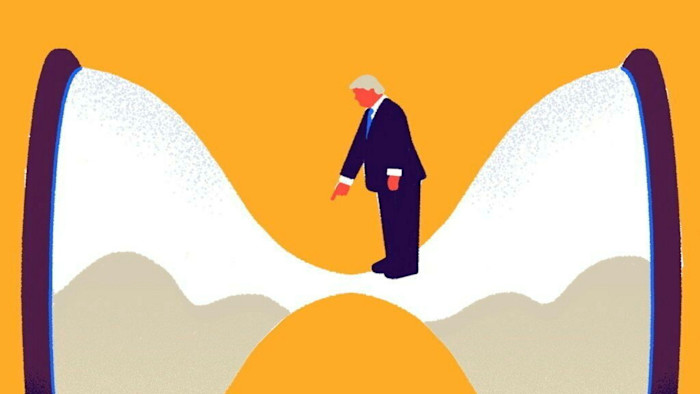
The French Revolution initiated a novel chronological system. The Russian Revolution vowed that upcoming events would redefine previous ones. But the core of the Trumpian upheaval is something more peculiar: the collapse of temporality itself. Trump exhibits no curiosity regarding preceding occurrences and is indifferent to what will unfold subsequent to his tenure. He behaves as though history must abruptly cease upon his departure from the scene. This clarifies his conviction that all conflicts ought to be concluded in a matter of weeks, if not days.
Trump’s perception of time is pivotal to his political conduct. The president does not conceptualize in enduring strategic frameworks but instead focuses on immediate completion points. He’s akin to a filmmaker who produces no actual features, merely promotional clips for unproduced cinematic works.
He is not genuinely focused on the result of the Russia-Ukraine war. His priority is its conclusion date. He shapes events much like a financially burdened entrepreneur bargains with his lenders.
Trump’s radical understanding of temporality, without an overarching transformative agenda, is an origin of both power and susceptibility. He exploits the populace’s increasing feeling of immediacy. The fundamental apprehension that “no moments remain” preempts the query: “Time for what?” His readiness to assault Iran is disconnected from any notion that he bears accountability for the nation’s forthcoming trajectory.
The core of this fundamentally novel temporal philosophy is the claim that his actions are not intended for permanence. Trump presents agreements that others find themselves unable to decline or endorse. Should the Kremlin forge an accord with him because he offers them something no subsequent US head of state would likely put forward? Or should the Russians apprehend that such a favourable arrangement might prove transient? Should Ukrainians rely on his assurances of safety if he personally advises against trusting anyone? Should the Chinese engage in talks with Trump or bide their time? Can Europeans circumvent the Trump-esque dilemma of transformative temporal urgency?
The compression of history and now in the lifetime of a single leader is Trump’s unique contribution to current political discourse. His era is characterized by a significant alteration in both our historical comprehension and our future aspirations. When Lenin died, the Bolsheviks embalmed his remains and interred them in a sepulchre on Red Square, communicating to the globe that, despite the esteemed leader’s demise, he would endure eternally. The yearning for perpetual existence is common among political figures. Trump’s novelty lies in his capacity to instill the conviction that he will perpetually remain present.