
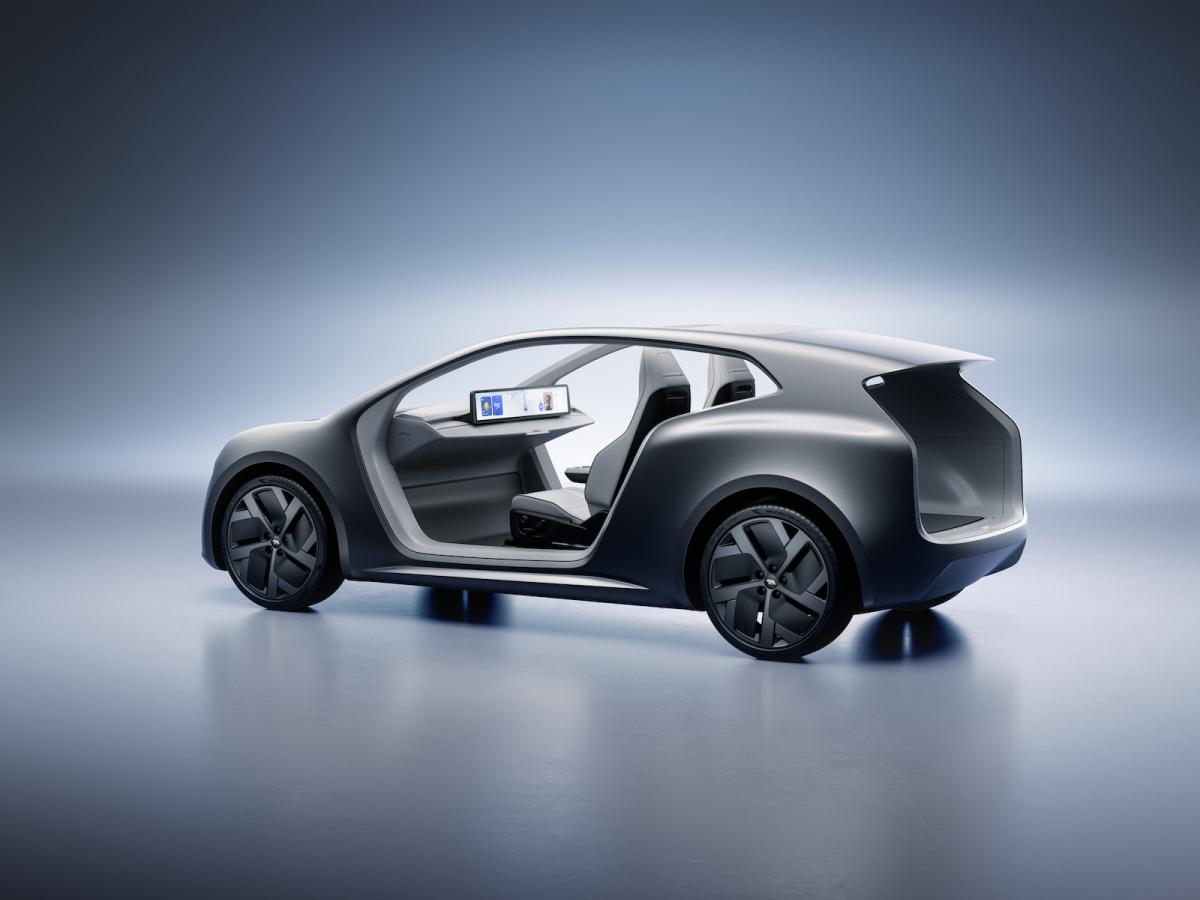
During an investor conference held on Thursday in New York City, Lucid Motors unveiled a prototype autonomous taxi, which it has dubbed the “Lucid Lunar.”
This dual-occupant automobile, notably devoid of a steering mechanism or foot controls, is conceived for construction upon the identical foundational architecture Lucid Motors is engineering for its forthcoming “mid-size” range of electric vehicles, as stated by the firm.
Provisional Chief Executive Officer Marc Winterhoff initially stated that Lucid was already “engaged in developing” the Lunar and that its launch would follow the introduction of the company’s mid-size vehicles. However, the firm subsequently specified to TechCrunch that no ongoing creation is currently underway for the exclusive autonomous taxi — as of now.
On Thursday, Lucid Motors additionally announced its proximity to finalizing a deal with Uber to partner in producing a robotaxi, derived from one of the mid-size vehicles Lucid currently has under development. Presently, Lucid Motors is collaborating with autonomous vehicle firm Nuro to create a self-driving variant of the Gravity SUV, slated for deployment within Uber’s operational system by the close of this year in the San Francisco region. Neither Nuro nor Lucid would verify if this novel vehicle will incorporate Nuro’s proprietary technology.
These revelations were made towards the conclusion of Lucid’s investor conference, yet they indicate the firm’s growing emphasis on establishing an autonomous driving enterprise capable of augmenting its electric vehicle sales. During a segment of the briefing, Lucid Motors presented a bar graph illustrating its projection that robotaxi partnership revenue would significantly surpass the earnings derived from its EV technology licensing, despite the absence of a Y-axis label.
Lucid is likewise seeking to monetize its semi-autonomous strategy. The company disclosed its intention to provide recurring monthly memberships for its DreamDrive Pro, which will escalate with enhanced features, commencing in early 2027. Vehicle owners could opt to pay $69 per month for the most basic driver aid tier, or up to $199 monthly for autonomous driving functionality precluding driver intervention at any juncture. (It bears mentioning that Lucid Motors has yet to develop such advanced functionality, a feat no other car manufacturer has achieved either.)
On Thursday, the company presented a visual aid asserting that autonomous driving memberships represent “the foremost software revenue prospect.” This is a practice Tesla has been implementing for some time with its Full Self-Driving (Supervised) software, and it mirrors the comparable strategy Rivian unveiled during its dedicated “Autonomy & AI Day” towards the end of December.
Techcrunch event
San Francisco, CA
|
October 13-15, 2026
Mirroring Rivian’s efforts, Lucid Motors is developing its proprietary in-vehicle AI aide. The company intends for this aide to be proficient in executing basic functions, such as adjusting the air conditioning, and addressing intricate requests like locating “something to do that’s a little unique, maybe off the beaten path, and maybe has kind of a maritime or nautical vibe.” Its current efficacy remains uncertain; Lucid Motors’ live demonstration of the aide during the occasion proved unsuccessful, and the company consequently presented a pre-filmed clip.
The remaining portion of Lucid’s presentation largely centered on the company’s endeavors to reduce production expenses for its vehicles, alongside its pursuits to enhance the efficiency limits of its electric drivetrain. These will be vital elements for rendering the mid-sized vehicles economical (projected to commence at approximately $50,000) upon the inaugural model’s market release before the close of the current year. The company disclosed that an initial model would bear the designation Lucid Cosmos, and the subsequent automobile would be named the Lucid Earth. The appellation for the third remained unrevealed on Thursday.
{content}
Source:{feed_title}