
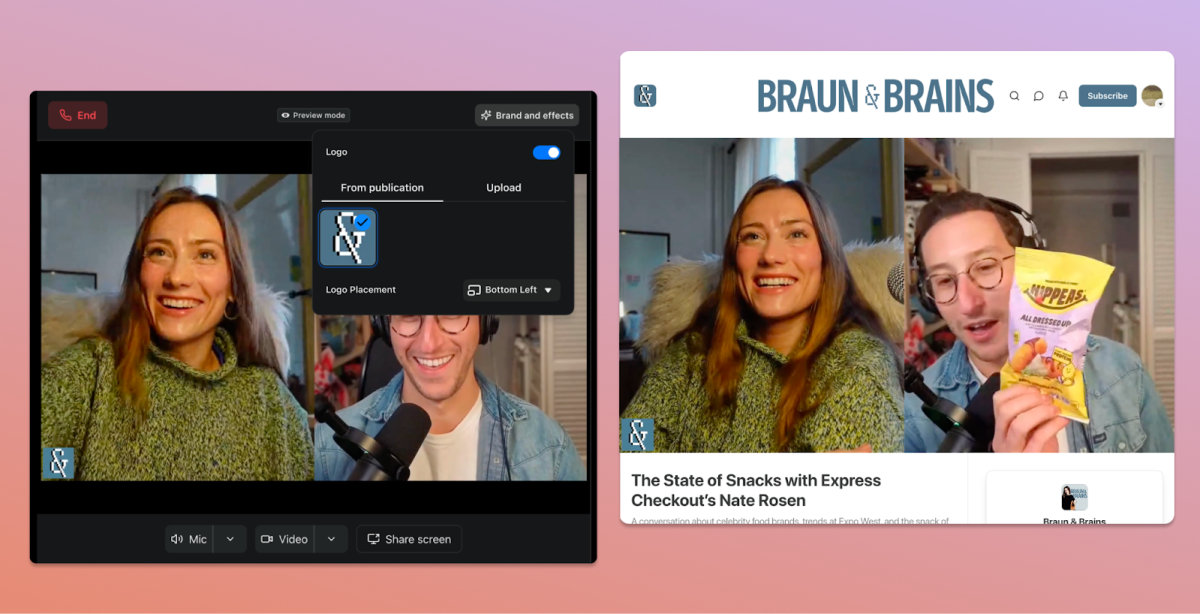
The publishing service Substack continues to pour resources into visual media, having unveiled its Substack Recording Studio – an integrated tool designed for creators to pre-record and disseminate videos.
Exclusively accessible via desktop, this studio facilitates individual video productions and dialogues involving a maximum of two participants. Content producers are able to embed personalized watermarks into their visual material and project their display for fellow hosts. Upon completion of the session, Substack automatically produces short segments and preview images for distribution.
“Previously, producing visual content on Substack necessitated broadcasting live, or assembling a distinct collection of instruments: a capture mechanism, a method for generating and disseminating short video excerpts, and an application for crafting a preview image,” the firm disclosed in a recent blog entry. “The Substack Studio now integrates all these functionalities into a singular hub.”
Furthermore, the article highlights that content producers who have leveraged sound or visual media on Substack over the preceding three months have seen their earnings increase at a rate 50% quicker than those who abstained.
While Substack is primarily recognized as a bulletin service, the enterprise has demonstrated a strong inclination towards visual content during recent years, emphasizing enhancements that render it more akin to a Patreon rival, thereby prompting content creators to delve into diverse media formats.
Although Substack has permitted content producers to upload visual files since 2022, it commenced enabling creators to broadcast live and generate income from videos in the preceding year, subsequently introducing a Creator Growth Initiative worth $20 million aimed at facilitating the migration of creators from alternative platforms onto Substack.
Similar to Instagram, Substack also recently debuted a television application, accessible via Apple TV and Google TV. This application enables audiences to view video entries and live broadcasts on their television sets and incorporates a “For You” section, reminiscent of TikTok, offering additional suggestions.
Notwithstanding the widespread appeal of viewing brief visual clips on mobile devices, individuals appear to be gravitating towards television displays for consuming extended-format material. Netflix has committed substantial capital to integrating video podcasts onto televisions. On YouTube, audiences consumed more than 700 million hours of podcasts monthly on home entertainment systems (such as TVs) in 2025, a notable increase from 400 million per month during the preceding year.
{content}
Source:{feed_title}