
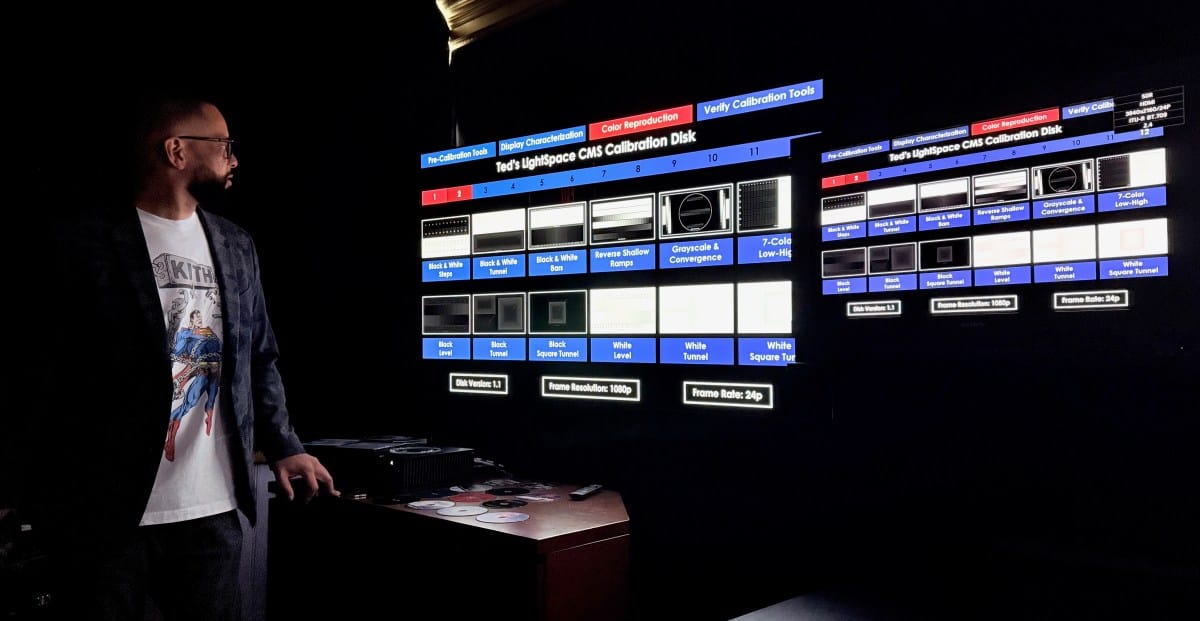
The 2025 TV Shootout went down over the weekend, and the outcomes are surprising: sure, the Sony Bravia 8 II received the general competitors and my private award for silliest title, however the LG G5 got here in final place by an enormous margin. I used to be one of many judges, and I feel I’ve a way of what’s occurring.
In the event you’re not acquainted, the TV Shootout is an annual occasion hosted by Worth Electronics, a boutique and high-end house theater retailer began by Robert and Wendy Zohn in 1998. They’ve been holding the occasion for 21 years now, and Robert proudly begins the event by holding up his framed registered emblems for “TV Shootout” and “King of TV,” which is the title bestowed on the winner. I’ve been following the outcomes for years, so it was an actual thrill when Robert requested me to evaluate final 12 months and equally thrilling when he requested me again once more this 12 months.
(As Vergecast and Decoder listeners know, I’m out on parental go away for a couple of months, however Worth Electronics is quarter-hour away from my home and watching TVs in a darkish room for a number of hours with different show nerds is my private heaven, so I made a tiny exception.)
The occasion is fairly simple: the flagship 65-inch OLED TVs from Sony, LG, Panasonic, and Samsung have been every professionally calibrated as carefully as attainable to reference requirements by Dwayne Davis, an expert ISF calibrator acquainted to AV discussion board nerds as D-Good. The TVs (and MSRP) this 12 months have been:
- LG OLED65G5WUA: $3,399.99
- Panasonic TV65Z95BP: $3,199.99
- Samsung QN65S95FAFXZA: $3,299.99
- Sony Okay-65XR80M2: $3,499.99
Robert had requested many extra producers to take part, and most declined, understanding they may not compete. He additionally excluded mini LED TVs this 12 months after they didn’t stack as much as the OLEDs final 12 months; he plans to have a separate shootout for these later.
The Shootout judges have been all skilled show specialists who work in and across the movie trade. Lots of them have been judging the Shootout for years now. They have been:
- Ilya Akiyoshi, a cinematographer who’s labored on The White Lotus and Captain America: Civil Warfare
- Todd Anderson, an authorized THX calibrator and host of the Dwelling Theater Information Evaluation podcast
- Chris Boylan, an ISF-certified calibrator and editor-at-large of eCoustics
- Jason Dustal, an ISF calibration teacher and co-chair of the CEDIA requirements committee
- Jeffrey Hagerman, a cinematographer and colorist
- Cecil Meade, an ISF-certified calibrator often known as ClassyTech on the AV boards
- John Reformato, an ISF-certified calibrator
- Mike Renna, an ISF-certified calibrator
- Richard Drutman, a filmmaker
- David Mackenzie, CEO of Constancy in Movement, a compression and mastering firm
- And, in fact, me
The remainder of the room was full of engineers and advertising of us from Sony, LG, and Samsung, a number of YouTubers, and numerous different show nerds, all paying shut consideration to the judging and the variations between the shows.
The judges have been requested to objectively consider how carefully the photographs on every set matched a pair of $43,000 Sony BVM-HX3110 skilled reference displays throughout quite a few classes in a really darkish room, utilizing each take a look at patterns and actual content material delivered from a Panasonic Blu-ray participant, a Kaleidescape streaming field, and an Apple TV, all switched by an AVPro Edge 8×8 HDMI matrix and delivered over Bullet Prepare optical HDMI cables.
The nearer the picture was to these BVM reference shows, the upper the rating, and the farther from the reference, the decrease the rating. There have been classes during which some TVs may need seemed subjectively higher than the reference shows, notably in darkish scenes the place all of the TVs tended to spice up shadow element to be extra seen. However the judges have been instructed to present decrease scores for deviating from the reference in both path. We have been additionally instructed to not evaluate the TVs to at least one one other, solely to the reference displays.
It was solely the ultimate class, “shiny room out of the field,” that was completely subjective, and during which we have been allowed to match the TVs to one another. Because the title suggests, the shades have been opened within the room, and the TVs have been set to uncalibrated filmmaker modes with energy-saving options turned off. Extra on this in a second.
As ever, this implies the Shootout finally delivers a very particular type of winner: the TV that may be most carefully calibrated to match an costly skilled reference show when seen in a darkish room. We didn’t take a look at anything in any respect: not gaming options, variety of HDMI inputs, working methods, and even Dolby Imaginative and prescient help (which the Samsung doesn’t have). This complete factor was concerning the limits of image high quality and film high quality alone. There are plenty of causes you may decide any of those TVs that don’t have anything to do with how carefully they are often calibrated to match a reference show, however that’s not what the Shootout is about.
It’s a giant improve 12 months for OLED TVs: Panasonic is again within the US market with the Z95B, and there are new panel applied sciences within the combine. LG and Panasonic are utilizing tandem OLED panels for the primary time, whereas Sony and Samsung are utilizing new, brighter QD-OLED panels. (You possibly can fairly simply surmise that Samsung is offering the QD-OLEDs and LG is behind the tandems, however not one of the producers will verify something.)
The underlying commonality of the panels means the Shootout actually stresses the picture processing variations between the producers, and the outcomes have been fascinating. Panasonic had an extremely sturdy displaying, coming in first on the HDR checks and third general by solely a hair. Sony received the King of TV title for the seventh 12 months in a row, which is able to do nothing to quell critics who say that measuring how shut all the pieces can come to a Sony reference show means Sony will at all times win. However the Samsung was a really shut second, and to my eye, it solely actually fell behind as a result of Samsung can not assist itself on the subject of colours — all the pieces was usually a bit extra saturated and vibrant than the reference show.
SDR Voting Classes
Producer | Distinction / Grayscale | Colour | Processing | Shiny Dwelling Room | Total Common |
|---|---|---|---|---|---|
| LG OLED65G5WUA | 3.69 | 3.84 | 3.31 | 4.06 | 3.68 |
| Panasonic TV65Z95BP | 3.84 | 3.97 | 3.78 | 4.25 | 3.92 |
| Samsung QN65S95FAFXZA | 4.38 | 3.88 | 3.66 | 4.19 | 4.00 |
| Sony Okay-65XR80M2 | 4.41 | 3.84 | 4.22 | 4.19 | 4.16 |
HDR Voting Classes
Producer | Dynamic Vary / EOTF Accuracy | Colour | Processing | Shiny Dwelling Room | Total Common |
|---|---|---|---|---|---|
| LG OLED65G5WUA | 3.41 | 2.84 | 3.34 | 3.94 | 3.30 |
| Panasonic TV65Z95BP | 4.03 | 4.00 | 3.97 | 3.88 | 3.98 |
| Samsung QN65S95FAFXZA | 3.88 | 4.13 | 3.72 | 4.38 | 3.97 |
| Sony Okay-65XR80M2 | 3.94 | 4.03 | 3.53 | 4.19 | 3.88 |
The shocker was the dismal displaying by the LG G5, a hotly anticipated set due to that new tandem OLED panel. There’s no different strategy to say it: the G5 principally failed a number of of the checks, displaying the unsuitable colours on a few of the linearity take a look at patterns, large posterization artifacts in darkish scenes, a slight inexperienced forged that stored reappearing, and an general tendency to push coloration and brightness in darkish scenes in ways in which didn’t require show nerds to see. The LG made Sansa Stark appear to be she had a blocky purple rash throughout a very dim Recreation of Thrones scene that the Sony and Samsung dealt with practically completely. “There are many issues with the LG this 12 months,” mentioned decide Cecil Meade. I heard different judges say, “Have you ever seen what the LG is doing?” greater than as soon as. Certainly, the G5 was to this point off on a few of the take a look at patterns that Dwayne reminded the judges that the bottom attainable rating was 1, not 0. That is usually a foul signal.
If I needed to clarify why the LG did so poorly whereas the Panasonic did so properly utilizing the identical panel, I’d put it right down to confidence, bordering on cockiness. The take a look at patterns tended to disclose that Panasonic’s picture processing is strictly by the e-book — the brand new child in class enjoying precisely by the principles, whereas the opposite producers have all discovered the place they need to push issues or make their very own decisions.

A easy instance is HDR element: the Panasonic dutifully accepts the metadata of the HDR content material it’s introduced and doesn’t show any element past the listed brightness whereas all the opposite producers have discovered HDR metadata is usually inaccurate, so that they learn the content material immediately to determine how greatest to show it, which regularly resulted in further element being proven. This may lead to a decrease technical Shootout rating, because it’s a deviation from the strict reference picture, however TV makers are all doing it as a result of they’ve discovered that customers will reliably complain about dropping element within the highlights and shadows, not about having an excessive amount of.
These little methods and ways are each the results of expertise constructing these shows and what looks like apparent makes an attempt to distinguish available in the market. Sony prides itself on reference-level restraint, and it tends to get that end result, whereas Samsung makes use of the identical panel to ship punched-up Samsung-style colours. And I’d say, primarily based on LG’s third-place displaying within the Shootout final 12 months, that LG has discovered a vivid, contrast-y OLED look sells far more TVs than the flexibility to calibrate carefully to a reference show.
Every little thing got here to a head within the “shiny room out of field” take a look at, which was pretty controversial within the room. It’s a completely subjective take a look at with no actual commonplace to measure in opposition to, and all of the producers spend virtually all their engineering time ensuring they give the impression of being nice this manner as a result of, properly, most individuals put their TVs in a shiny room and by no means change the settings. There’s no strategy to actually price TVs of this caliber in opposition to one another on this take a look at — it actually comes down to non-public desire. “They’re all fives — they’re all shiny, they’re all colourful. What else is there to say?” mentioned David Mackenzie, a decide on the panel who additionally helped writer the UHD specs. You possibly can see it within the scores, the place the LG managed to tug itself again into rivalry and the saturated colours of the Samsung pushed it right into a commanding lead within the HDR take a look at. I’d go as far as to argue the intense room scores are necessary however must be taken out of the averages that decide the winners, as a result of they’re primarily a wild card.

And it’s true: the superb variations between these units take a darkish room and plenty of time and calibration to see. Anybody simply placing one on the wall will undoubtedly be proud of their buy, particularly should you issue issues like HDMI ports and Dolby Imaginative and prescient into your determination. I’ve each Sony and LG OLED TVs that reliably wow everybody who appears at them, and lots of people love the contrast-y LG OLED look — and LG’s cheaper value tags.
However should you’re chasing reference-level picture perfection, it’s one other 12 months for Sony, whereas it looks like LG has all however deserted this specific recreation. And I’d guess Panasonic goes to place up a fair larger combat subsequent time round.
{content material}
Supply: {feed_title}