
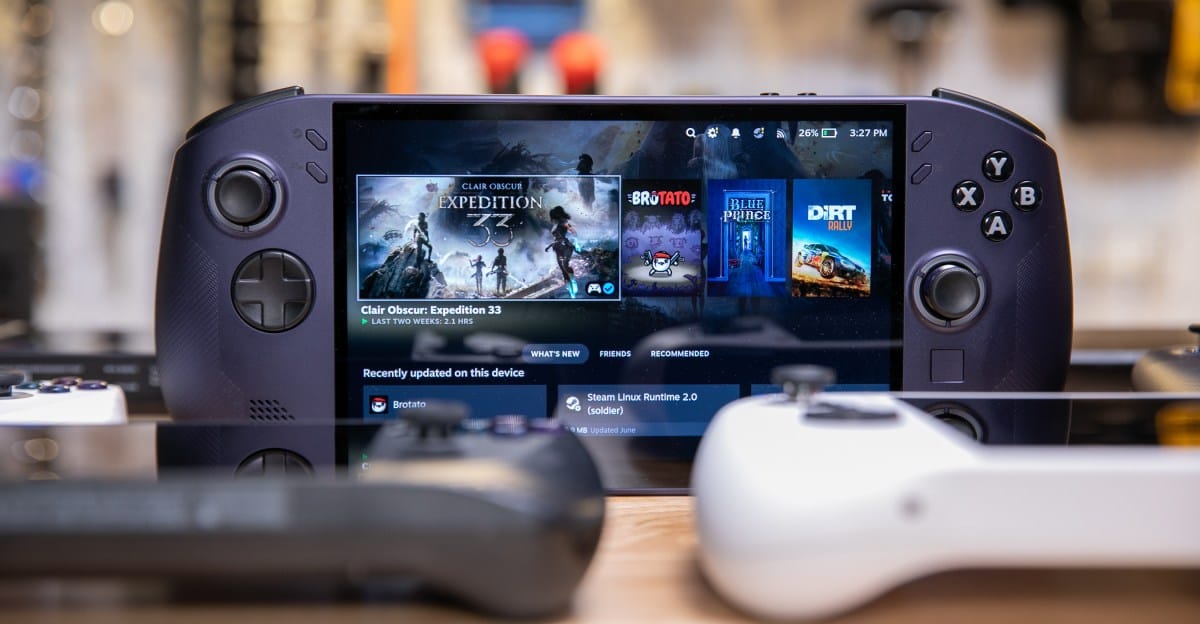
Valve’s Steam Deck has dominated the hand held gaming PC house since its 2022 debut. However whilst extra highly effective Home windows handhelds arrived to maintain up with extra demanding video games, none have overwhelmed the Steam Deck’s mixture of ease-of-use, ergonomics, energy, and battery life at an reasonably priced worth.
That also hasn’t modified. The Lenovo Legion Go S with SteamOS shouldn’t be the Steam Deck killer that some headlines would have you ever imagine.
This was presupposed to be a second for handhelds. When the Legion Go S was revealed as the primary licensed third-party handheld to run SteamOS, with a $499 beginning worth, it seemed like a real Steam Deck competitor was lastly on the way in which. It even had the blessing and help of the Steam Deck’s creators — one thing we’d by no means seen earlier than.
With an precise worth of $599 and tradeoffs galore, the bottom Legion Go S with SteamOS shouldn’t be a match for the $550 Steam Deck OLED. The extra highly effective AMD Z1 Excessive mannequin shouldn’t be half dangerous, nevertheless it’s far dearer at $829.
However throughout the disappointment, there’s some excellent news: it’s higher than the $730 Home windows model with the identical {hardware} that got here out final February, and SteamOS is unquestionably a greater expertise than Home windows.

$600
The Good
- SteamOS is a big enchancment over Home windows
- Good ergonomics
- Nice, variable refresh fee display screen
- Highly effective cooling
The Dangerous
- Z2 Go efficiency solely on par with Steam Deck
- Battery life falls behind Steam Deck
- Considerably slippery texture
- Almost ineffective touchpad


$830
The Good
- SteamOS is a big enchancment over Home windows
- Good ergonomics
- Good efficiency
- Nice, variable refresh fee display screen
- Highly effective cooling
The Dangerous
- Battery falls behind prime Home windows handhelds
- Considerably slippery texture
- Almost ineffective touchpad
Again in February, I couldn’t imagine simply how poor the Home windows gaming expertise was on this handheld’s AMD Z2 Go chip. A $550 Steam Deck ran Cyberpunk 2077 quicker on battery than a $730 Lenovo did whereas plugged in at most enhance! And as standard, Home windows was a pig: the much less you recognize in regards to the Home windows out-of-box expertise and wake / sleep points, the higher.
Fortunately, SteamOS washes away the Home windows stains. Think about simply urgent an influence button to pause a sport, then seamlessly resuming the following time you press it! Think about merely choosing a language and scanning a Steam Guard QR code to log into your handheld for the primary time, as an alternative of spending 45 minutes batting away upsells for Microsoft 365 Copilot and kin.
And regardless that the Home windows model has additionally (barely) improved since I first examined it, the Legion Go S is a lot quicker with SteamOS: roughly 17 % quicker, in my checks.
Home windows vs. SteamOS with the Legion Go S
Recreation and energy mode | Z2 Go Home windows (spring ‘25) | Z2 Go Home windows (summer time ‘25) | Z2 Go SteamOS (summer time ‘25) | Home windows enchancment since spring | SteamOS enchancment over Home windows |
|---|---|---|---|---|---|
| AC Valhalla, 15-watt TDP | 44 | 46 | 60 | 4.55% | 30.43% |
| 20-watt TDP | 55 | 55 | 69 | 0.00% | 25.45% |
| 25-watt TDP | 60 | 60 | 73 | 0.00% | 21.67% |
| 30-watt TDP | 62 | 64 | 76 | 3.23% | 18.75% |
| Plugged in | 65 | 68 | 77 | 4.62% | 13.24% |
| Cyberpunk 2077, 15-watt TDP | 36 | 39 | 50 | 8.33% | 28.21% |
| 20-watt TDP | 41 | 46 | 59 | 12.20% | 28.26% |
| 25-watt TDP | 45 | 50 | 63 | 11.11% | 26.00% |
| 30-watt TDP | 46 | 52 | 66 | 13.04% | 26.92% |
| Plugged in | 49 | 56 | 62 | 14.29% | 10.71% |
| DX: Mankind Divided, 15-watt TDP | 56 | 58 | 67 | 3.57% | 15.52% |
| 20-watt TDP | 63 | 67 | 74 | 6.35% | 10.45% |
| 25-watt TDP | 66 | 71 | 77 | 7.58% | 8.45% |
| 30-watt TDP | 67 | 72 | 78 | 7.46% | 8.33% |
| Plugged in | 70 | 73 | 79 | 4.29% | 8.22% |
| Returnal, 15-watt TDP | 24 | 25 | 21 | 4.17% | -16.00% |
| 20-watt TDP | 26 | 30 | 24 | 15.38% | -20.00% |
| 25-watt TDP | 29 | 31 | 26 | 6.90% | -16.13% |
| 30-watt TDP | 30 | 33 | 27 | 10.00% | -18.18% |
| Plugged in | 32 | 35 | 27 | 9.38% | -22.86% |
| Shadow of the Tomb Raider, 15-watt TDP | 53 | 48 | 54 | -9.43% | 12.50% |
| 20-watt TDP | 53 | 56 | 59 | 5.66% | 5.36% |
| 25-watt TDP | 55 | 60 | 61 | 9.09% | 1.67% |
| 30-watt TDP | 64 | 62 | 62 | -3.13% | 0.00% |
| Plugged in | 65 | 65 | 71 | 0.00% | 9.23% |
| HZD Remastered, 15-watt TDP | 18 | 18 | 30 | 0.00% | 66.67% |
| 20-watt TDP | 21 | 20 | 32 | -4.76% | 60.00% |
| 25-watt TDP | 24 | 21 | 33 | -12.50% | 57.14% |
| 30-watt TDP | 24 | 21 | 34 | -12.50% | 61.90% |
| Plugged in | 24 | 25 | 39 | 4.17% | 56.00% |
SteamOS’s efficiency enhance can translate to raised battery life, too. On the Home windows mannequin, enjoying 2020’s Murderer’s Creed Valhalla at 720p decision and 60fps at low settings required a mean of 36 watts — sufficient to empty the Legion Go S’s 55 watt-hour battery in 1.5 hours. However with SteamOS, the identical 60fps gameplay requires simply 22 watts, supplying you with a whole further hour of gameplay (55 watt-hours divided by 22 watts = 2.5 hours) simply by putting in a unique OS.
Not all video games see as dramatic a lift, however the identical is true of Cyberpunk 2077: should you play at 50fps, you rise up to an additional hour of battery life from SteamOS.
SteamOS additionally makes it a lot simpler to alter these energy modes, map out new management schemes, and monitor your efficiency and battery life. You’ll be able to merely maintain down a button and flick a joystick to alter your display screen brightness or summon a digital mouse, so there’s no have to dive into menus. You’ll be able to even set up Decky, the unofficial SteamOS plugin loader, on a Legion Go S, to flesh out your Steam Library with sport artwork or extra simply set up Epic Recreation Retailer titles.
However all that can be true of the Steam Deck, which prices much less, excels at video games that don’t require the horsepower of Cyberpunk 2077, and makes it simpler to play a long time of PC titles that weren’t constructed for gamepad controls.
1/13
The Steam Deck has two giant, responsive touchpads that may emulate a trackball, pull up a radial menu, or every act as an additional set of 4 buttons to map your keyboard instructions. The Legion Go S has a single ultra-tiny touchpad that places up such a combat at any time when I attempt to use it that I’ve already given up. The Steam Deck has 4 again buttons, sufficient so you’ll be able to bind ABXY and by no means should take your thumb off the best analog stick; the Legion Go S solely has two.
Extra importantly to me: maybe due to these variations in controls, the Legion Go S is lacking the mountain of neighborhood controller layouts that Steam Deck, PlayStation, and Xbox controller customers have been creating for years. These layouts, which map the video games’ instructions to the controllers’ buttons and joysticks, make it a cinch to play mouse-and-keyboard video games on a handheld with out the tedious work of determining a management scheme from scratch. On a Steam Deck, or on any PC with a typical controller plugged in, these format choices present up robotically should you go searching. With the Legion Go S, the repository of customized controller profiles is completely empty. The Legion Go S’s format is almost similar to Xbox, so why doesn’t it pull up Xbox controller profiles not less than? This actually appears like an oversight, and I hope it’ll be mounted.

As I defined in my overview of the Home windows Legion Go S, although, this {hardware} does really feel nice. It’s stable, reassuringly well-built, with my second-favorite display screen on a handheld after the Steam Deck OLED. Whereas it doesn’t have the true HDR or deep blacks of Valve’s OLED, the 8-inch IPS touchscreen makes the Steam Deck’s 7.4-inch display screen appear cramped by comparability, to say nothing of the 7-inch ROG Ally X. And just like the Ally, Lenovo’s 120Hz variable refresh fee could make for smoother gameplay, significantly on the mannequin with AMD’s Z1 Excessive chip.
The Steam Deck’s one notable drawback is that its efficiency has solely barely improved in three and a half years as video games proceed to get extra demanding. Huge hits like Expedition 33 and Baldur’s Gate 3 have pushed it out of its consolation zone, and the place rivals just like the Legion Go S can unlock higher efficiency when plugged into the wall or draining their batteries at very excessive charges, the Steam Deck can’t.
The Legion Go S formally brings these “turbo” modes to SteamOS, as properly. But when that’s why you’re shopping for, don’t get the $599 Z2 Go mannequin.
Recreation and energy mode | Z2 Go FPS | Z1 Excessive FPS | Deck OLED FPS | Z2G battery drain | Z1E battery drain | Deck battery drain |
|---|---|---|---|---|---|---|
| Cyberpunk 2077, 15-watt TDP | 50 | 57 | 50 | 22W (~2.5h) | 25W (~2.2h) | 23.5W (~2.1h) |
| 20-watt TDP | 59 | 73 | N/A | 29W (~1.9h) | 32W (~1.7h) | N/A |
| 25-watt TDP | 63 | 79 | N/A | 36W (~1.5h) | 38W (~1.4h) | N/A |
| 30-watt TDP | 66 | 82 | N/A | 42.5W (~1.3h) | 44.5W (~1.2h) | N/A |
| DX: Mankind Divided, 15-watt TDP | 67 | 74 | 61 | 22.5W (~2.4h) | 25.5W (~2.2h) | 22W (~2.2h) |
| 20-watt TDP | 74 | 92 | N/A | 29W (~1.9h) | 32W (~1.7h) | N/A |
| 25-watt TDP | 77 | 99 | N/A | 35.5W (~1.5h) | 38.5W (~1.4h) | N/A |
| 30-watt TDP | 78 | 100 | N/A | 41.5W (~1.3h) | 45W (~1.2h) | N/A |
| Returnal, 15-watt TDP | 21 | 24 | 25 | 22.5W (~2.4h) | 25.5W (~2.2h) | 23W (~2.1h) |
| 20-watt TDP | 24 | 30 | N/A | 30W (~1.8h) | 32W (~1.7h) | N/A |
| 25-watt TDP | 26 | 32 | N/A | 36W (~1.5h) | 38.5W (~1.4h) | N/A |
| 30-watt TDP | 27 | 33 | N/A | 42.5W (~1.3h) | 45.5W (~1.2h) | N/A |
| Shadow of the Tomb Raider, 15-watt TDP | 54 | 62 | 57 | 23W (~2.4h) | 25W (~2.2h) | 23.5W (~2.1h) |
| 20-watt TDP | 59 | 83 | N/A | 29W (~1.9h) | 31.5W (~1.7h) | N/A |
| 25-watt TDP | 61 | 89 | N/A | 36W (~1.5h) | 37.5W (~1.5h) | N/A |
| 30-watt TDP | 62 | 93 | N/A | 42.5W (~1.3h) | 43.5W (~1.3h) | N/A |
| HZD Remastered, 15-watt TDP | 30 | 37 | 33 | 23.5W (~2.3h) | 25W (~2.2h) | 23W (~2.1h) |
| 20-watt TDP | 32 | 47 | N/A | 29W (~1.9h) | 32W (~1.7h) | N/A |
| 25-watt TDP | 33 | 50 | N/A | 35.5W (~1.5h) | 37.5W (~1.5h) | N/A |
| 30-watt TDP | 34 | 52 | N/A | 43W (~1.3h) | 44W (~1.3h) | N/A |
| Balatro, 3 to 5-watt TDP, 60fps cap | 60 | 60 | 60 | 8.1W (~6.8h) | 8.2W (~6.7h) | 6.9W (~7.1h) |
| Balatro, lowest playable wattage and brightness, 30-40fps | 30-40 | 30-40 | 30-40 | 7.6W (~7.2w) | 8.0 (~6.9h) | 5.2W (~9.4h) |
It’s not that the Z2 Go is slower than the Steam Deck general. At max enhance on wall energy, the bottom Legion Go S can supply as much as 35 % higher framerates. However the Z1 Excessive mannequin supplied as much as 72 % quicker framerates than the Steam Deck and was 29 % quicker on common than the Z2 Go mannequin. That’s sufficient to make a sport really feel easy that was barely playable — like Expedition 33 on the lowest settings — or comfortably go up a whole graphics preset in most video games whenever you’re plugged into the wall.
(In case you do plan to plug the Legion Go S into the wall, you might wish to activate quick charging within the BIOS — maintain down Energy + Quantity Up when booting, then change Charging Pace Choice — and get your self a 100W energy adapter, as a result of Lenovo’s inventory 65W adapter isn’t sufficient to maintain the battery from draining when you’re enjoying full bore.)

The Steam Deck OLED can’t do turbo in any respect, however its customized chip can maintain its personal towards the Z2 Go in unplugged “balanced” energy modes. After I capped each on the identical 15 watt energy draw, the Steam Deck gained in Murderer’s Creed Valhalla and Deus Ex: Mankind Divided and tied in Cyberpunk 2077, even because it misplaced in Shadow of the Tomb Raider, Horizon Zero Daybreak, and Returnal.
One other shock within the Steam Deck’s favor: I performed a lot of fiendish mansion-building thriller Blue Prince whereas testing the Legion Go S, and it’s far choppier on Lenovo’s handhelds. I don’t know if it’s had Steam Deck-specific optimizations, however I discovered I wanted turbo mode on the Z1 Excessive for it to run as easily because it does on the Steam Deck.
In case you do end up selecting between the 2 Lenovo Legion Go fashions, you gained’t sacrifice a lot battery life by choosing the beefier chip. In my checks, the Z1 Excessive mannequin solely drew 1 to three watts greater than the Z2 Go on battery energy — we’re speaking about 5 minutes shorter battery life in essentially the most intensive video games and quarter-hour in much less intensive ones.
However in these much less intensive video games like Filth Rally or Balatro, the Steam Deck OLED continues to be the champ. Regardless of having a smaller 49Wh battery, it lasted over 50 minutes longer than both Legion Go S in my Filth Rally battery drain check (the place I set every handheld’s display screen to the identical brightness utilizing a calibration software) and managed two further hours of magic poker sport Balatro with battery-saving tweaks: 9 hours for Steam Deck vs. 7 hours for the Legion Go S.

I’ve handy it to Lenovo and Valve: after tangling with the Home windows mannequin, I assumed your complete Legion Go S lineup was going to be lifeless on arrival. However that’s not the case. Even the Z2 Go runs quicker and extra effectively than it did on Home windows, and the Z1 Excessive model is a legitimately good handheld should you get it with SteamOS. (You’ll be able to technically set up SteamOS on the Home windows-based Legion Go S, however Valve tells me that’s not formally supported, and I bumped into a number of points once I tried it in early June.)
Valve and Lenovo have additionally moved swiftly to deal with a number of the bugs the SteamOS model launched with. Within the month and alter since launch, it’s mounted wonkiness across the energy modes and the variable refresh fee display screen, and the way each the tiny touchpad and joystick LEDs can generally cease working when the hand held goes to sleep. (We’re nonetheless ready on a solution to management these RGB joystick LEDs in SteamOS, although.)
However when you may be pleased with the $829 Z1 Excessive mannequin round your house or in any other case near an outlet, it’s not the most effective handheld you should purchase. The Steam Deck OLED has it beat on worth vs. efficiency and battery life for much less intensive video games, plus these neighborhood controller profiles and twin trackpads. It’s the decide should you don’t want beefy turbo modes or a giant display screen.

You may additionally attempt putting in Bazzite on an Asus ROG Ally X: I discover it barely much less comfy to carry, however with the identical Z1 Excessive chip and a far bigger 80Wh battery, it’s a greater choice than the Legion Go S for intensive video games away from a plug.
In truth, although, I wouldn’t purchase any PC handheld at this explicit second. Lenovo’s best achievement with the Legion Go S was to show the prevalence of SteamOS over Home windows for handhelds, however costs are unusually excessive proper now and Microsoft is about to fireplace again.
Even in case you have no real interest in an Xbox Ally or Xbox Ally X this vacation season, it looks as if Microsoft is lastly making an attempt to repair handheld Home windows. I, for one, would wish to know the way the up to date OS fares, and which units will get it, earlier than I purchase a brand new handheld.
Images by Sean Hollister / The Verge
{content material}
Supply: {feed_title}