
Editor’s Note: This article was curated and enhanced for our readers.
Source: Original content from Steven Garcia, as told to Gaby Del Valle.
—
## Bearing Witness: A Reporter’s Account of Unrest in Minneapolis
In the heart of winter, as Minneapolis braced for another bitter cold day, the city found itself once again at a flashpoint. Following a local shooting, the streets erupted in protest, drawing both the community and law enforcement into a tense standoff. Steven Garcia, a dedicated reporter for a prominent publication, found himself plunged into the thick of it, offering a firsthand perspective on the unfolding events.
### The Unsettling Alert: From Frozen Lake to Fiery Streets
The tranquility of a frozen lake, host to a community pond hockey event, shattered instantly for Steven Garcia. A notification from the *Minnesota Star Tribune* confirmed a shooting had occurred, a stark contrast to the playful atmosphere. The news rippled through the gathering, with one participant foreseeing the inevitable: “I probably wouldn’t be able to make it — they knew there would be protests and demonstrations happening.” This chilling premonition set the stage for what was to come.
Garcia arrived on the scene just over three hours later. Federal investigators, including the FBI, had already concluded their initial work and departed. What remained was a heavy local and state law enforcement presence: officers from the Minneapolis Police Department, their SWAT team, the Hennepin County Sheriff’s Office, and the Minnesota State Patrol, all girding for the anticipated public reaction.
### Escalating Tensions: Protests, Retreat, and Chemical Clouds
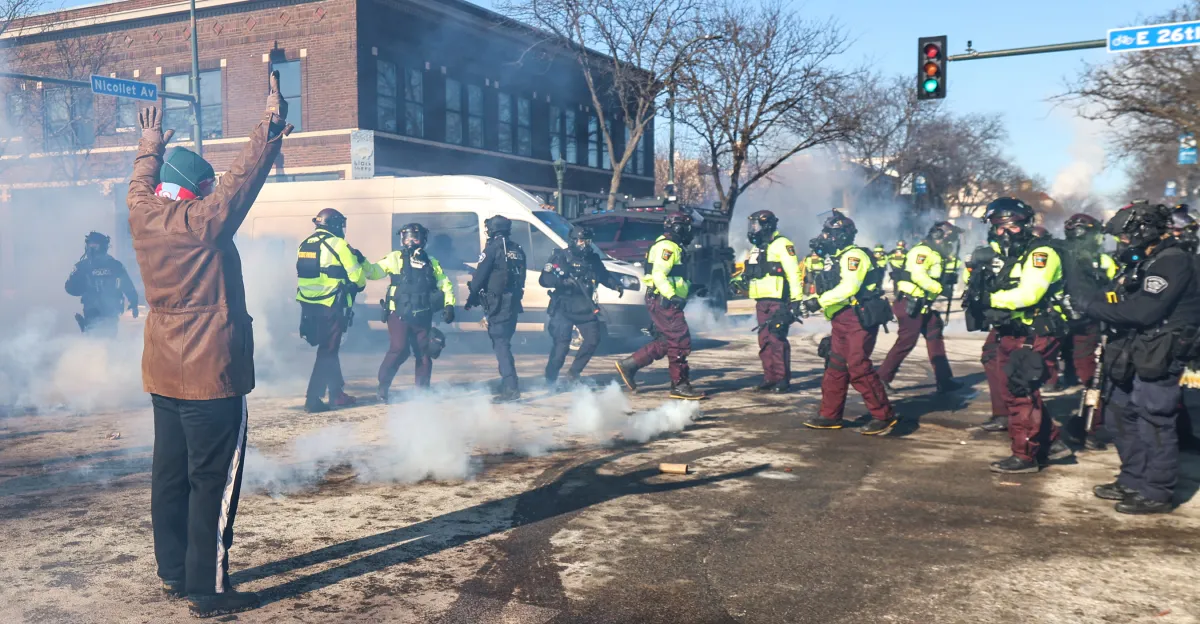
The air crackled with tension as protestors gathered at multiple intersections, their presence a defiant blockade against the normal flow of the city. Streets became impromptu stages for demonstration, adorned with discarded furniture like trash cans, dumpsters, and mattresses, strategically placed to impede movement. While heckling and vocal defiance filled the air, the initial phase of the protest remained largely free of physical confrontations.
This uneasy calm, however, proved short-lived. Law enforcement, after a strategic retreat of one block, deployed a volley of chemical irritants. The air quickly filled with the tell-tale “green smoke” of hexachloroethane. As officers withdrew further, their vehicles rolled over the makeshift barricades, crushing the mattresses in their path—a symbolic act underlining the hardening lines between the protestors and the authorities.
### The Stinging Reality of Tear Gas
The deployment of chemical agents was not a subtle affair. Canisters detonated with startling force, akin to fireworks, showering the area with irritants. “Dozens of canisters were going off,” Garcia recounted, describing initial volleys of “four, five, six canisters at a time.” The pervasive green cloud quickly enveloped the immediate vicinity.
Even with protective gear, the chemical assault was relentless. Garcia himself had to seek refuge in an alley as the irritant penetrated his mask. He described the harrowing experience: “It’s not a fun experience, even in very small amounts. You have to keep your eyes closed. It burns your eyes, it burns your mouth.” For many, the effects extended to nausea and a burning sensation on the skin. Another local reporter shared his immediate need for a decon wipe to soothe a burning neck, underscoring the severity of exposure.
### A Community Forged in Resilience
Remarkably, despite the chaos, there was a palpable sense of preparedness within the community. The indelible memory of the 2020 George Floyd protests had instilled a deep-seated readiness among Minneapolis residents. Gregory Bovino, head of the US Border Patrol, observed this phenomenon firsthand, noting the exceptional preparedness of local community members.
“I had my respirator ready from 2020,” was a common refrain Garcia heard. Many had not only retained their safety equipment but had also restocked on vital supplies like decon wipes and comprehensive first aid kits, demonstrating an impressive capacity for rapid response. Beyond personal protection, the community rallied with spontaneous acts of mutual aid, setting up tables to distribute essential items such as food, water, and hand warmers—a critical gesture given the day’s brutal cold, where temperatures struggled to rise above zero degrees.
### A Spontaneous Vigil: Remembering Alex Pretti
As law enforcement eventually cleared the more volatile areas, the community converged at the intersection of 26th and Nicolette, mere hundreds of feet from where the shooting victim, Alex Pretti, lost his life. Here, a poignant transformation occurred. The site of recent conflict became a place of mournful solidarity, as community members spontaneously created a makeshift vigil. Pinecones were meticulously arranged to spell out Pretti’s name, and flowers began to accumulate, a quiet, solemn tribute amidst the lingering echoes of protest.