
Research Highlights Potential for High-Energy Lasers on Hybrid Military Vehicles
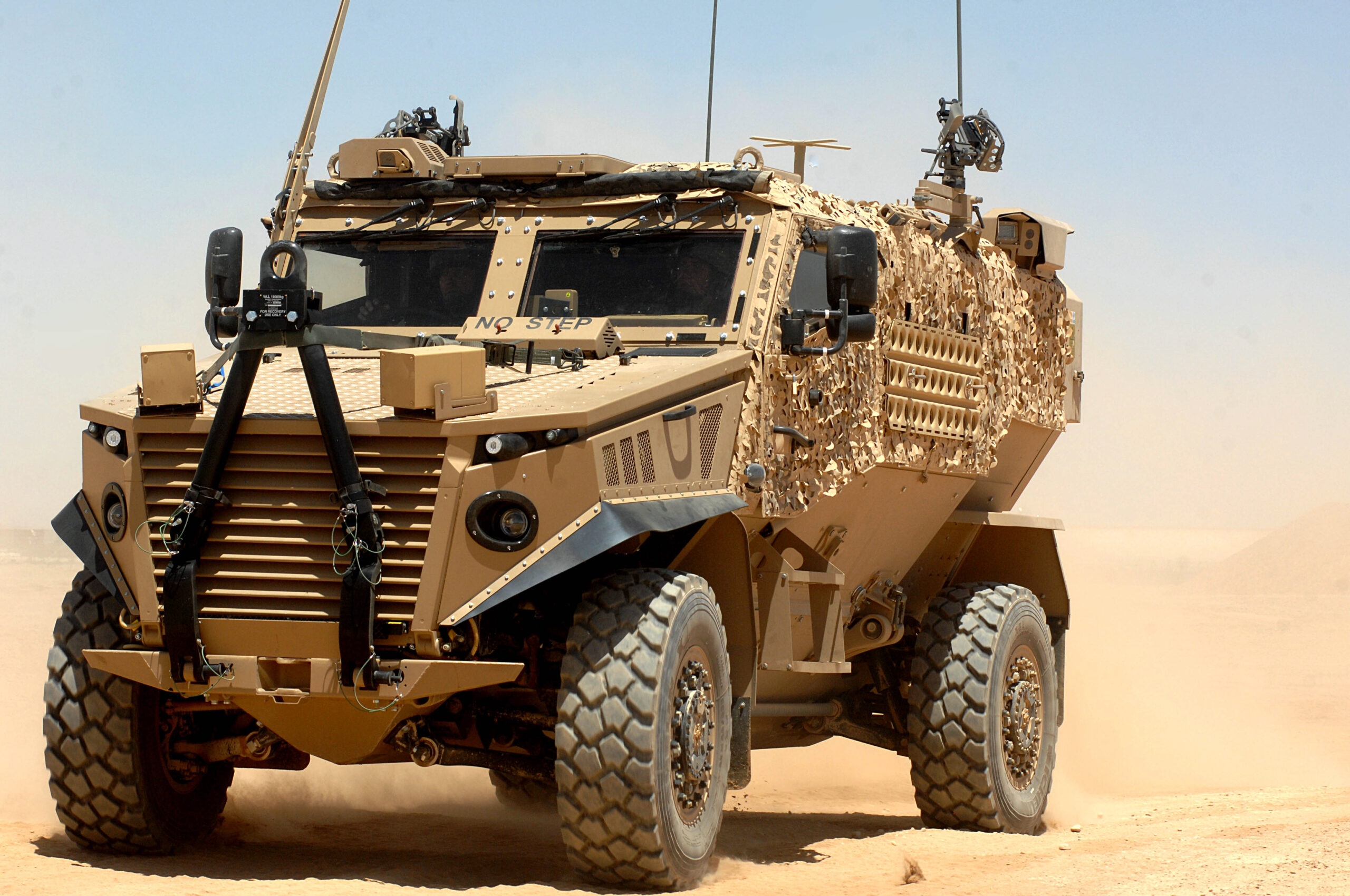
A technical paper presented at the Ground Vehicle Systems Engineering and Technology Symposium (GVSETS) in Novi, Michigan, today outlines how hypothetical hybrid versions of the British Army’s Foxhound and Boxer armoured vehicles could be adapted to carry powerful high-energy lasers (HELs) within their existing payload capacities. The research suggests that the inherent electrical infrastructure of a hybrid powertrain significantly reduces the additional weight and complexity typically associated with integrating such advanced weaponry.
The paper, authored by Rupert Tull de Salis of Power Size Technologies and presented by the company’s chief executive Wiktor Dotter, details the findings from a simulation using the firm’s powersize.tech software. This analysis screened five distinct classes of laser systems against publicly available vehicle data for both platforms, demonstrating their theoretical capabilities.
According to the modelling, a hybrid variant of the Foxhound light protected patrol vehicle could support a 60-kilowatt (kW) laser with minimal alterations to its existing powertrain. With an engine uprated from 160 kW to 228 kW, it could potentially accommodate a 150 kW laser. For the larger Boxer multi-role armoured vehicle, the study indicates that a hybrid version could support a 300 kW laser without requiring any engine modification. Furthermore, an uprate of the Boxer’s engine from 600 kW to 704 kW could enable it to carry a 500 kW laser. Notably, for the Boxer, the paper concludes that its substantial 15,000 kg mission module payload capacity is never the limiting factor for laser integration.
It is important to note that these hybrid variants of the Foxhound and Boxer are conceptual models based on simulation rather than actual designs currently under development. Power Size Technologies explicitly states that these hypothetical configurations are not proposed, funded, or being developed by any vehicle manufacturer or by the UK Ministry of Defence (MOD). The results are presented as concept-stage screening outputs, intended to inform early design decisions rather than serve as detailed engineering specifications.
However, the concept of a hybrid Foxhound is less abstract than it might initially appear. The MOD has previously developed an experimental hybrid Foxhound as part of its Technology Demonstrator 6 programme, providing a real-world precedent for the underlying vehicle modification.
Why Hybridization Benefits Laser Integration
The central premise of the paper is that the costs and complexities associated with hybrid vehicle development and laser integration are not entirely separate. Traditionally, fitting a high-energy laser to a conventional diesel-powered vehicle necessitates the addition of an entire dedicated power supply system—including a separate generator, specialized electrical distribution, and power conversion equipment. A hybrid vehicle, by its very nature, already possesses much of this infrastructure, as generating and distributing electrical power is fundamental to its operation.
The paper estimates that for a hybrid platform, the laser’s remaining power supply requirement shrinks considerably, often to little more than a converter and a filter. This streamlined approach can reduce the weight of the laser’s power supply by roughly half compared to a standalone system, with the weight savings growing proportionally with the size of the laser.
A second significant advantage lies in the vehicle’s batteries. Sized to allow the vehicle to operate in a “silent watch” mode (observing without running the engine) or engage in “silent mobility” (moving electrically), these batteries also hold sufficient energy to power the laser. This capability means that a hybrid vehicle could engage targets with its diesel engine switched off, a critical tactical advantage as engine noise and exhaust heat are primary indicators that can betray a parked vehicle’s position to adversaries.
Wiktor Dotter emphasized this synergy, stating,“Everyone in this industry knows that lasers need power and that power means hybridisation, but until now there has been no quick way to find out whether a particular vehicle can carry a particular laser before either design is frozen. If you have already hybridised a platform for silent watch and silent mobility, you have paid most of the price of putting a laser on it.”
Challenges for Foxhound Integration
While the Boxer appears to have ample capacity, the integration presents a more significant challenge for the Foxhound. Hybridizing the Foxhound adds approximately 1,100 kg to its powertrain. This addition must be weighed against its original 2,000 kg payload capacity. Crucially, the Foxhound’s 7,500 kg gross vehicle mass (GVM) ceiling cannot be easily raised. Exceeding this limit would classify the vehicle under different driving license regulations in the UK and across Europe, potentially complicating its operational deployment and personnel training.
The paper addresses this by assuming that, as is common in vehicle redesign programs, weight would be recovered from other parts of the vehicle to maintain the original payload target. This assumption is a critical point for further engineering scrutiny, as achieving such significant weight savings elsewhere can be complex. In contrast, the Boxer faces no equivalent pressure, possessing an order of magnitude greater payload capacity relative to the comparatively smaller weight addition of its hybrid powertrain.
A Proposed Classification Scheme for Laser Weapons
Beyond the vehicle-specific analysis, the paper also introduces a proposed classification scheme for high-energy laser weapons, addressing what it identifies as a current gap in standardized terminology. Current discussions often rely on informal shorthand, such as “the 50 kW class,” which primarily describes the weapon’s power draw rather than its effective capability against specific threats. The proposed scheme defines five classes, A through E, escalating up to 500 kW, with each class explicitly linked to the types of targets it can defeat. These range from optical sensors and small drones at the lower end, progressing through loitering munitions and rockets, up to more challenging targets like helicopters, fast jets, and supersonic cruise missiles.
Underpinning this new classification is a novel metric introduced by the paper: the “Sustained Firing Fraction.” A laser cannot fire continuously; a significant portion of the electrical power it draws is converted into heat that must be dissipated before subsequent shots. The Sustained Firing Fraction quantifies how much of an engagement duration a laser can actually spend firing. The paper argues that this is one of the least published yet most critical numbers in the entire calculation, directly impacting the power supply requirements and the weapon’s operational effectiveness.
Current Procurement Landscape and Context
This analysis arrives at a time of clear and increasing procurement signals for directed energy capabilities globally. The UK’s 2025 Strategic Defence Review committed close to £1 billion to developing directed energy capabilities. More recently, in June 2025, Defence Equipment and Support (DE&S) issued a market engagement notice for a vehicle-mounted land laser, indicating a budget of £20 million and an ambitious requirement for deployment within twelve months of contract award.
Internationally, the United States Army has already fielded a 50 kW high-energy laser system on its Stryker armoured vehicle and is actively pursuing a more powerful 300 kW-class programme. Similarly, the German Bundeswehr has placed orders for Skyranger 30 HEL systems, which are designed to be integrated onto the Boxer chassis. While the paper specifically focused on Foxhound and Boxer, Dotter indicated that Power Size Technologies could offer similar analytical screening for platforms like the Stryker, highlighting the company’s broader capabilities. Power Size personnel also have direct experience in the field, having been involved in Project SWINTON, which focused on mounting and trialling a directed energy laser on a Wolfhound armoured vehicle.
Dotter underscored the transparency of their methodology, stating,“We have built the whole analysis on open-source vehicle data so that anyone can challenge the numbers or rerun them with their own assumptions. I would far rather have that argument in a conference room than discover the problem later in a programme.”This emphasis on open data aims to foster collaboration and robust validation within the defense engineering community.
Why This Matters
This research is significant because it highlights a potential pathway for integrating advanced Directed Energy Weapons (DEWs) onto existing military platforms, which could fundamentally alter tactical and strategic defense capabilities. The ability to mount powerful lasers on vehicles like the Foxhound and Boxer offers several transformative advantages:
Firstly, from a **military capability** standpoint, DEWs provide a new dimension to warfare. Lasers offer precision, speed-of-light engagement, and the potential for a virtually unlimited magazine capacity, as long as power is supplied. This could be crucial for defending against increasingly prevalent drone swarms, rockets, artillery, and mortar threats, potentially reducing reliance on costly and limited conventional interceptor munitions. The “silent engagement” capability offered by hybrid powertrains provides a significant tactical advantage, allowing forces to operate and engage targets with reduced acoustic and thermal signatures, enhancing survivability.
Secondly, the research points towards **significant economic implications**. While the initial research and development costs for DEWs are high, their operational costs per “shot” are considerably lower than traditional kinetic weapons, which require manufacturing and transporting expensive projectiles. This could lead to long-term cost savings in defense budgets, shifting investment from munitions procurement to power generation and system maintenance. It also drives innovation within the defense industry, fostering new partnerships between traditional defense contractors and companies specializing in electrical power and hybrid technologies.
Thirdly, it underscores the growing importance of **hybrid technology in military applications**. Beyond powering lasers, hybrid powertrains offer other battlefield advantages such as improved fuel efficiency, reduced logistical burdens, enhanced stealth, and the ability to export power for other uses. This research makes a compelling case for accelerating the adoption of hybrid solutions across military fleets, influencing future vehicle design and procurement strategies.
Finally, this study contributes to the **evolution of military doctrine and the future of warfare**. As nations grapple with new threats and the imperative for more sustainable and technologically advanced forces, integrating DEWs onto ground vehicles represents a substantial leap. The proposed classification scheme for lasers is also important, as it provides a common language for discussing and developing these complex systems, facilitating clearer communication and more effective design decisions across the defense community. While challenges remain, particularly in managing weight, cooling, and the practicalities of deployment, this conceptual work provides a critical early step in understanding how cutting-edge directed energy technology can be effectively realized on the battlefield.