
U.S. Northern Command (NORTHCOM) and a consortium of research organizations have successfully concluded a pivotal three-year experiment aimed at enhancing the capabilities of the Northern Warning System. The initiative focused on testing innovative radar technology designed to detect incoming threats at significantly longer ranges across the challenging landscapes of Alaska and northern Canada.
The final phase of live-fly testing for this experiment series took place from September 7-14, culminating an extensive effort to explore how existing radar infrastructure could be augmented by emerging technologies. According to an October 19 release from Alaskan Command, a subordinate unit under NORTHCOM, the overarching goal of the Arctic air domain awareness experiment was to close critical surveillance gaps. The vast distances, extreme weather conditions, and limited ground infrastructure in the Arctic present unique and persistent challenges for comprehensive air surveillance.
Key participants in this collaborative endeavor included the Air Force Research Laboratory (AFRL) and Defense Research and Development Canada (DRDC), alongside various scientific organizations operating within the region. For decades, the U.S. Air Force and the North American Aerospace Defense Command (NORAD) have relied on established radar systems such as the AN/FPS-117 and the AN/Transportable Phased Array System-77. While effective, these systems typically offer a detection range of approximately 250 miles, a range that proves increasingly insufficient given the evolving nature of air and missile threats and the immense expanse of the Arctic.
The core of the experiment involved an innovative pairing: an existing high-frequency transmitter was linked with a newly developed, low-cost receiver array. This approach sought to leverage current assets while introducing more affordable, advanced detection capabilities.
Initial analysis of the data collected during the final test event indicates a significant breakthrough. The experimental system successfully achieved “full skywave (beyond line of sight) detections” of various aircraft. These cooperative targets included an E-3 Sentry from the 962nd Airborne Air Control Squadron, HC-130J Combat King IIs from the 211th Rescue Squadron, and KC-135 Stratotankers from the 168th Air Refueling Wing. By using aircraft with known flight paths and positions, researchers could accurately compare the experimental radar data against confirmed locations, validating the system’s performance.
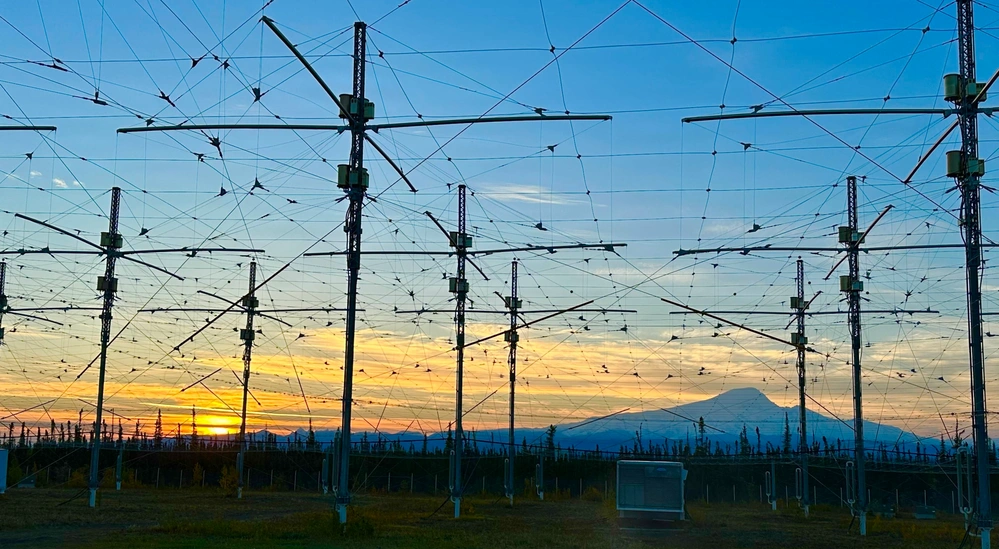
To gather the necessary data, researchers utilized the University of Alaska Fairbanks’ High Frequency Active Auroral Research Program (HAARP) facility, a renowned scientific installation known for studying the ionosphere. This facility, combined with a receiver array developed by MITRE and situated in Cold Bay, allowed for the collection of comprehensive data on participating aircraft flying over the Gulf of Alaska and the Bering Sea. HAARP, typically used for fundamental atmospheric and ionospheric research, was adapted to serve as the high-frequency transmitter for this experiment, showcasing its versatility for defense-related applications.
This concentrated effort directly supports Alaskan Command’s broader strategic objective: to improve how military units detect and track aircraft across the vast Alaskan territory and its critical maritime approaches. Such improvements are vital for commanders to accurately assess potential threats and enhance overall homeland defense capabilities in the Arctic region, which is gaining increasing geopolitical significance.
Dr. Carolyn Stwertka, Chief Scientist for Alaskan Command, emphasized the importance of real-world testing. “Understanding what this technology can do in the Arctic starts with collecting data under real operating conditions,” she stated in the release. “Working with operational units allows us to compare the experimental observations with known aircraft positions and assess where this approach could help address gaps in air surveillance.” This scientific rigor ensures that promising technologies are validated in the demanding environment where they would ultimately be deployed.
The timing of this experiment aligns with a larger, ongoing modernization initiative by NORAD. This includes the development and deployment of new high-frequency systems specifically designed to detect advanced threats like hypersonic missiles using over-the-horizon (OTH) radar technology. Furthermore, NORAD is actively engaged in modernizing the existing Northern Warning System and establishing a comprehensive polar over-the-horizon radar network, indicating a strategic shift towards more robust, long-range detection capabilities across the entire Arctic domain.
A significant component of this modernization is the Homeland Defense OTHR program, which commenced in 2022. This ambitious project is jointly funded by the United States and Canada, with estimated contributions of $6-7 billion and $3.1 billion, respectively. Initial Operating Capability (IOC) for the Homeland Defense OTHR is projected for 2028-29, with Full Operational Capability (FOC) targeted for 2031, demonstrating a long-term commitment to Arctic security.
Concurrently, the Air Force is also looking to replace its Air Route Surveillance Radar-4 (ARSR-4) system. This three-decade-old radar warning system has been a critical component in protecting the coastlines and borders of the United States, as well as several remote locations.
The ARSR-4 system, originally built in the 1990s, was designed to differentiate aircraft or potential missile threats from radar “clutter,” which is more prevalent at lower altitudes. While historically very effective, Air Force officials note that newer additions to the landscape, particularly the proliferation of wind farms, can increasingly distort the radar’s ability to “see” clearly. This challenge, highlighted in a recent Air Force Life Cycle Management Center (AFLCMC) sources sought notice, underscores the continuous need for radar modernization to adapt to both evolving threats and changing environmental conditions.
Why This Matters
The successful conclusion of this three-year radar experiment in the Arctic represents a crucial step in bolstering North American homeland defense and air domain awareness. The Arctic region, once considered a remote frontier, is rapidly becoming a zone of increasing geopolitical importance due due to climate change opening new shipping routes and increased military activities by global powers. Enhancing the ability to detect and track aerial threats over this vast, challenging area is no longer merely a strategic advantage but a national security imperative.
Firstly, the ability to achieve “beyond line of sight” detection using skywave technology directly addresses a fundamental limitation of traditional radar systems. Current radars are largely line-of-sight, meaning their range is limited by the Earth’s curvature. Skywave propagation, which bounces signals off the ionosphere, allows for detection over thousands of miles, providing significantly more warning time against potential threats. This is especially vital for detecting advanced, fast-moving threats like hypersonic missiles, which necessitate early warning for effective interception.
Secondly, the focus on a “low-cost receiver array” indicates a pragmatic approach to defense modernization. By leveraging existing high-frequency transmitters, such as the HAARP facility, and pairing them with more affordable, advanced receivers, the U.S. and Canada can expand their surveillance footprint without prohibitive expenses. This cost-effectiveness is critical for sustaining long-term defense capabilities across a region with immense infrastructure challenges.
Thirdly, this experiment is an integral part of a broader, collaborative effort between the United States and Canada, reflecting the shared responsibility for North American defense through NORAD. The substantial joint investment in the Homeland Defense OTHR project underscores the commitment to a unified and technologically advanced defense posture against evolving threats. International cooperation in such critical defense research and development ensures a more robust and resilient security framework for both nations.
Finally, the initiative highlights the ongoing need for continuous technological adaptation in military defense. As new challenges emerge, such as the interference from modern infrastructure like wind farms affecting older radar systems, and the proliferation of sophisticated weaponry, the development of adaptable and resilient detection technologies becomes paramount. This experiment not only validates a specific technology but also reinforces the strategic importance of ongoing research and development to maintain a credible and effective defense against future threats.