
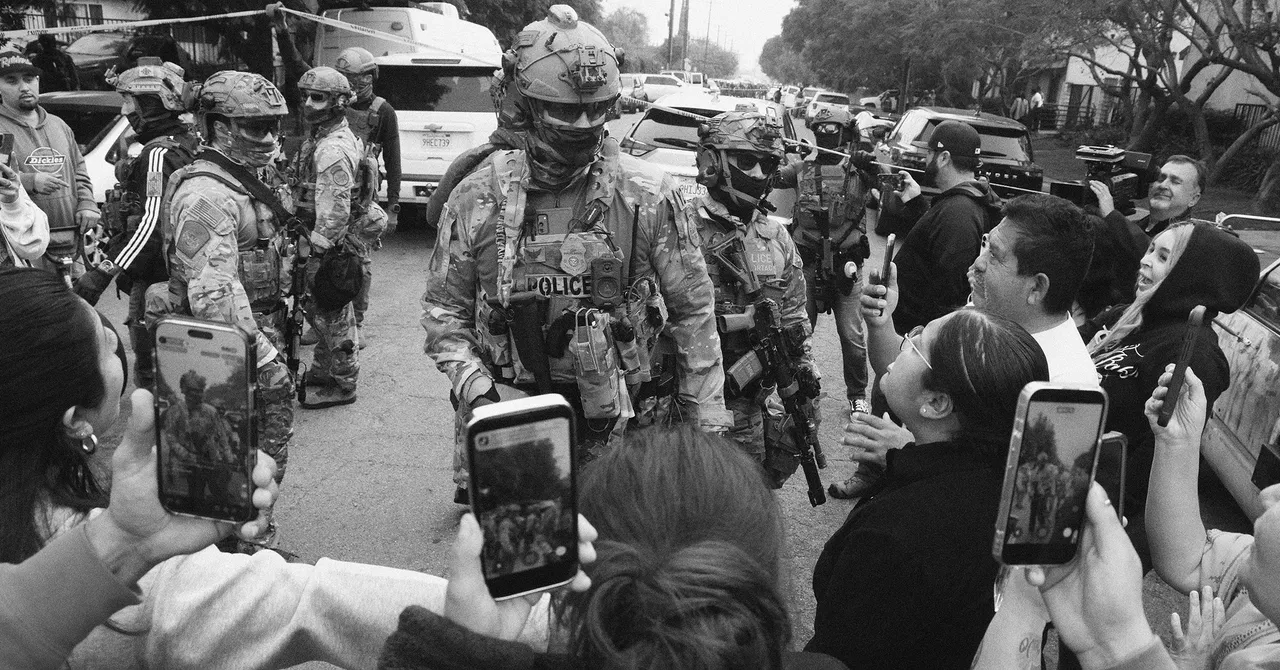
**Editor’s Note:** This article was curated and enhanced for our readers.
*Source: WIRED*
—
## Filming Federal Agents: A Dangerous Act of Accountability
In a chilling incident from January 2026, the lives of two Americans were tragically cut short in Minneapolis while they observed operations conducted by Immigration and Customs Enforcement (ICE). Renee Nicole Good, serving as a legal monitor, and Alex Pretti, her partner, who was recording the federal immigration agents they encountered, became victims of the very actions they sought to document. Pretti, holding his phone to capture the scene, was ultimately killed by the agents he filmed. This harrowing event tragically highlights the extreme peril associated with merely observing government actions. Yet, in a profound paradox, it was precisely this video evidence that meticulously documented their deaths, now serving as a crucial tool for holding federal agents accountable.
This stark dichotomy defines the challenge faced by United States residents: how to effectively resist—and record—the expanding presence of ICE within American urban centers.
### The Perilous Pursuit of Transparency
“Regrettably, the concept of ‘safe’ filming has largely evaporated,” states Trevor Timm, cofounder and executive director of the Freedom of the Press Foundation. “Everyone engaging in this activity may be exposing themselves to risk, given the increasingly aggressive, brazen, and often unlawful conduct exhibited by ICE.” (Disclosure: WIRED’s global editorial director serves on Freedom of the Press Foundation’s board.) Timm emphasizes the tragic irony of Pretti’s death. “Alex Pretti lost his life partly because he was filming ICE, an absolute travesty. However, we also witnessed that shooting from numerous perspectives because other individuals were also recording. Their footage was instrumental in immediately debunking the egregious falsehoods disseminated by the Trump administration.”
For over two decades, the widespread availability of smartphones has transformed video documentation and livestreaming into an indispensable tool for activists and concerned citizens worldwide. These individuals leverage the power of the lens to expose injustice and influence public discourse. In the U.S., despite the First Amendment explicitly safeguarding the right to record government officials in public spaces, those with cameras or smartphones out are frequently targeted by federal agents.
### The Weaponization of Rhetoric
Officials from the previous administration, however, actively sought to obscure this constitutional protection as immigration enforcement operations intensified across the nation. In July, then-Department of Homeland Security (DHS) Secretary Kristi Noem provocatively labeled the act of documenting federal agents as “violence,” asserting, “It is doxing them. It is videotaping them where they’re at.”
Echoing this sentiment, DHS spokesperson Tricia McLaughlin informed WIRED in a statement that “videoing our officers in an effort to dox them and reveal their identities is a federal crime and a felony.” This position has been steadfastly maintained by DHS, despite the questionable premise that, by their own definition, ICE agents are effectively “doxing” themselves simply by operating in public view.
Such rhetoric represents an unmistakable threat to anyone recording ICE agents—be they legal observers, activists, or journalists, warns Jackie Zammuto, associate director at Witness, a nonprofit dedicated to leveraging video in the fight against human rights abuses.
“Video documentation possesses immense power: to unveil abuses, to galvanize demands for accountability, and to challenge official narratives,” Zammuto explains. “Concurrently, we are witnessing a significant escalation in the targeting of documenters, including accredited journalists, even when they operate within legal parameters and comply with police directives. It constitutes a massive risk, and I believe it’s imperative for individuals to carefully assess that risk and their own willingness to undertake it.”
Nevertheless, Zammuto also highlights that practical strategies exist to enhance personal safety when recording authority figures like ICE agents. “There are methods to operate more securely, to safeguard your own well-being, and also the security of those around you,” Zammuto advises.
Here are some essential tips compiled by WIRED, drawing insights from individuals who have embraced the profound act of pointing video cameras at authority figures in the pursuit of activism, media reporting, and legal advocacy.
## Before You Press Record: Essential Preparations
### Safeguarding Your Digital Footprint
When preparing to film ICE or Customs and Border Protection agents, or more broadly, when documenting events at a protest, utilizing an alternative or “burner” phone can significantly enhance your privacy and that of individuals around you. Despite these precautions, achieving complete digital anonymity remains a formidable challenge. Immigration officials have developed extensive surveillance capabilities, including the acquisition of online advertising data, the deployment of surveillance drones, access to vast license plate reader networks, and systems capable of monitoring mobile phones across entire neighborhoods.
Beyond the widespread surveillance apparatus, the potential for ICE or Border Patrol access to your personal device introduces direct digital surveillance risks. This could occur either on-site during an encounter or at a later stage if you are detained and your device is seized for data extraction.
### Fortifying Your Device Security
If you opt to bring your primary smartphone to a protest, it is crucial to disable all biometric authentication methods. This includes deactivating Face ID and fingerprint unlocking systems. Instead, secure your device using a strong password or a PIN. Federal officials generally require a warrant or a court order to compel you to provide a PIN or passcode. In contrast, it is often legally simpler for them to compel you to unlock your device using a biometric identifier.