
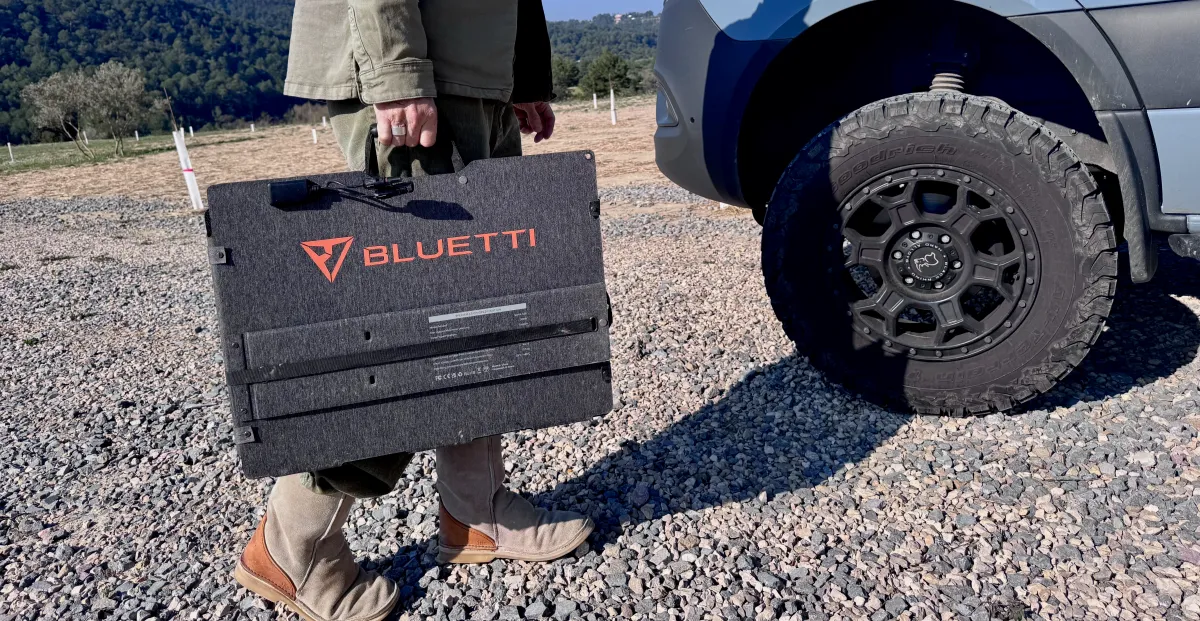
Our coverage of solar panels is not extensive atThe Verge, but the advanced engineering within Bluetti’s exceptionally transportable Sora 500 panel warrants closer examination. The innovative N-Type modules, manufactured by Bluetti and other entities, deliver superior value in terms of cost, weight, and surface area. This represents a significant advantage for individuals like myself living the van life, relying on these robust, mobile solar arrays to prolong their time disconnected from the main power grid.
During practical trials, Bluetti’s 500W module supplied 509W to my vehicle’s power hub, enabling me to produce more than 800W when integrated with the trio of less-than-optimal 140W monocrystalline panels already fitted on my van’s roof. Such a level of fixed power generation is remarkable. My daily energy consumption usually hovers around 1.6kWh, meaning this setup permits me to accumulate a complete day’s charge in merely two hours. My sole desire is that Bluetti had engineered the Sora 500 as a bifacial unit, similar to offerings from Jackery and the emerging brand Zoupw, whose N-Type panels are even more lightweight, boast high wattage, are portable, and are crafted to optimize power yield under suboptimal environmental circumstances.
In Europe, the Sora 500 carries a price tag of €849; however, it has not yet been introduced for sale in the United States. According to Bluetti’s representative, Ellen Lee, the firm aims to launch it in the US sector but is at present “contending with evolving regional regulations and commercial fluctuations.” These are hurdles that Zoupw and Jackery have already successfully addressed.

$984
The Good
- Remarkably space-saving when collapsed
- Strong functionality in dimmed light conditions
- Surpassed specified power generation
- High-efficiency N-Type TOPCon cells
The Bad
- Substantial weight relative to rival products
- Unilateral design (not dual-sided)
- Cumbersome to deploy and stow away
- Currently inaccessible in the American market
The Sora 500 panel from Bluetti, featuring a unilateral design, integrates TOPCon (Tunnel Oxide Passivated Contact) cells, an N-Type advancement that is gradually supplanting the more dated PERC (Passivated Emitter and Rear Cell) technology. In contrast to PERC, TOPCon modules exhibit superior performance in dim illumination, manage elevated temperatures more effectively, and experience a slower rate of degradation. Typically, TOPCon panels can attain greater efficiencies (frequently in the range of ~23–25 percent) when measured against standard PERC panels (~20–23 percent), contingent on their specific application.


Collectively, these benefits indicate that consumers will receive enhanced value for their investment, as soon
as you deploy all 12 panels of the Sora 500 and throughout their prolonged operational period. This module also boasts an IP67 protection against dust and water, along with an ETFE coating that facilitates the removal of grime that might hinder solar energy collection.

During my evaluations conducted in mid-March in the southern French region, at an elevation of around 600 meters, I consistently observed the Sora 500 exceeding its specified power production. On a cool and cloudless day, it registered readings of up to 509W. The panel also performs well even if the sun is partially obscured.
Illustratively, on an exceptionally bright day when the 12 distinct modules forming the Sora 500 were generating more than 500W, the power diminished to 412W upon partially shadowing one corner panel. This further dropped to 390W when the two furthest to the right were partially obscured. Partially shading the four panels immediately to the right of the central section caused the output to decrease to 276W.
The energy output from the Sora 500 plummeted significantly when I obstructed the center four panels, reducing to a mere 50W. This is presumably due to the fact that I severely restricted the whole assembly by disrupting the connection between all four parallel zones. Bluetti employs a half-cut cell design and a 3-series, 4-parallel (3S4P) electrical configuration for the Sora 500. This establishes multiple autonomous energy regions by splitting the photovoltaic cells into smaller halves and spreading them over four concurrent energy routes. It assists in hindering a single shadowed region from acting as a constraint for the entire panel, unlike what is common with less expensive modules.
Regrettably, Bluetti opted to enclose the reverse side of its modules with fabric and an intricate arrangement of supports and fasteners. In contrast, the Zoupw 480W and Jackery SolarSage 500 X N-Type panels are bifacial, implying their ability to absorb supplementary ambient light from their back surfaces when positioned on reflective mediums like snow, sand, concrete, and, to a smaller degree, grass.
While I have not personally evaluated these modules, unverified accounts from users allege to have driven the Zoupw to exceed 525W in power production. Notably, both of these panels also have a mass of merely 22lb (10kg), rendering them considerably less heavy than the 28.4lb (12.9kg) Bluetti Sora 500.
Solar Panel | Base Power | Weight | Unfolded Area (sq in) | Watts per lb | Watts per sq in |
|---|---|---|---|---|---|
| Bluetti SORA 500 | 500W | 28.40 lbs | ~4,510 sq in (100.0” x 45.1”) | 17.61 W/lb | 0.110 W/sq in |
| Jackery SolarSaga 500 X | 500W | 22.05 lbs | ~3,848 sq in (98.1” x 39.2”) | 22.68 W/lb | 0.130 W/sq in |
| Zoupw 480W | 480W | 22.49 lbs | ~4,512 sq in (138.6” x 32.6”) | 21.34 W/lb | 0.106 W/sq in |
While mass is a crucial factor for ease of transport, it’s pertinent to observe that these devices are prone to being lifted by the wind when wind activity increases. Luckily, the Bluetti module I’ve been evaluating includes anchoring provisions for windy periods. All three panels are significantly less heavy than the robust 400W PERC unit from EcoFlow that I’ve been transporting for the past four years. This unit weighs 35.3lbs (16kg) and can still be acquired for $599.
Regarding individuals embracing the van lifestyle, the Bluetti Sora 500 truly excels during stowage of the panel into a recreational vehicle, camper, or storage space. The Zoupw and Jackery utilize conventional four- or six-panel flat-folding designs, whereas Bluetti employs a twelve-segment lattice folding mechanism, enabling its reduction to a considerably more compact, attaché-style form. Despite this, the 3.3-inch thick folded Bluetti is of lesser thickness than both the 3.35-inch thick Zoupw panel and the 3.82-inch Jackery.
Photovoltaic Module | Nominal Output | Collapsed Measurements (L × W) | Compact Surface Area (sq in) | Wattage per Compacted sq in |
|---|---|---|---|---|
| Bluetti SORA 500 | 500W | 22.4” × 17.5” | 392 sq in | 1.28 W/sq in |
| Jackery SolarSaga 500 X | 500W | 39.2” × 20.7” | 812 sq in | 0.62 W/sq in |
| Zoupw 480W | 480W | 34.7” × 32.6” | 1,131 sq in | 0.42 W/sq in |
Conversely, the Sora 500 can be quite challenging to assemble due to the numerous hinges and straps required to support its many segments. It was a complex task that I largely conquered after the third deployment, yet realigning the panel to track the sun throughout the day demands considerable patience.
1/8
Given the absence of official US pricing for the Sora 500 panel, conducting a straightforward cost-per-watt analysis against the $649.99 Zoupw 480W and the $999 (frequently discounted to $799) Jackery SolarSage 500 X is challenging. Nevertheless, if we deduct the European VAT from its €849 cost and convert it, the Sora 500’s price translates to approximately $820. Although this figure is competitive, the Zoupw 480W maintains the superior cost-to-output efficiency within this category.
While Bluetti’s Sora 500 cannot rival the Zoupw 480W and Jackery SolarSage 500 X regarding mass, it easily surpasses them in power density per compacted square inch. This makes it the sole 500W panel capable of conveniently stowing away in a compact closet or beneath a van bench. Consequently, it merits its higher cost for individuals like myself who possess restricted area for an additional solar array they only need to activate infrequently.
- Extended: 100 × 45.1 × 0.1 in / 2541 × 1146.6 × 3 mm
- Stowed: 22.4 × 17.5 × 3.3 in / 570 × 445 × 85 mm
- Mass: 28.4 lbs / 12.9 kg
- Panels: 12x TOPCon
- Conversion Efficacy: up to 25 percent
- Voltage at Pmax (Vmp):40.92V
- Current at Pmax (Imp): 12.22A
- Open Circuit Voltage (Voc): 49.1V
- Short Circuit Current (Isc): 13.31A
- Operational Temperature: -13°F to 149°F / -25°C to 65°C
- Optimal Working Temperature: 77°F / 25°C
- 1.5m MC4 to XT60 cable included in package
Imagery by Thomas Ricker / The Verge
{content}
Source:{feed_title}