
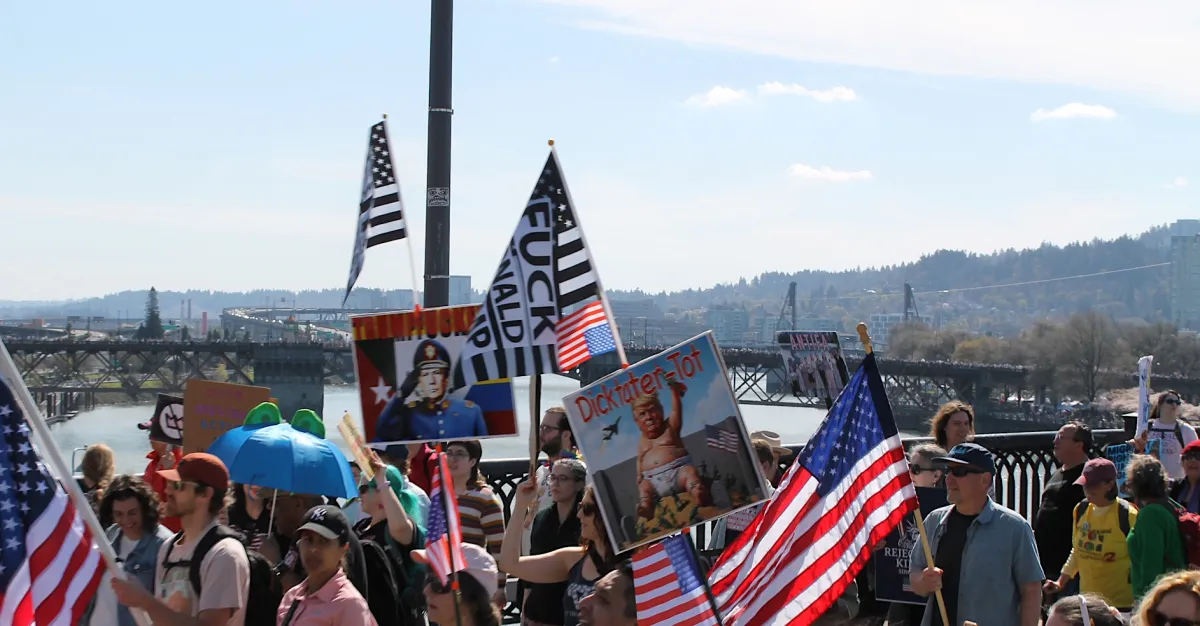
The Distributed Uprising: Portland’s Signal Amidst a Nationwide Digital Swell
Key Takeaways:
Beyond the Algorithm of Expectation:Initial on-the-ground sentiment in Portland suggested flagging momentum, but the nationwide “No Kings” protests shattered expectations, demonstrating a robust, distributed network of dissent capable of massive turnout.
The “Big Tent” as a Feature, Not a Bug:The amorphous nature of the “No Kings” movement, embracing a wide spectrum of grievances, acts as a powerful platform, allowing diverse groups to find common ground and amplify their collective signal, even without singular, codified demands.
Decentralization and the New Protest Topography:Federal crackdowns and legal maneuvers in urban centers inadvertently fostered a “hub-and-spoke” model of activism, pushing engagement into suburban and exurban areas, effectively scaling the protest footprint and making it harder to contain.
“I was hoping we were going to have a bigger crowd than this,” Michael Maria confessed to me, his voice a low hum against the gentle lapping of the Willamette River. It was 11 AM, and the downtown Portland waterfront, usually a pulsating node of dissent, felt strangely subdued for a “No Kings” protest. Maria, a veteran of previous demonstrations, recalled an October 2025 turnout “about 10 times as many people at this time of day.” His observation wasn’t just a casual remark; it was a data point, hinting at a potential dip in the protest cycle that many observers, including myself, were scrutinizing. But as often happens in the volatile landscape of modern activism, the early metrics proved profoundly misleading.
The Shifting Spotlight: From Viral Frogs to Distributed Resistance
Portland’s journey in the national protest narrative has been a peculiar one. In the autumn of 2025, it was ground zero, a city deemed “war-ravaged” by President Donald Trump. His executive orders targeting “antifa” and attempts to deploy the National Guard to protect ICE facilities had turned the Rose City into a surreal theater of operations. The iconic image of a protester in an inflatable frog costume being accosted by DHS law enforcement didn’t just go viral; it became a national symbol, a meme of resistance that permeated digital culture. Portland’s “frog” was a tangible, shareable icon, a potent signal in a noisy information environment.
Yet, as quickly as the spotlight fixated, it pivoted. The “deranged spectacle” of federal agents clashing with costumed activists in Portland was soon eclipsed by grimmer realities in Minneapolis – a shift from what felt like a cartoonish skirmish to stark, undeniable violence. The national mood darkened, and with it, the narrative moved on from Portland’s unique brand of resistance. This transition prompted a critical question for organizers and participants: how do you maintain momentum when the national media ecosystem has re-prioritized its focus?
Navigating Regulatory Hurdles and the Suburban Pivot
The winter of 2025-2026 brought a series of escalating challenges, both geopolitically and locally. The occupation of Minneapolis, military actions in Venezuela, and an illegal war in Iran fueled a cumulative national discontent. Logic suggested a massive surge in protest. However, local dynamics in Portland introduced significant friction. A mass tear-gassing incident during a January labor march near the ICE facility, indiscriminately affecting peaceful civilians and children, served as a potent deterrent.
For a brief period in early March, federal judges offered a glimmer of hope, issuing injunctions to limit the use of force, including tear gas and mortar launchers, against protesters. This legal firewall, championed by both activists and aggrieved residents, promised a safer environment for dissent. But this digital-age struggle over the right to assemble encountered a swift counter-move: an appeals court, featuring two Trump appointees, stayed both rulings just days before the “No Kings” protests. The 2-1 decision, clearly favoring the administration, effectively re-opened the floodgates for aggressive crowd control tactics. This legal reversal sent a clear, chilling signal to potential attendees, impacting the perceived risk-reward calculation of participation.
This dynamic, coupled with a broader dissatisfaction, inadvertently triggered a decentralization trend. Why brave potential tear gas and federal aggression in downtown Portland when local, lower-risk options were flourishing? Suburbanites, increasingly mobilized, found their own local protest ecosystems thriving. Lake Oswego, a traditionally affluent suburb, drew thousands. Senator Ron Wyden (D-OR) strategically chose to attend demonstrations in Gresham and The Dalles, acknowledging the growing importance of these more conservative-leaning satellite communities. Maria’s friends, nervous about the rumored crackdown, had opted for Beaverton, confirming a nascent “hub-and-spoke” model of activism was taking root.
The Network Effect: When Local Swells Go National
Maria’s initial anxieties about turnout, however, ultimately proved to be a misread of the larger system. As noon approached, the individual streams of protesters from various neighborhoods converged, transforming the downtown waterfront. The cherry trees, now in full, vibrant bloom, served as a stark, beautiful counterpoint to the underlying tension. The Burnside Bridge, a critical artery, became a human river, packed with people. Just north, the Steel Bridge mirrored this surge, thick with Portlanders chanting, carrying signs, and embodying a collective purpose. An estimated 30,000 people ultimately thronged the streets of downtown Portland, patiently traversing the two-mile route. It was a staggering local figure, but it was merely a single data point in a far larger matrix. Organizers’ national estimates, perhaps leveraging new digital tracking and aggregation methods, reported a monumental 8 million people protesting nationwide.
The “No Kings” movement in March 2026 didn’t just meet expectations; it smashed them, setting new records that surpassed those of October 2025. Eight million people isn’t just a number; it’s an undeniable signal, a profound data tremor in the political landscape that cannot be ignored by any administration. But the critical question, one that every tech journalist and political analyst grapples with, remains: what exactly does this signal augur? Does this collective voice translate into actionable political change, or is it a powerful, albeit transient, expression of discontent?
Decoding the “Big Tent” Algorithm: Ambiguity as Strength
In the lead-up to these protests, publications likeThe New York Timesquestioned the efficacy of “No Kings,” challenging whether such massive turnout could genuinely convert into political leverage. “Beyond urging the faithful to turn out in big numbers and remain nonviolent, organizers were hands-off about what they expected from attendees,” theTimesnoted. This lack of singular, defined demands is often viewed as a weakness, a fuzzy algorithm that fails to compute clear policy outcomes.
However, this intentional ambiguity, this “big tent” approach, might be its greatest strength. “No Kings” functions less like a prescriptive political party and more like a distributed computing platform for diverse grievances. The protesters I engaged with articulated a wide array of concerns. When I pressed them to identify the *most* important issue, a common response was a weary sigh and an exasperated shrug. “How does one choose?” asked Laurel Barnes, a Portland social worker, visibly grappling with the complexity. She eventually narrowed her top three to “attacks on trans people, attacks on immigrants, [and] attacks on countries like Iran.” Derek, a resident of Hillsboro, offered a more overarching sentiment: “It’s the fact that he has lied about everything he’s done since he got into office.”
This multiplicity of motivations isn’t a flaw; it’s a feature. It allows the movement to cast a wider net, aggregating disparate anxieties under a unifying, yet flexible, banner. It’s a testament to the power of shared opposition, even if the specific solutions remain decentralized and diverse. This model of collective action, amplified by digital connectivity, allows for unprecedented scale, even if its immediate policy implications are less direct than traditional lobbying.
Photo by Sarah Jeong / The Verge
The Bottom Line
The March 2026 “No Kings” protests represent a significant evolution in the landscape of political dissent. What began with initial, localized trepidation in Portland blossomed into a nationwide phenomenon, defying federal suppression tactics and demonstrating the immense power of distributed, multi-faceted opposition. The record-breaking 8 million participants nationwide, unified by a broad but potent rejection of the status quo, sends an unequivocal signal to power. This isn’t just about single-issue activism; it’s about a collective, digitally-enabled roar against a perceived systemic failure. While the exact conversion rate from protest turnout to specific policy change remains a complex calculation, the sheer volume and geographical spread of this movement indicate a deeply entrenched dissatisfaction that cannot be dismissed. It suggests a future where political power isn’t just challenged at central hubs, but also continuously pressure-tested across a vast, interconnected network of local communities, forcing administrations to confront a distributed, persistent, and increasingly sophisticated form of public accountability.
The Persistent Signal: Decoding Portland’s Enduring Protest Culture
Key Takeaways
- Diverse Motivations:Portland’s “No Kings” protests are fueled by a wide spectrum of deeply personal and systemic concerns, from bodily autonomy and immigrant rights to global conflicts and healthcare access.
- Sustained Pressure:These demonstrations are not isolated events but critical data points in a continuous, grassroots effort to exert pressure on political systems and challenge prevailing narratives, aiming for incremental change.
- Localized Impact, National Echoes:Actions within Portland, particularly around symbolic sites like the ICE building, generate ripple effects that influence legal proceedings, legislation, and national political discourse, often becoming focal points in broader cultural debates.
In an era often dominated by digital discourse and algorithmic feeds, the visceral reality of street protest continues to serve as a powerful, undeniable signal. Portland, Oregon, a city synonymous with activism, once again became a focal point as its citizens gathered for “No Kings 3.” Far from a singular, issue-driven demonstration, this event showcased a complex tapestry of grievances and aspirations, illustrating the multifaceted motivations that compel individuals to step out from behind their screens and into the public square.
What drives people to brave potential conflict, to dedicate their time and energy to causes that often feel insurmountable? The answers, as observed on the ground, are as varied as the individuals themselves, yet woven together by a common thread of frustration with the status quo and an unwavering commitment to change. These protests, while localized, reflect a deeper discontent with national and global systems, echoing through political corridors and public consciousness.
The Human Algorithm: Voices from the Street
The streets of Portland, on the day of No Kings 3, presented a living mosaic of American discontent and hope. Each protester, a node in a vast human network, contributed their unique data point to the collective message. From long-time activists to first-time participants, their reasons for being there articulated a broad indictment of current societal and political directions.
A Spectrum of Outrage
The issues at play were anything but monolithic. Kayla Barnes, a veteran protester, articulated a comprehensive stance: “No Kings for me is about fighting fascism, period. It’s about the whole ball of wax.” Her words underscore the belief that systemic oppression cannot be compartmentalized; it demands a holistic and persistent resistance, a continuous “chipping away” at its foundations rather than focusing on a single policy or election cycle.
Personal Stakes, Universal Rights
For Ezra, a trans person who chose to be identified by their first name, the protest was a deeply personal imperative. “For me, it’s the policing of other people’s bodies. It’s the efforts to deport people, whether they are legally here or not,” they explained. “I feel like as a trans person, I need to be here.” Their presence was a testament to the intersectionality of struggles, where personal identity merges with broader battles for autonomy and human dignity, highlighting the vulnerability and resilience of marginalized communities. Similarly, Albert Gonzalez, a Portland native whose family hails from Mexico, voiced his motivation clearly: “I’m tired of people not being treated as human beings.” Citing the mistreatment of immigrants and the discrimination faced by gay Americans, including his own brother, Gonzalez highlighted how personal connections amplify the urgency of collective action. His “FUCK ICE” pin was not just a statement but a symbol of solidarity and defiance against perceived government overreach and cruelty.
Conscience and Conflict
Ian Keim, a Portland Mennonite, brought a distinct ethical framework to the demonstration. Identifying himself as an Anabaptist, Keim asserted, “Today, it’s the war in Iran… I’m a pacifist, so I have to stand against war, and I can’t sit by the sidelines. If that means getting arrested, look, I won’t raise a fist in violence, but I’ll take them. I have to. That’s part of the deal.” His willingness to face arrest, though without violence, stemmed from a profound religious conviction, a moral algorithm dictating active opposition to conflict. This highlights how diverse philosophical and spiritual frameworks contribute to the momentum of protest movements, expanding the ideological bandwidth of street demonstrations.
Healthcare & Labor’s Front Lines
The front lines of activism also extend to those advocating for essential services. Kaleigh Roehl and Lisa Incognito, both registered nurses, embodied this commitment. Having experienced the harsh realities of protest firsthand, including being tear-gassed at a prior labor march, they were now actively organizing at No Kings 3, distributing informational flyers for the Oregon Nurses Association. Their ultimate goal? “Healthcare for all.” Their presence demonstrates the tangible link between labor rights, public health, and broader social justice, showing how professional advocacy translates into street-level activism, demanding systemic reforms.
The Political Calculus
Beyond specific issues, a profound disillusionment with the existing political machinery also propelled many into the streets. Michael Maria, a lifelong Democrat and past fundraiser, expressed deep frustration with his own party. “We really don’t have a plan. As horrible as Project 2025 is, it’s a plan. We have nothing in place that can help us as a guidepost.” This sentiment speaks to a broader critique of political inertia and the perceived failure of traditional institutions to offer clear, actionable solutions, pushing citizens to seek change through direct action and demonstrating a craving for robust ideological frameworks on all sides of the political spectrum.

Beyond the Ballot Box: The Enduring Impact
The value of protests like No Kings extends far beyond the immediate moment of assembly. While the national media often fixates on electoral cycles, the participants understand that true societal shifts are incremental and continuous. “It’s not gonna be a singular event that’s gonna turn this tide,” Barnes affirmed, emphasizing the long-term commitment required to fight entrenched systems. These demonstrations are not isolated incidents but rather sustained “signals” in a complex socio-political ecosystem.
Echoes in the Courts and Capitols
The collective presence of “more bodies in the streets” has tangible, if sometimes subtle, consequences. Previous No Kings demonstrations have demonstrably influenced court rulings and state and local legislation. The sheer visibility and sustained pressure created by these movements can force political actors to acknowledge, and sometimes respond to, public sentiment. This dynamic underscores a critical feedback loop: grassroots activism generates public pressure, which in turn informs legislative and judicial processes, challenging the notion that change only occurs through formal channels. The relationship between local law enforcement and federal agencies also remains “inextricably entwined” with each No Kings protest, as authorities react and adapt to the persistent public presence.
Ground Zero: The ICE Building’s Symbolic Weight
Nowhere is this ripple effect more pronounced than around the ICE building in south Portland. This specific location has become a micro-theater of national political tensions. Historically, a small percentage of No Kings protesters would gravitate towards this site, and their increasing numbers would often lead to clashes, including the deployment of tear gas. These localized “scuffles on a weird little street by the Portland Tesla dealership” have served as pretexts for attempted National Guard deployments, shaped executive orders, and influenced court injunctions. They have also been selectively amplified and distorted by segments of the right-wing commentariat, fueling apocalyptic fantasies about “antifa.” The events at this single building on South Macadam Avenue, therefore, do not remain contained; they resonate throughout the nation, becoming potent symbols in a larger culture war narrative, demonstrating how local events can be amplified into national talking points.

The Bottom Line
The “No Kings” protests in Portland offer a compelling case study in modern activism. They demonstrate that despite the allure of digital engagement, the physical act of gathering, amplifying diverse voices, and maintaining a persistent presence remains a vital mechanism for societal change. These aren’t just protests; they are sustained acts of collective agency, continuously feeding into, and fundamentally altering, the political and cultural operating system of both Portland and the nation. Their enduring signal serves as a reminder that the pursuit of justice is a long game, played out not just in election cycles, but in the relentless, human-powered push for progress on the streets.
The Evolving Front Line: Inside Portland’s ICE Protests of 2026
Key Takeaways:
- Professionalization of Conflict:Both protesters and law enforcement are increasingly adopting sophisticated tactics and gear, blurring visual distinctions and escalating the operational complexity of demonstrations.
- Shifting Enforcement Dynamics:Changes in federal leadership bring new optics to DHS presence, while the controversial involvement of local and state police alongside federal agents redefines inter-agency relations in sanctuary jurisdictions.
- Economic Barrier to Entry:The necessity of protective gear transforms sustained protest into an activity with a growing financial prerequisite, subtly but significantly altering participant demographics.
In March 2026, the streets of Portland once again pulsed with the energy of protest, drawing some of the largest crowds the city had ever witnessed. Yet, despite the sheer numbers converging for the “No Kings” march, the subsequent reinforcement at the Immigrations and Customs Enforcement (ICE) building told a different story. As twilight draped the city, only about 250 protesters remained outside the federal facility – a noticeably weaker continuation compared to previous demonstrations. This subtle shift underscored a deeper evolution within the protest movement itself, reflecting changing demographics, tactical adaptations, and an increasingly complex interplay with law enforcement.
The Evolving Face of Protest: Organization and Cost
Among the smaller crowd, a distinct division emerged. Those flowing directly from the “No Kings” march were identifiable by their earnest, often wordy signage advocating for “democracy” and “due process,” and a noticeable lack of specialized protective gear. Yet, even within this newer contingent, the majority carried or wore gas masks, a stark reminder of the volatile history of these protests.
The seasoned protesters at the ICE building, however, operated with a level of organization that had reached new heights by March 2026. This was not merely a spontaneous gathering but a meticulously operationalized event. Designated medic stations stood ready, a testament to the anticipated risks. More surprisingly, perhaps, was the inflatable costume library—neatly arranged with a freestanding closet rack displaying various inflatable frogs—and a dedicated pumping station to inflate them. An organizer, clad head-to-toe in black, moved through the crowd, providing practical instructions: “If a tear gas canister came rolling toward them,” she advised, “drop the cone on top of the canister.” The air was thick with controlled tension, punctuated by commands from a loudspeaker: “We got riot cops here. Do not run, we do not want to trample our friends. Do not scream. Yell ‘medic’ if you are hurt.”
A striking observation was the increasing resemblance between the most experienced protesters and the riot police they faced. After enduring countless barrages of munitions, many protesters now wore gear – helmets, body armor, robust gas masks – that was functionally, if not aesthetically, similar to that worn by law enforcement. This convergence speaks to a profound shift: protesting has become so dangerous that self-protection requires significant investment. The crowd at ICE appeared older than previous gatherings, and crucially, the youngest protesters often lacked this essential protective equipment. This points to a disturbing trend: disposable income has effectively become a prerequisite for safe, sustained participation in high-risk demonstrations.
DHS’s New Uniformity and Shifting Alliances
Around 5:45 PM, the fragile equilibrium was shattered as DHS officers burst from the building. A swift scuffle ensued on the grass, a blur of helmets and bodies. In the frenzy, a stack of board games on a picnic blanket was overturned – a surreal detail amidst the tension. It was momentarily difficult to discern federal agent from protester, a testament to the increasingly militarized aesthetics on both sides.
Yet, DHS itself presented a transformed image. Gone were the “gaitered wannabe soldiers” who once loomed menacingly from the rooftop. The federal agents guarding the building now appeared unmasked, in clear uniforms, adorned with patches identifying them as Department of Homeland Security. They looked and behaved with a calculated professionalism, a stark contrast to the previous, often ambiguous, appearance that rendered them indistinguishable from right-wing militia members.
This shift was partly driven by recent legislation; Oregon had restricted the use of masks by law enforcement earlier that month, though the constitutionality of such state anti-masking laws remained a point of debate. More significantly, the change in appearance was undeniably linked to a change at the top: Kristi Noem, who had notoriously paraded on the roof of the Portland ICE building, was no longer Secretary of Homeland Security. Her departure signaled a deliberate effort to rebrand federal presence, perhaps to mitigate the intense public backlash against earlier tactics.
The intensity of protester sentiment, however, remained undimmed. “Fuck you, fascists!” one protester bellowed. Another screamed, “My grandparents used to kill scum like you!” – encapsulating a deep-seated historical animosity that transcended the immediate confrontation.
“My grandparents used to kill scum like you!”
After a brief retreat by the feds behind the gate, a lull settled. Three teenage boys, initially peering excitedly at the building, quickly decided, “OK, let’s get the fuck out of here,” snapping a quick photo before disappearing. Their fleeting presence highlighted the differing levels of commitment and preparedness within the crowd.
The Contested Ground: Local vs. Federal Authority
The calm was short-lived. A shout of “Yellowjackets! Yellowjackets are coming!” signaled the arrival of Portland city police, distinguishable by their neon-yellow long-sleeved shirts under black vests, forming a mass on bicycles up the street. A young woman without a gas mask mused, “I mean, what are they going to do? If they arrest us, are they going to put us on their handlebars?” Her question underscored a naive understanding of the situation, quickly dispelled by the palpable animosity among other protesters towards these city officers.
Soon, a combined force of city bike cops and Oregon State Police in full riot gear advanced, pushing down the street and damming the crowd. As the tumult settled, a new and deeply contentious arrangement became visible: at least four officers, two “yellowjackets” and two Oregon State Police, had stationed themselves within the driveway of the ICE building. This driveway, federal property, has been central to numerous lawsuits concerning the use of force at the building and the National Guard case, where the federal government argued military force was necessary for its protection. The sight of city and state officials unambiguously guarding a federal immigration enforcement facility, particularly in a sanctuary state like Oregon, immediately raised eyebrows and fueled shouts of “Shame! Shame!” from the crowd.
Oregon has been a sanctuary state since 1987, legally barring local and state officials from aiding federal immigration law enforcement. Throughout the prolonged crisis of the Trump administration’s obsession with Portland, the relationship between local police and federal agencies has been a constant source of controversy. The clear alignment of city and state forces with federal DHS agents at the ICE building represented a significant, and potentially illegal, escalation of inter-agency cooperation that directly challenged the spirit, if not the letter, of sanctuary laws. This collaboration signals a troubling erosion of the traditional separation between local policing and federal immigration enforcement, impacting civil liberties and public trust.
There was once a form of aggressive Americana that was entirely Republican-coded, but the new landscape suggests a more pervasive and bipartisan embrace of securitization.
The events of March 2026 at the Portland ICE building illustrate a critical juncture in the ongoing saga of civil protest and state power. Both sides are evolving, adapting to a new normal where confrontation is increasingly professionalized and militarized. The shift in DHS appearance, while superficial, signals an attempt to temper public perception, yet the underlying mission remains unchanged. More profoundly, the visible cooperation between local and federal law enforcement agencies in a sanctuary state represents a dangerous precedent, blurring jurisdictional lines and potentially undermining the very principles of local governance and community protection. As the cost of safe protest rises, so too does the exclusivity of participation, threatening the democratic inclusiveness of dissent.
Bottom Line:
The 2026 ICE protests reveal a landscape where civil dissent faces an increasingly sophisticated and unified state response. The professionalization of both protesters and law enforcement, coupled with the controversial convergence of local and federal authority, reshapes the battlefield for civil liberties, raising urgent questions about access to protest, the integrity of sanctuary policies, and the future of democratic engagement in an era of heightened securitization.
Key Takeaways:
- Digital Dissonance in Real Life:Contemporary protests are increasingly manifesting the fragmented, meme-driven, and ideologically fluid landscape of the internet, blurring traditional political signifiers.
- Youth as Digital Interpreters:Younger generations, fluent in online culture, are co-opting and remixing symbols—from patriotic flags to obscure internet frogs—to express nuanced, often ironic, forms of dissent.
- The “No Kings” Phenomenon:Movements like “No Kings” demonstrate how digitally native aesthetics and viral spread can transcend traditional political alignments, gaining significant cultural traction among diverse, disaffected groups.
Five years ago, the scene I witnessed would have been profoundly disorienting. A protest space, typically demarcated by clear ideological lines, instead presented a bewildering pastiche of cultural signifiers. It wasn’t just the surreal presence of frogs and dinosaurs—emblems often associated with internet meme culture—but the effortless, almost defiant, commingling of symbols typically considered antithetical. The American flag, both reverently right-side up and provocatively inverted, fluttered alongside anarchist black bloc attire and graffiti advocating for Molotov cocktails. Shouts of “All cops are bastards” fused with impassioned appeals to the sanctity of the US Constitution and due process, while veiled threats of violence were subtly embedded in proud, anachronistic references to World War II military service. This was not a protest conforming to a historical script; it was a live-action remix, a physical manifestation of the internet’s chaotic, boundary-dissolving influence on public discourse.
Earlier that day, the prelude had been equally perplexing: a rumbling parade of motorcycles, not the usual counter-protest fare, brandishing a banner that defiantly proclaimed “FUCK TRUMP” in the stark, corporate font style of “TRUMP / VANCE” campaign signage. The visual irony was potent, echoing the right-wing pickup truck and SUV caravans that once swaggered through Portland, suburbanites on a “thrill ride” through perceived leftist territory. What was once an aggressive Americana, firmly Republican-coded, is now being joyfully co-opted. The flag, the Constitution, the very idea of the “heartland” and the “suburbs” are being implicitly claimed by an emergent anti-Trumpism, signaling a profound shift in how political identity is constructed and communicated in a digitally saturated era.
The Semiotics of Digital Discord
The blending of these disparate symbols is not accidental; it’s a deliberate strategy, honed and amplified by digital platforms. The frogs and dinosaurs, for instance, are classic examples of internet memes that transcend their initial context, becoming versatile vehicles for irony, humor, and coded messages. Their presence in a physical protest underscores how online aesthetics and internal communication loops—often opaque to outsiders—are now dictating the visual language of real-world activism. This phenomenon reflects a broader trend: as our political discourse increasingly occurs online, traditional ideological boundaries erode, replaced by a more fluid, remix culture where symbols can be detached from their original meanings and re-appropriated for new narratives. The internet, with its infinite capacity for information synthesis and reinterpretation, acts as a cultural blender, producing unexpected and often contradictory political hybrids.
This ideological fluidity is further exacerbated by the architecture of social media and online forums. Algorithms can inadvertently create echo chambers that reinforce niche interpretations of symbols, while also exposing users to a wider, often contradictory, array of content. The result is a generation of activists who are adept at navigating and deploying a complex, multi-layered semiotic language, one that can be deeply resonant to insiders while appearing nonsensical or even paradoxical to those outside the digital loop. The “aggressive Americana” that once belonged solely to one political wing has become a common linguistic resource, ready for re-deployment by any group willing to engage in its ironic or sincere re-appropriation, often mediated through shared digital experiences and viral content.
Gen Z/Alpha and the Meme-ification of Protest
The youth, as ever, are at the vanguard of this cultural shift. Just as Gen Alpha has a “weird fascination with Starbucks”—a consumer choice potentially influenced by digital trends and peer validation—the “mass appeal and cultural dominance” of movements like “No Kings” is “infecting the most disaffected among Americans.” I observed this firsthand as a teenager, clad in baggy cargo pants, extricated himself from a half-inflated frog costume with small, exaggerated hops. Free from its collapsed, cartoonish form, he casually slipped his sneakers back on, grabbed a pair of miniature American flags, and scampered to the front lines. This tableau encapsulates the essence of digitally native protest: a seamless transition between the absurd and the serious, the ironic and the direct. The frog costume, a nod to online humor, gives way to a pointed political gesture with national symbols. This generation doesn’t merely engage with digital culture; they embody it, translating its logic and aesthetics into their real-world actions.
The act itself was a digital-age taunt made physical: the kid leaned forward, twiddling the flags inches from a police officer’s face. The officer, a “yellowjacket,” responded with a practiced, impassive straight line of his lips, his eyes fixed past the stars and stripes, past the provocation. This interaction wasn’t just a challenge; it was a performative act, designed for an audience beyond the immediate participants. In an age of instant recording and viral dissemination, every gesture, every symbol, is potentially a piece of content, a clip destined for social media feeds, analyzed and reinterpreted by millions. The protester understood this, using the potent, re-contextualized symbols to needle authority in a way that resonates with a digitally savvy generation accustomed to online trolling and viral spectacle.
The Digital Undercurrents of “No Kings”
The “No Kings” movement itself, while not explicitly defined here, is presented as a powerful cultural force, a testament to the viral potential of digitally-driven activism. Its ability to achieve “mass appeal and cultural dominance” and “infect the most disaffected” points to sophisticated, albeit perhaps decentralized, digital organizing. This isn’t just about sharing memes; it’s about building networks, fostering solidarity, and coordinating action through encrypted messaging apps, alternative social media platforms, and online forums that bypass traditional media gatekeepers. The movement’s strength lies in its ability to harness the internet’s capacity for rapid information diffusion and community building, creating a sense of shared identity and purpose among individuals who might otherwise feel isolated. It’s a testament to how online spaces can cultivate real-world political movements that challenge established power structures and traditional party lines.
Ultimately, what these protests underscore is the evolving relationship between digital culture and physical activism. The internet has not merely provided new tools for organization; it has fundamentally reshaped the language, aesthetics, and ideological underpinnings of protest itself. The lines between online identity and offline action are increasingly blurred, creating a dynamic, often unpredictable, landscape where traditional political categories struggle to contain the fluidity of modern dissent. For a tech journalist, observing such a scene is a stark reminder that the impact of our digital ecosystems extends far beyond screens, manifesting in the most visceral and impactful ways on the streets.
Bottom Line
The contemporary protest landscape is a complex, hyper-real reflection of our digitally fragmented world. Traditional political signifiers are being unmoored and remixed, driven by meme culture, online communication, and a generation fluent in digital irony and activism. Understanding these protests requires acknowledging the profound influence of technology, not just as a tool for organizing, but as an architect of new identities and expressions of dissent that defy easy categorization and continue to challenge the established order.
Source:{feed_title}