
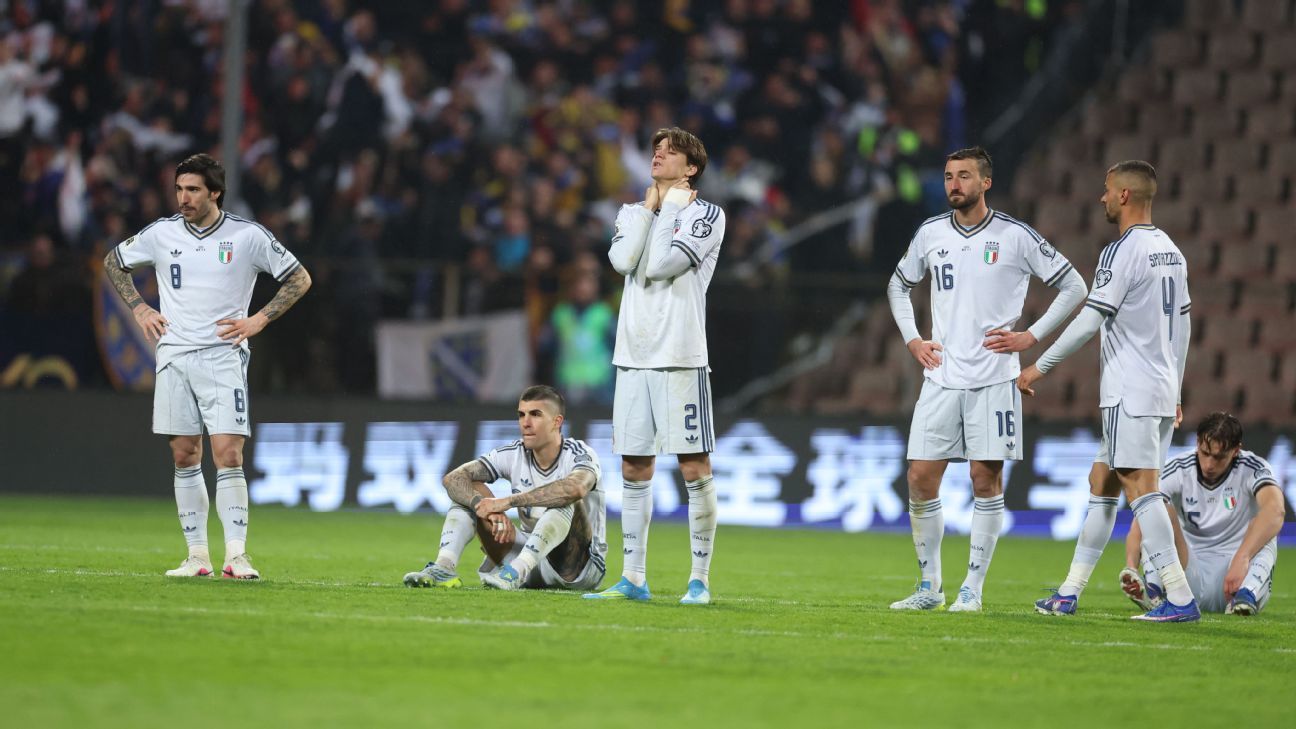
One might declare that “this has ceased to be amusing,” yet I uttered that particular remark previously. Furthermore, I employed the argument regarding “permitting another contender an opportunity to secure victory in a World Cup, given our possession of four trophies domestically — a tally equaling the combined count of England, Spain, and France — as our aim is not to appear avaricious,” back in 2018.
Therefore, what recourse remains, now that Italy has been unable to secure a spot in three consecutive World Cups, an unprecedented occurrence for any triumphant World Cup nation? Particularly during an era when the number of participating teams in the World Cup expanded by half, from thirty-two to forty-eight squads?
My certainty is lacking, yet I am reasonably confident about what is unwelcome following Tuesday’s loss decided by penalty shoot-out against Bosnia-Herzegovina.
– Discover the World Cup’s newcomers: Curacao, Uzbekistan, Cape Verde, Jordan
– O’Hanlon: Assessing the 2026 World Cup contenders
– Karlsen: A singular tactical insight for all forty-eight World Cup squads
For instance, there is no call for extensive analytical articles concerning the deterioration of Italian soccer and demands for comprehensive overhauls. No, the reason Italy could not advance is not that Serie A today does not possess the same caliber it did in the 1990s. Serie A exhibited no superior quality — indeed, it was arguably inferior — when Italy contested the Euros final in 2012 and 2021, triumphing in the subsequent instance.
Nor is it useful for Gennaro Gattuso, the Italy manager (presently, at least), to extol his squad’s spirit and endeavor, asserting they merited remaining in the competition. Their spirit and exertion are beyond reproach, yet consider this: Bosnia demonstrated an equivalent, if not greater, degree. Moreover, they had just concluded 120 minutes plus a penalty shootout against Wales on foreign soil, featuring a forty-year-old forward. (Should one wish to discuss “spirit” and “endeavor” currently? Research Edin Dzeko.)
Another unproductive path is Gattuso’s repeated lamentation over their squandered opportunities and critical moments. Certainly, had Moise Kean converted his counterattack in the latter half, or Fede Dimarco scored with his less dominant foot, or Francesco Pio Esposito’s header eluded Nikola Vasilj, Italy would have progressed. Perhaps their qualification would have been secured if Tarik Muharemovic received a caution rather than an expulsion. And — a bitter twist of fate! — if Gianluigi Donnarumma had not intervened on Dzeko’s shot, deflecting it directly to Haris Tabakovic for his score, Italy would have advanced since the ball struck Dzeko’s elbow. However, what relevance does this hold? Donnarumma was compelled to execute ten saves, numerous of which were exceptional. Bosnia also attempted thirty shots and squandered numerous chances.
The reality is, the matter is not profoundly complex. Italy might not possess an abundance of talent akin to France, Spain, or England, yet they exhibited ample quality to secure advancement. They stand thirteenth in the FIFA ranking, for heaven’s sake. Furthermore, this is neither an aged squad (only one starting player, Matteo Politano, exceeds thirty years of age) nor an indifferent one (exertion and commitment were not the concern).
The actuality is they rendered circumstances exceedingly challenging for themselves at the commencement of the qualification effort, suffering an early defeat against Norway (partially due to some abysmal rulings) which implied that, practically speaking, sidestepping the playoffs was no longer within their control subsequently. Upon entering the single-elimination structure, unforeseen events may occur, and specific instances acquire disproportionate significance.
Alessandro Bastoni is arguably among the premier central defenders globally, yet that egregious red card incurred after forty-one minutes constitutes a primary factor explaining Italy’s spectating role via television this summer. In an eleven-versus-eleven scenario, their prospects would have appeared favorable, not due to superior performance — up to that juncture, the Azzurri had registered merely two shots on target for an expected goals (xG) value of 0.15 — but rather because, with Italy leading 1-0 at that moment, a distinct route to success was apparent.
Maintain possession of the sphere, compel Bosnia-Herzegovina to pursue, exhaust them, and leverage your seasoned expertise. This represents Gattuso’s reasonably effective approach: straightforward strategic designs, adhering to probabilities, and an abundance of impassioned gestures, fervent exhortations, and demonstrative arm movements from the touchline.
With a player disadvantage, nevertheless, all strategic coherence dissolved. Italy adopted a profoundly defensive posture, thereby welcoming Bosnian offensive pressure. Consequently, the match transformed, for both the participants and the tens of millions of Azzurri supporters, into an eighty-minute ordeal orchestrated by Esmir Bajraktarevic and Kerim Alajbegovic. This stemmed from a straightforward strategy by an uninspired manager in Gattuso who — beyond mere touchline encouragement — contributed negligible added value throughout his tenure.
A period which, it should be recalled, was notably brief: Gattuso conducted merely fifteen training sessions with his squad during his ten-month leadership. However, in fairness, one is prompted to ponder whether extended duration might have provided him additional occasions to mismanage affairs, as, undeniably, Gattuso hindered his own cause.
Possessing superior players compared to the adversaries, the optimal approach typically involves leveraging that aptitude, initiating offensive play against them. Yet, as observed, Gattuso failed to implement this, potentially due to being unnerved by the initial advantage bestowed upon them by the home team, or conceivably because he was incapacitated by apprehension following the red card.
Do systemic impediments hinder the advancement of Italian soccer? Certainly. One might highlight an excessive prioritization of outcomes and tactical shrewdness over skill cultivation and technical proficiency at junior levels. One could also indicate that Serie A teams exhibit greater hesitation in relying on domestically developed players compared to those in other divisions, thereby forming a “bottleneck” obstructing progression to senior squad participation, or the reality that clubs offer minimal or no assistance to the national team (as evidenced by Gattuso’s incapacity to arrange even a two-day training session).
However, these do not constitute the explanation for Italy’s failure to qualify for the World Cup. Poor choices and subpar displays during qualification resulted in margins considerably narrower than advisable. Bosnia’s resolve, tenacity, and zeal (along with several unconverted penalties) accounted for the remainder.
This, naturally, does not mitigate the anguish in any manner, guise, or dimension. When one has triumphed in four World Cups, trust me: the pain intensifies further.