
UK DragonFire Laser Weapon Program Reaffirms 2027 Royal Navy Deployment Target
The United Kingdom’s DragonFire high-energy laser weapon system remains firmly on track for deployment with the Royal Navy by 2027, with government ministers reiterating the existing accelerated timeline. This confirmation comes as part of ongoing efforts to advance the development and integration of this cutting-edge directed-energy weapon technology into the UK’s defense capabilities.
Responding to a written inquiry from Lord Spellar, Defence Minister Lord Coaker affirmed the government’s steadfast commitment to the DragonFire program. Lord Coaker stated, “The UK Government is committed to accelerating the development, testing, production, and installation of the DragonFire high energy laser system.” This statement serves to reinforce the established schedule rather than announcing a further acceleration of the program.
The timeline referenced by the minister reflects significant progress already in motion to expedite the system’s operational readiness. A pivotal contract for the initial two DragonFire systems was awarded to MBDA in November 2025, laying the groundwork for the first unit to be installed on a Type 45 destroyer in 2027. This revised deployment target represents a substantial acceleration, bringing the in-service date forward by five years compared to the original projections for the program.
Key milestones supporting the system’s trajectory towards operational capability include the completion of two major firing trials in 2025. These trials have been crucial in validating DragonFire’s performance and demonstrating its readiness for integration into frontline service. With this advanced development, the United Kingdom aims to achieve a significant first among its allies, positioning itself as the inaugural European NATO nation to field a laser-directed energy weapon system.
DragonFire is a sophisticated British-developed laser directed-energy weapon, the product of a collaborative consortium comprising leading defense technology firms. This consortium includes MBDA UK, responsible for missile systems and integration; Leonardo UK, specializing in advanced electronics and sensors; QinetiQ, a defense technology and security company; and the Defence Science and Technology Laboratory (Dstl), which provides scientific and technological expertise. First publicly unveiled in 2017, the system has undergone an extensive series of trials across the UK. Notable testing has occurred at the Hebrides range, where DragonFire has successfully demonstrated its ability to track and engage various aerial targets with high precision. The weapon is specifically engineered to counter emerging and established threats, such as unmanned aerial vehicles (drones) and mortar rounds, by utilizing a high-energy laser system within the 50 kilowatt class, according to previously released technical specifications.
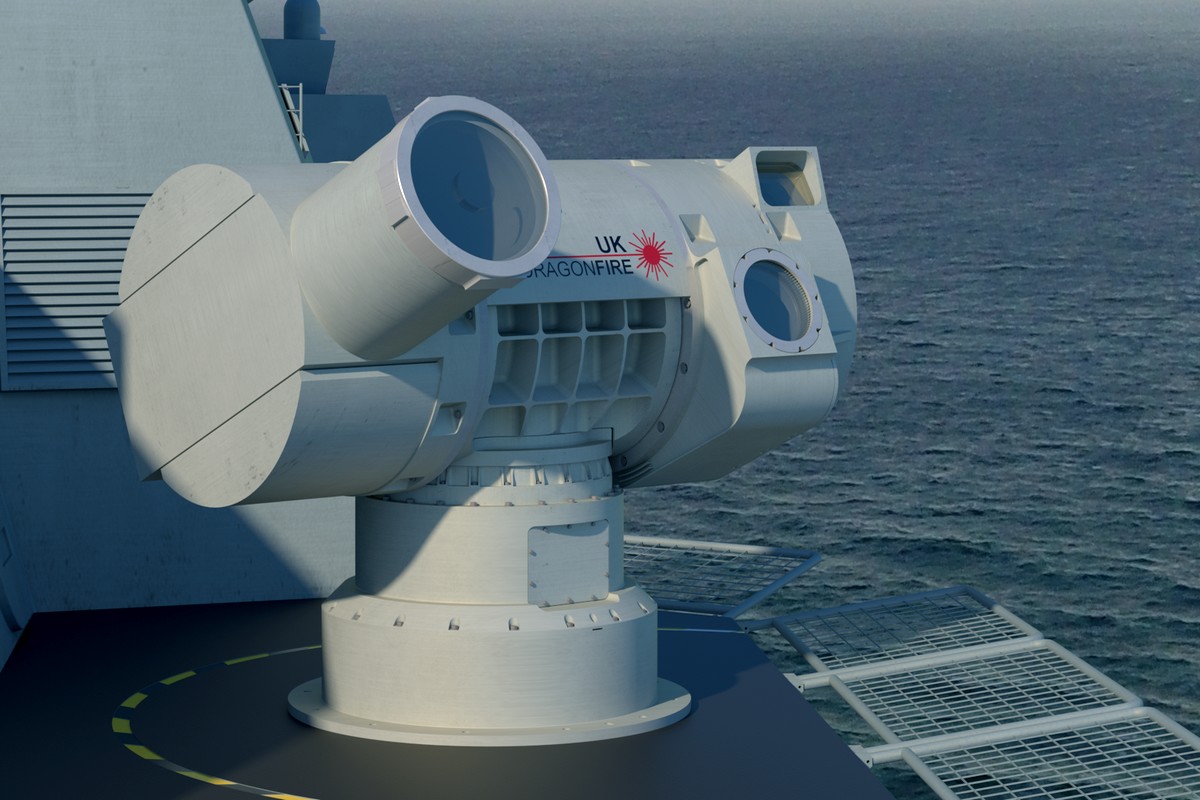
Technologically, DragonFire represents a significant leap forward in directed-energy weapons. The system integrates multiple glass-fibre lasers, precisely combining their energy into a single, potent beam. This laser apparatus is mounted within a stabilized turret, which also houses advanced tracking sensors, including a high-resolution electro-optical camera. These sensors are vital for acquiring, tracking, and maintaining a lock on fast-moving targets. Trials have consistently showcased an exceptional degree of accuracy, with the Ministry of Defence previously highlighting its precision as comparable to striking a small coin at a distance of one kilometre. While the precise operational range of DragonFire remains classified for security reasons, it is understood to function as a line-of-sight system, meaning it requires an unimpeded optical path to its target.
One of the most compelling advantages of DragonFire, as emphasized by the Ministry of Defence, is its remarkably low cost per shot. Estimates place the operational cost of a single laser engagement at approximately £10, a dramatically lower figure compared to the hundreds of thousands or even millions of pounds associated with conventional missile interceptors. Furthermore, as an electrically powered system, DragonFire significantly reduces reliance on finite, stored munitions. This attribute has profound implications for sustained combat operations, particularly in scenarios where logistical resupply lines might be constrained or vulnerable. The ability to engage numerous threats without depleting a finite magazine offers a considerable tactical and strategic advantage.
The acceleration of the DragonFire program from an earlier projected in-service date later in the decade is a direct result of successful trials and the allocation of additional funding. Beyond its initial planned deployment aboard naval vessels, the underlying laser technology is also being actively explored for potential integration into land-based platforms and, looking further ahead, for use within the air domain. This multi-domain potential underscores the versatility and strategic importance of directed-energy weapon systems in future defense architectures.
Why This Matters
The continued and accelerated development of the DragonFire laser weapon system holds profound implications for the UK’s defense capabilities, the future of naval warfare, and the broader landscape of military technology. Its impending deployment by 2027 signifies a pivotal shift in how the Royal Navy can defend itself against a growing array of threats.
Firstly, the strategic advantage of being the first European NATO nation to field such a system cannot be overstated. It positions the UK at the forefront of military innovation, potentially influencing defense doctrines and procurement strategies across allied nations. This technological leadership could foster greater interoperability and shared defense capabilities within NATO, as well as opening avenues for future export opportunities for British industry.
Secondly, DragonFire addresses critical vulnerabilities and economic realities of modern warfare. The proliferation of low-cost drones, rockets, and mortar rounds presents an increasing threat to high-value assets like warships. Countering these threats with expensive, conventional missiles is often described as an “asymmetric cost exchange,” where the defender spends vastly more than the attacker. DragonFire’s estimated £10 per shot dramatically alters this equation, offering a highly cost-effective solution for point defense. This sustainable defense mechanism means that naval vessels can engage numerous incoming threats without rapidly depleting their missile magazines, enhancing their endurance and operational flexibility in prolonged engagements.
Thirdly, the transition to electrically powered directed-energy weapons reduces reliance on traditional munitions supply chains. This has significant logistical benefits, as ships equipped with DragonFire would primarily require fuel for their generators rather than needing constant resupply of missiles. In an era where long-range logistics are increasingly contested, this self-sufficiency offers a distinct operational advantage, allowing platforms to remain on station longer and reduce their vulnerability during resupply operations.
Finally, DragonFire’s potential for multi-domain application—beyond naval deployment to land and air platforms—signals a broader transformation in defense thinking. Laser weapons offer precision, speed-of-light engagement, and reduced collateral damage potential, characteristics that are highly desirable across various combat scenarios. This program is not just about a single weapon system; it represents a significant investment in a foundational technology that could redefine air defense, force protection, and even offensive capabilities for decades to come, thereby safeguarding national interests and projecting influence in a rapidly evolving global security environment.