
FOX Business correspondent Jeff Flock appears on ‘Varney & Co.’ to analyze the significant rise in SUV and truck purchases, the decline in electric vehicle interest, and how billions in tariffs are transforming the automotive sector.
An undeniable trend is emerging in the automotive sector, with buyers’ preference leaning again towards more substantial, fossil-fuel-powered automobiles, while electric vehicles find it difficult to sustain their earlier growth.
STELLANTIS INCURS SUBSTANTIAL $26B LOSS AFTER SHIFTING AWAY FROM EVS
Jeff Flock, a FOX Business correspondent, appeared with Stuart Varney on “Varney & Co.” to provide coverage from the New York Auto Show, a venue where car manufacturers are focusing on SUVs and trucks as purchasers’ tastes evolve.
Christian Meunier, Chairman of Nissan Americas, details the unveiling of the 2027 Z Nismo at the New York Auto Show, emphasizing its enhancements to capability and the manufacturer’s future vision for sports vehicles on ‘Mornings with Maria.’
Current market figures confirm this shift in direction. Midsize SUVs and trucks are enjoying considerable growth, conversely, smaller cars and electric vehicles are declining in popularity, revealing an expanding disparity between manufacturers’ goals and the true purchasing habits of buyers.
Data from Cox Automotive and Kelley Blue Book indicates that midsize SUV purchases have increased by 15%, and midsize truck purchases by 14%, whereas compact car sales have decreased by 8% and EV sales by 26% year-over-year for February. The growth trajectory of electric vehicles has become progressively inconsistent. In the third quarter of 2025, electric vehicles attained 10.5% of new vehicle sales in the U.S. However, this share declined to 5.8% in the fourth quarter once inducements diminished, underscoring a considerable retraction following previous advancements.
HONDA SCRAPS 3 PLANNED EV MODELS FOR US MARKET
Christian Meunier, Nissan Americas Chairman, identified tariffs as another element affecting the market. Car manufacturers and their providers have shouldered billions of dollars in additional expenditures, constraining their capacity to transfer these charges to consumers.
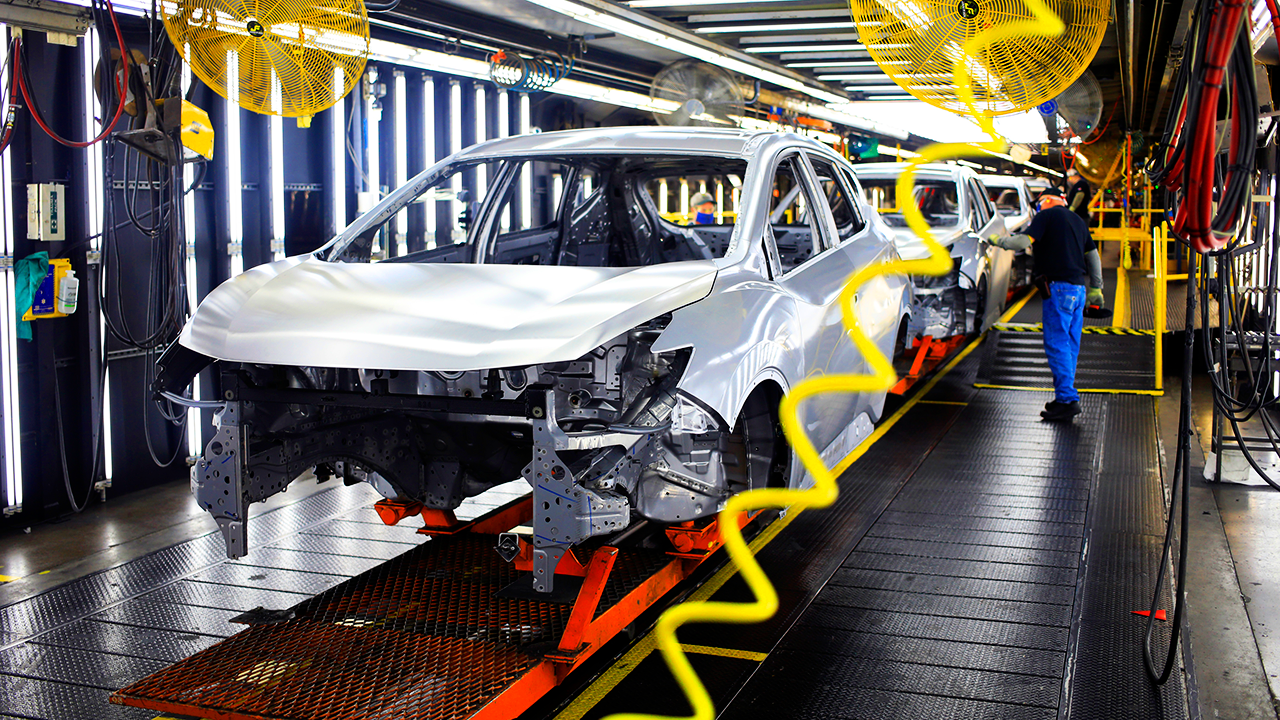
A vehicle frame moves down the assembly line at the Nissan Motor Co. manufacturing facility in Tennessee.(Luke Sharrett/Bloomberg / Getty Images)
“While it’s a substantial sum, it represents significantly less financial liability than what we faced a year ago upon its introduction,” Meunier stated.
AMERICANS ARE HESITATING ON ELECTRIC VEHICLE ADOPTION: ‘AFFORDABILITY REMAINS A KEY CHALLENGE’
He further mentioned that the company has endeavored to alleviate that load by simultaneously boosting in-country manufacturing.
Interior Secretary Doug Burgum commends President Donald Trump’s economic agenda on ‘The Evening Edit.’
“Initially, our liability stood at $4 billion. We reduced it to $1.5 billion in 25, and we aim to eliminate it entirely. Our objective is to manufacture the maximum possible number of vehicles within the U.S.,” Meunier explained.
ACCESS FOX BUSINESS ON THE GO BY VISITING HERE