
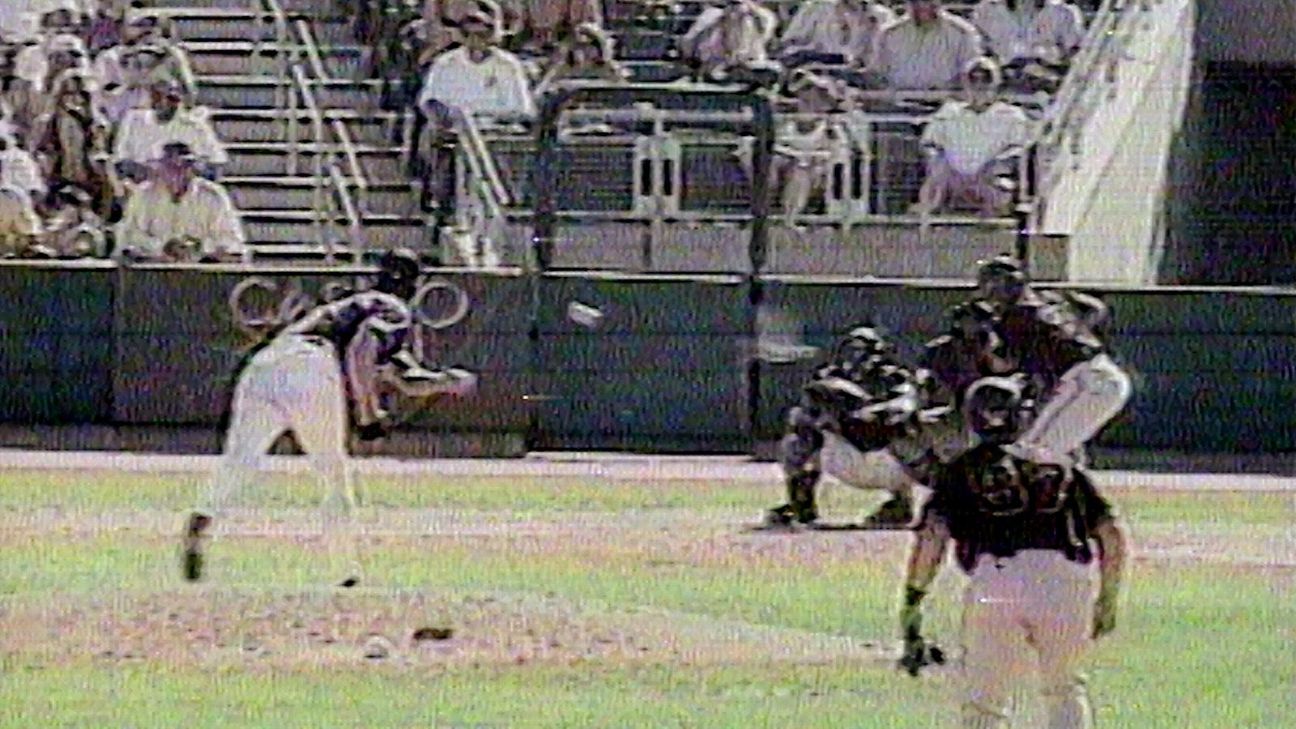
Twenty-five years ago, on a seemingly ordinary spring training afternoon, the impossible happened. A moment so bizarre, so utterly improbable, it defied logic and etched itself into the annals of sports history. Forget the record books, the championships, the MVPs. For many, the enduring image of the legendary Randy Johnson isn’t him mowing down hitters in the World Series, but rather, a fastball, a bird, and an explosion of feathers that captured the world’s stunned imagination.
For Calvin Murray, the former major league outfielder who stood helpless in the batter’s box that fateful day, the calendar is irrelevant. The annual flurry of text messages, the sudden spike in online chatter, the viral replays — they are his internal clock, a yearly reminder of March 24, 2001. Late last month, as the 25th anniversary rolled around, his phone once again became a conduit for collective memory, buzzing ceaselessly with echoes of a moment that has transcended baseball to become a true cultural phenomenon.
“I get the yearly text message during spring training,” Murray recounted, the familiar refrain tinged with a blend of disbelief and amusement. “I’m usually blown up quite a bit when people start seeing that highlight.”
Indeed, “highlight” barely scratches the surface. The infamous collision of Johnson’s 100 mph heater and an unsuspecting dove transformed a sleepy Cactus League exhibition into one of sports’ earliest, and most enduring, viral moments. The raw, unadulterated footage of the “Big Unit’s” fastball striking the bird in the seventh inning of a split-squad game in Tucson has become synonymous with Johnson’s Hall of Fame career, amassing over 2.3 million views on YouTube alone. It’s a testament to the sheer, mind-bending improbability of it all.
Two and a half decades later, those who witnessed it still recount the event with astonishing clarity. The sights, the sounds, the collective gasp, and the immediate, profound aftermath are not just memories; they are indelible imprints on the minds of players, coaches, and fans alike. It’s a story passed down, a legend burnished with each retelling.
For Rod Barajas, then the Arizona Diamondbacks catcher, now a quality control coach for the Texas Rangers, the story is a bridge across generations. “They don’t know a whole lot of players that played back in the ’90s or the 2000s,” Barajas said of his younger players. “They’re kind of clueless of who those guys are, but they know that video. So, when I tell them that’s me in that video, they remember. They’re like, ‘Oh my gosh, that’s huge.’ And it’s a big hit with all the players.” The “Big Unit” didn’t just strike out a batter; he created an instant, universal legend.
Hall of Fame second baseman Jeff Kent, then with the Giants, stood on the top step of the dugout. When asked about the wildest moments of his illustrious career, the bird incident always tops the list. The initial shock, the surreal nature of the event, remains undimmed by time.
Barajas remembers the sequence vividly. He called for Johnson’s signature fastball, and as the missile hurtled towards the plate, his professional instincts took over. His glove moved, anticipating the pitch. Then, an anomaly. “Obviously, I see the ball,” Barajas began, his voice still carrying a hint of the original astonishment. “It’s coming and then it disappears and then there’s nothing there. So, yeah, the muscle memory was like, ‘Go get that ball.’ But I went to get it and nothing came to me.”
Game Highlights: March 24, 2001 – Cactus League Classic
The desert sun beat down on Tucson, a typical March day in Arizona, perfect for America’s pastime. The Arizona Diamondbacks, led by their towering ace, Randy Johnson, faced off against the San Francisco Giants in a routine spring training encounter. The stakes were low, but the intensity on the mound, as always with Johnson, was sky-high. In the bottom of the seventh inning, with Giants outfielder Calvin Murray digging into the batter’s box, a routine pitch was about to become anything but. Johnson, a force of nature, wound up and unleashed a blistering fastball. In a blink, a dove, seemingly oblivious to the impending danger, darted across the field of play, directly into the path of the pitch. The world held its breath, though it didn’t know it yet. A thunderous “thwack” echoed through the stadium, followed by a sudden, jarring puff of white feathers. The ball was gone. The bird was gone. The collective silence that fell over the ballpark was deafening, replaced only by the bewildered murmurs of a crowd trying to process what their eyes had just witnessed. An impossible play, forever seared into the fabric of baseball history.
The bird, observers noted, had been flying freely between the guide wires behind home plate all game, a common sight at spring training. But on this pitch, destiny, or perhaps just cruel, improbable luck, intervened. Former Diamondbacks general manager Joe Garagiola Jr., seated just rows behind home plate, described the scene as surreal. Murray, initially, thought it was a prank. “All I remember is, I just know that baseball players, they’re just a bunch of practical jokers, especially being spring training,” Murray admitted. “My initial thought was he threw the ball and I thought it was an exploding baseball. I thought it was some pranked-up baseball, guys being goofy like that.”
“And I was kind of like, ‘The ball blew up halfway.’ I thought the ball blew up, but it was actually the bird that blew up. And I was like, ‘What the heck?’ And I froze and I looked back.” The moment Murray locked eyes with an equally dumbfounded Barajas, the grim reality set in. This was no joke. This was an unprecedented, visceral event. “Then we were both like, ‘What the hell’s going on?'” Murray recalled, the shared sentiment rippling across the diamond.
The confusion was universal. Barajas, closest to the impact, didn’t even immediately register it was a bird. “It took a while for those feathers to start falling,” he noted, emphasizing the sheer speed and force of the collision that literally vaporized the creature in mid-air. The two players, frozen in their positions, simply stared at each other. “I think it was just kind of looking at each other like, ‘Did that just really happen?'” Barajas mused. “Just the shock and the surprise. I know I can remember seeing his face and I probably had the exact same face he did, big eyes and just at awe of what happened.”
Former Diamondbacks manager Bob Brenly, an avid bird hunter, confessed that in all his experience, he had never seen a bird disintegrate into so many feathers. “Obviously, we didn’t know what the heck happened at first,” he said. “But because of my hunting experience, I recognized feathers in the air and I kind of figured out what had happened. And then trying to figure out how does that happen? How in the world does a guy throwing a hundred miles an hour hit a bird flying full speed? It was just mind-boggling.” The physics of the moment were staggering: two objects, both in rapid motion, converging with a destructive force that was almost impossible to comprehend.
Jeff Kent, a competitor who had traveled two hours specifically to face Johnson, was intently watching the “Big Unit.” When he finally spotted the bird’s remains on the ground, the hunter in him emerged. He started laughing, albeit with a sense of awe. Yet, no one moved. The entire ballpark was suspended in a collective tableau of disbelief. Kent, breaking the spell, walked onto the field, picked up the bird by its wing, confirming the grim reality. “The bird’s breast was blown out,” he stated bluntly.
In a gesture of morbid appreciation, Kent then turned to Johnson, who remained stoic on the mound. “I looked at Randy like, ‘Hey, you just did an amazing thing,'” Kent remembered. But Johnson, ever the competitor, was unyielding. “He looked at me and he was wanting to tear me apart. I could see it in his eyes. There was no smile. He had his game face on, and he didn’t react one bit. And I thought that was funny, but it just showed how much of a competitor … It was spring training. Randy’s out there with his game face on and he didn’t give a s— whether he hit a bird or not. I’m laughing. I’m going like, ‘This is an amazing moment.’ I know a bird’s dead, but I said, ‘You can’t ever replicate this. You’d probably win the lottery.'”
Kent’s analysis hits the nail on the head. This wasn’t just a freak accident; it was a testament to Johnson’s superhuman velocity and focus, an accidental, macabre demonstration of pure power. It was a singular event, an impossible intersection of fate and physics, captured for posterity. It’s why, a quarter-century later, the video still resonates, why the stories are still told, and why Johnson’s legend, already immense, grew even larger with a puff of feathers.
Prediction:Twenty-five years from now, on March 24, 2051, the internet will undoubtedly still be buzzing. In an era of advanced analytics, virtual reality, and increasingly predictable sports narratives, the Randy Johnson bird incident will continue to be a refreshing, bewildering anomaly. It stands as an enduring symbol of the chaotic beauty of live sports – a reminder that sometimes, the most memorable moments are utterly unplanned, completely bizarre, and impossibly spectacular. It will remain a timeless piece of sports folklore, discussed, debated, and re-watched, forever solidifying the “Big Unit” not just as a Hall of Fame pitcher, but as the unwitting orchestrator of one of the most unbelievable events ever seen on a baseball field.
The Improbable Interception: Randy Johnson, a Bird, and Baseball’s Most Bizarre Blast
March 24, 2001 – Tempe, Arizona
In the annals of baseball history, some moments are etched in memory for their sheer athletic brilliance, others for their dramatic tension. And then there’s March 24, 2001, a seemingly innocuous Spring Training game in Tempe, Arizona, where the legendary Randy Johnson unleashed a fastball that defied all expectations, not by striking out a batter, but by intercepting a feathered flyer mid-flight. It wasn’t just a pitch; it was an act of accidental, brutal, and utterly improbable nature, forever sealing its place as one of the sport’s most surreal, jaw-dropping spectacles.
The “Big Unit,” a towering inferno of left-handed power, was already a force of nature. His pitches weren’t just fast; they were a blur of menacing velocity, a tangible threat to anyone daring to stand in the batter’s box. On this particular afternoon, facing the San Francisco Giants’ Calvin Murray, Johnson wound up, unleashed a heater, and in the fraction of a second that separates anticipation from reality, the world witnessed something no one could have predicted, nor would have believed without the cold, hard proof of video.
The Unthinkable Collision: A 100 MPH Fastball Meets Feather and Fury
It was the seventh inning. Randy Johnson, in his prime, was doing what he did best: dominating. Calvin Murray stepped to the plate, ready to face the left-handed titan. What happened next transcended the game itself. “It looked like a feather flying out of a pillow,” recalled Diamondbacks manager Bob Brenly, his voice still tinged with disbelief years later. A dove, perhaps caught off guard by the sheer velocity of the pitch, made the fatal error of crossing the path of Johnson’s fastball. The impact was instant, violent, and tragically poetic.
The ball, a white blur, struck the bird with an audible thud, erupting in a sudden, macabre puff of feathers. The bird disintegrated, a testament to the unimaginable force generated by Johnson’s arm. The ball, deflected, continued its trajectory toward catcher Damian Miller, who, along with everyone else in the stadium, was left in stunned silence. Murray, who had swung and missed, instinctively knew something was terribly wrong. “I saw a puff of smoke,” Murray described, “and I’m like, ‘Did the ball explode?'”
The surreal nature of the moment was palpable. Johnson himself, a man whose presence on the mound could intimidate entire lineups, was momentarily taken aback. “I just remember the ball coming off the bat and a puff of feathers,” Johnson said, recalling the incident that would forever be linked to his storied career. It wasn’t just a missed pitch; it was a cosmic event, a moment where the raw power of a human athlete met the fragile innocence of nature, with devastating consequences.
Beyond Belief: The Rules, the Reaction, and the Legacy
The immediate aftermath was a whirlwind of confusion and dark humor. Murray, ever the competitor, attempted to leverage the chaos, turning to the umpire and jokingly pleading for a ball to be called. “He’s like, ‘No pitch, Calvin,'” Murray recounted with a chuckle, recalling the swift, definitive ruling. And indeed, baseball rules are clear: if a pitched ball strikes a bird in flight or an animal on the field, the pitch is immediately replayed. No strike, no ball, just a rewind to a moment that could never truly be unwound.
The task of clearing the field fell to Diamondbacks bullpen catcher Steve Kent, who approached the gruesome scene with a mix of duty and profound awkwardness. “I just looked at Randy and he had this, ‘Get the f— off my field look,'” Kent recalled, highlighting Johnson’s intense focus even amidst the unprecedented. Kent, a hunter himself, appreciated the animal but understood the gravity of the moment, scooping up the bird and unceremoniously depositing it in the trash. The image of Kent holding the bird with a baseball lodged in its chest – an idea Johnson fleetingly considered for taxidermy – remains a haunting, iconic visual.
This bizarre incident, far from being forgotten, has followed those involved for decades. Johnson, initially reluctant to discuss the morbid event, eventually embraced it, choosing a dead bird as the distinctive logo for his post-career photography studio. Murray still delights in the shock of friends discovering his role in baseball’s most unique “strikeout,” turning it into an enduring conversation starter. It’s a testament to the enduring power of the truly unexpected in sports – a moment so strange, so unbelievable, that it transcends mere statistics and becomes a part of the cultural lexicon.
Beyond the Box Score: The Unofficial ‘Game Highlights’ of March 24, 2001
While traditional box scores might show zeros for this particular pitch, the real “highlights” of that day are seared into the collective memory of baseball fans:
- The Big Unit’s Ascent:Randy Johnson, in full intimidating glory, winds up for what would become his most talked-about pitch. The anticipation, the power, the sheer force of his delivery.
- The Avian Intersection:A small, unsuspecting dove, perhaps drawn by curiosity or simply fate, crosses the invisible plane of Johnson’s 100 mph heater. A fraction of a second, an irreversible collision.
- The Feather Explosion:The instantaneous, shocking eruption of feathers, momentarily clouding the vision of the pitch and leaving spectators gasping in disbelief. A visual marker of an impossible event.
- The Stunned Silence:The collective gasp and subsequent hush from the crowd and players, momentarily suspending the game as everyone processed the surreal scene.
- Murray’s Plea & Umpire’s Ruling:Calvin Murray’s quick-witted, albeit futile, attempt to claim a “ball” – met by the umpire’s decisive, rules-mandated “no pitch.”
- Kent’s Somber Retrieval:Bullpen catcher Steve Kent’s unforgettable walk to home plate, the grim task of collecting the unfortunate bird, cementing the moment’s bizarre reality.
- The Video Evidence:The crucial role of early 21st-century technology, transforming an improbable “urban legend” into undeniable, rewatchable history.
A Harbinger of History? The Unpredictable Road to Glory
What makes this incident even more captivating is its context. The Diamondbacks, just months later, would embark on one of the most thrilling World Series runs in history, culminating in their dramatic victory over the formidable New York Yankees. Was the bird incident a bizarre, almost mystical, harbinger of the unpredictable magic that would define their championship season? Perhaps. It certainly underscored the idea that in baseball, anything can happen, and often does.
Without the advent of modern video technology, this story might have been relegated to campfire tales and exaggerated locker room myths. “Nobody would’ve believed us if we’d said, ‘Hey, Randy Johnson knocked a bird out of midair today with a fastball,'” Brenly admitted, highlighting the critical role video played in immortalizing the moment. It transformed a fleeting, unbelievable occurrence into an undeniable piece of baseball folklore, accessible for generations to come.
The poignant observation from catcher Rod Barajas the next day, noting that one less bird sat on the guide wires behind home plate, adds a melancholic footnote to the tale. It was a reminder that even in the high-stakes world of professional sports, life and death, however small, can intersect in the most unexpected ways.
Prediction: An Enduring Symbol of Baseball’s Unpredictable Charm
The Randy Johnson bird incident will never fade from baseball’s collective memory. In an era increasingly dominated by analytics and predictable outcomes, this moment stands as a defiant testament to the sport’s inherent, glorious unpredictability. It will continue to be a perennial highlight reel staple, a go-to anecdote for broadcasters, and a conversation starter that transcends generations of fans.
My prediction? Far from becoming just a quirky footnote, this incident will only grow in its mythical stature. It will forever be Johnson’s most bizarre, yet iconic, “strikeout” – a moment that encapsulates not just his terrifying power, but the raw, unscripted beauty of baseball itself. It serves as a constant, thrilling reminder that sometimes, the greatest highlights aren’t found in the stat sheet or the perfectly executed play, but in the utterly improbable, the unexpectedly surreal, and the truly unforgettable collision of man, beast, and ball.