
Unlock the Editor’s Digest for free
Roula Khalaf, Editor of the FT, selects her favourite stories in this weekly newsletter.
**Key Takeaways:**
1. **Cautious De-escalation Signal:** The safe passage of a CMA CGM vessel, a major Western shipping line, through the Strait of Hormuz offers a fragile signal of potential de-escalation and a clearer, albeit conditional, operating environment for commercial shipping, potentially easing war risk premiums.
2. **Geopolitical Precedence over Free Passage:** Transit through the critical chokepoint is increasingly dictated by bilateral negotiations and geopolitical alignment rather than unfettered international maritime law, creating a fragmented access system that adds complexity and cost to global trade.
3. **Persistent Supply Chain Volatility:** Despite this individual success, the underlying geopolitical tensions, the necessity for “negotiated” access, and the ongoing threat of disruption underscore the enduring vulnerability of global energy and trade supply chains, maintaining a significant risk premium for businesses and commodity markets.
***
**Financial Markets Eye First Western Shipping Line’s Safe Passage Through Strait of Hormuz Amidst Geopolitical Volatility**
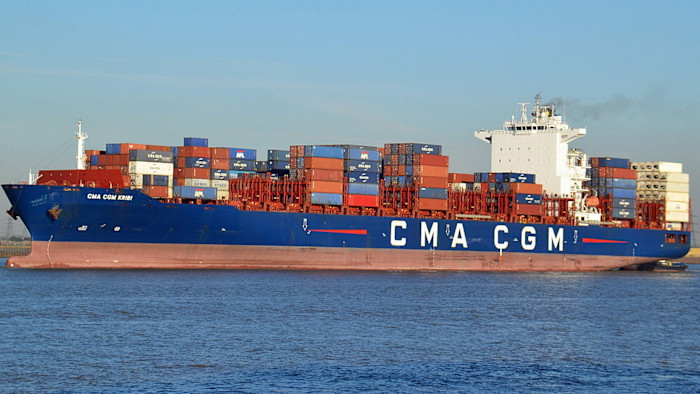
In a development closely watched by global financial markets and shipping executives, a vessel owned by France’s CMA CGM has successfully transited the Strait of Hormuz, marking the first known safe passage by a major Western shipping line since the outbreak of the US-Israeli war against Iran. This event, occurring against a backdrop of heightened regional tensions and a significant slowdown in maritime traffic, provides a cautious glimmer of a potential, albeit fragile, pathway for de-risking a critical global trade artery.
The Malta-flagged CMA CGM Kribi, carrying vital cargo, switched on its transponder off the coast of Dubai on March 28 and completed its transit through the strait on Thursday afternoon, according to ship-tracking data from MarineTraffic. Its journey hugged the route around Larak Island, close to the Iranian coast – a corridor increasingly utilized and, according to maritime executives and analysts, now part of an Iranian system for visual verification of crossings. This suggests a tacit, if not explicit, understanding or approval facilitated by diplomatic channels.
The significance of this passage cannot be overstated for global supply chains. The Strait of Hormuz is the world’s most important oil transit chokepoint, through which roughly one-fifth of the world’s total oil consumption and a substantial portion of global liquefied natural gas (LNG) pass daily. Disruptions here send immediate ripples through energy markets, impacting crude oil and gas futures, and by extension, inflation expectations and industrial production worldwide. The previous slowdown, characterized by more than a dozen Iranian attacks on vessels since February 28, has already fueled spikes in war risk insurance premiums, elevated freight rates, and prompted costly rerouting decisions for many carriers, further exacerbating inflationary pressures.
CMA CGM, the world’s third-largest container shipping line, is owned by the Franco-Lebanese billionaire Rodolphe Saadé, who maintains a close relationship with French President Emmanuel Macron. The French group also boasts an extensive presence across the Middle East, including significant investments in ports and logistics infrastructure. France’s prior provision of naval escorts for CMA CGM vessels in the Red Sea during Houthi attacks in 2024 highlights the strategic importance of government support to safeguard commercial interests in volatile regions. While France’s Élysée Palace and foreign ministry remained tight-lipped regarding any direct facilitation for the Kribi’s passage, the geopolitical weight of France in the region and Macron’s active diplomacy are undeniable factors in market calculations of risk.
Indeed, Macron has explicitly stated that while France could participate in missions to re-establish free navigation, military solutions alone are “unrealistic,” emphasizing the need for negotiations with Iran. This pragmatic stance contrasts with more hawkish positions, particularly from some elements within the United States, and provides a framework for how future stability might be achieved – or not. For the markets, this implies that stability in Hormuz will likely remain a function of complex diplomatic arrangements rather than outright military dominance, adding a layer of unpredictable political risk to operational planning.
The current landscape of transit through the Strait is highly fragmented. Iran has explicitly signalled its willingness to negotiate safe passage for what it deems “allied” countries. Pakistan recently claimed a deal for 20 of its flag-bearing ships, though analysts remain skeptical of such a broad agreement. Iranian officials are also reportedly working on a protocol with Oman to oversee strait transit. This indicates a shift from universal freedom of navigation to a more controlled, permission-based system, creating a multi-tiered market for access and potentially differential pricing for cargo based on national origin or diplomatic ties.
Further underscoring this complexity, three Omani-linked vessels – two crude oil tankers and an empty LNG carrier (the first to exit since the war began) – successfully passed using a route close to the Omani coast, distinct from the Iranian corridor. This suggests a bifurcation of transit options, potentially offering a safer, albeit possibly less efficient, route for some. Last week, at least two container vessels linked to Chinese state-owned shipping group Cosco also successfully transited, highlighting China’s significant economic leverage and its ability to secure access.
The US, in parallel, hosted a conference in the UK aimed at marshalling international resources to re-establish free navigation. Such initiatives aim to reassure markets, but Macron’s caution about military means underscores the prevailing view that diplomatic channels are paramount.
The Kribi’s decision to keep its transponder on throughout its journey is also noteworthy. At the war’s outset, many vessels resorted to “dark” transits – switching off automated tracking systems – to avoid detection, a practice that significantly increases insurance costs and operational risks. The Kribi’s transparent passage suggests a degree of confidence, possibly derived from prior assurances, in its safety. Its Automatic Identification System (AIS) transmission, signalling “OWNER FRANCE,” explicitly broadcasted its national affiliation, a crucial detail in the current geopolitical climate.
The market implications of this event are multifaceted. While it doesn’t signify a complete return to normalcy, it offers a tentative roadmap for how commercial shipping might navigate the volatile Gulf region. However, the reliance on specific diplomatic channels and the implicit “permission” from Iran mean that the underlying risk remains high. Shipping lines, insurers, and commodity traders will continue to factor in significant risk premiums, awaiting more consistent evidence of secure passage for all commercial traffic.
**Market Impact:**
The successful passage of the CMA CGM Kribi, while a positive signal, will likely be met with cautious optimism by financial markets. In the immediate term, it could temper some of the upward pressure on war risk insurance premiums for vessels operating in the Strait of Hormuz, offering a slight reprieve to shipping companies’ operational costs. Energy markets, particularly crude oil and LNG futures, might see a modest easing as supply disruption fears are marginally reduced, though a significant price correction is unlikely given the persistent geopolitical backdrop. Longer-term, this event reinforces the need for businesses reliant on Gulf trade to embed robust geopolitical risk assessments into their supply chain strategies. Investors will continue to price in a “Hormuz premium” for energy assets and logistics firms exposed to the region, understanding that free passage is now heavily influenced by complex diplomatic maneuvers rather than guaranteed international maritime law. This necessitates diversified sourcing, flexible routing, and a keen eye on evolving political alliances, as the cost of doing business in this critical region will remain elevated and unpredictable.